
























Three in One: How Ukrainian and Polish Scientists Taught a Detector to "See" the Invisible
All news | | 1,663 | Author: Olena Zelenina
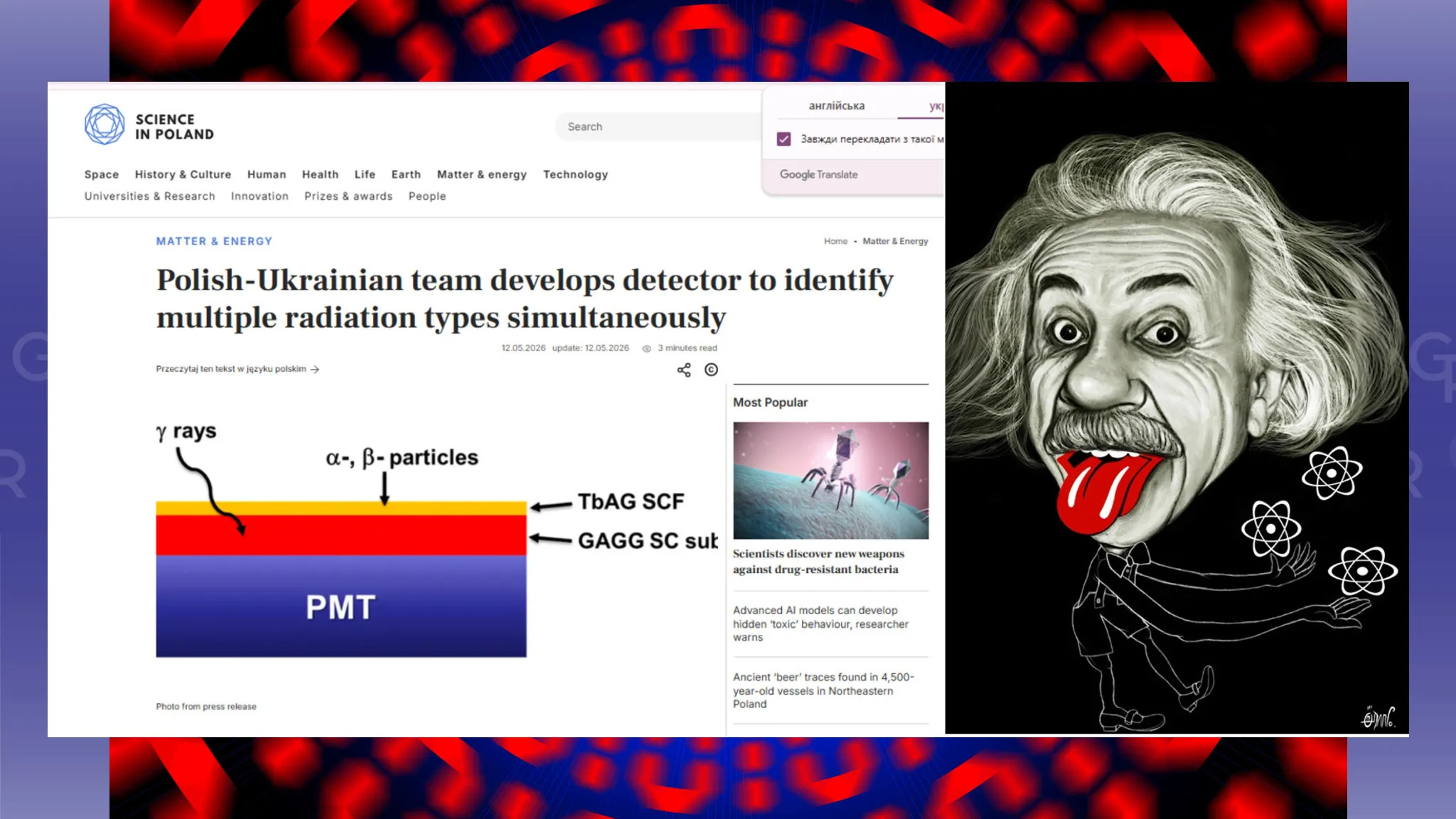
Collage by Olena Zelenina. Author of the cartoon "Albert Einstein" - Darko Drljevic.
Ukrainian and Polish scientists have opened a new era in radiation safety and medicine. As reported to "Hromada" at the State Organization "Institute for Single Crystals" of the National Academy of Sciences of Ukraine, a next-generation detector has been created that can simultaneously "see" different types of radiation — $\alpha$-, $\beta$-, and $\gamma$-rays.
As it is known, radioactive radiation is insidious because a person is unable to sense it. It has no color, no smell, and no taste. Moreover, in real life, radiation rarely walks "alone" — usually, it is a complex mix of different types of particles and rays. Until now, recognizing each of them required bulky systems or several different devices. But an international team of scientists, the core of which was made up of Ukrainian specialists from Kharkiv, has achieved a true technological revolution.
As the Science in Poland portal writes, the results of this fundamental work, which has already aroused lively interest in the European scientific community, have just been published by the authoritative international journal Crystals.
Anatomy of the Invisible,
or Why Was This a Problem?
To understand the essence of the discovery, let us recall the three main letters of the radiation alphabet: $\alpha$ (alpha), $\beta$ (beta), and $\gamma$ (gamma). They have a completely different nature, and most importantly — penetrating power.
Alpha particles are heavy and massive, but "lazy." They can be stopped even by an ordinary sheet of paper or the upper layer of our skin.
Beta particles are faster and lighter. They are able to submerge into living tissues by a few millimeters or centimeters, but are stopped by a thin sheet of aluminum.
Gamma rays are pure energy, waves of colossal power. They pierce through objects entirely, and to stop them, thick walls of concrete or lead are required.
Imagine a real emergency situation, a radioactive contamination zone, or a complex medical procedure. All three types of rays are present there simultaneously — a so-called "mixed radiation field."
Creating a single, sole material that would not just register "some radiation," but clearly and instantly indicate: "this is alpha, this is beta, and this is gamma" — has until now been considered an extremely difficult challenge for world science.
Kharkiv Foundation
for European Success
The key to solving this puzzle was found by a powerful team: the Institute for Scintillation Materials (ISMA) of the National Academy of Sciences of Ukraine (Kharkiv), V. N. Karazin Kharkiv National University, as well as their colleagues from leading Polish centers — the National Centre for Nuclear Research, Kazimierz Wielki University, and the Oncology Center in Bydgoszcz.
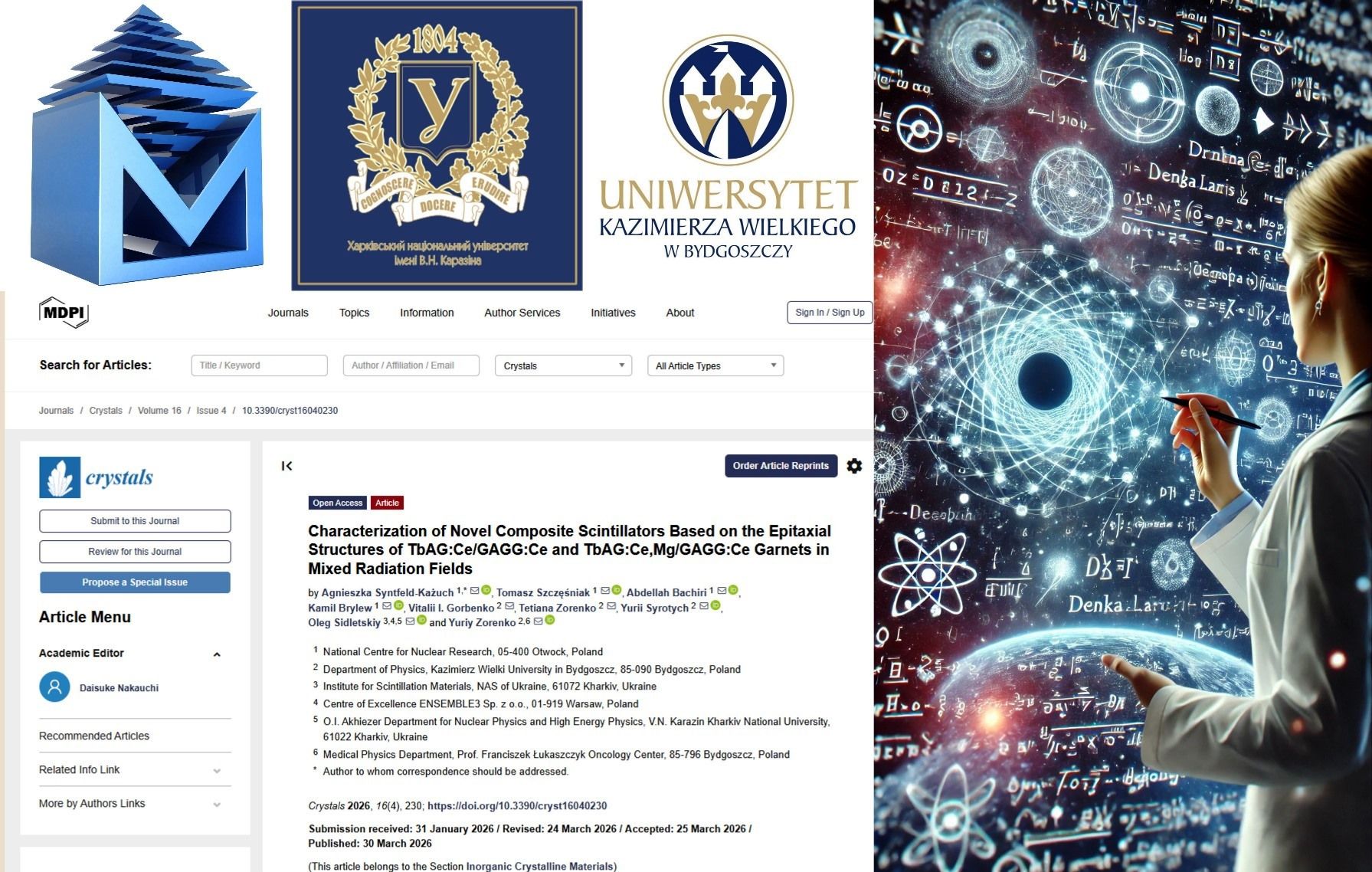
And it was the Kharkiv scientists who laid the foundation for this success in the literal sense. ISMA scientists developed and grew with their own hands ultra-modern single-crystal substrates (GAGG:Ce crystals).
In simple words, when a radioactive particle hits the crystal, it responds to this with a microscopic flash of light. A special ultra-sensitive sensor "catches" this light and converts it into an electrical signal, which is then read by a computer.
An Ingenious "Layer Cake":
How It Works
The breakthrough lies in the fact that the scientists created a two-layer structure based on the principle of a "sandwich" or a layer cake. On the crystalline base of Kharkiv production, the Polish colleagues applied another ultra-thin layer of a different crystal (TbAG).
The physics of the process turned out to be elegant and logical. Since different types of radiation have different penetrating power, they "get stuck" at different depths of the detector:
Low-penetrating alpha and beta particles are completely stopped in the first, ultra-thin outer layer.
All-penetrating gamma rays fly through the thin film unnoticed and produce a flash already in the deep main substrate.
The main secret of the technology: each of these two layers responds to radiation with light of a different character (with a different decay speed of the flash). A computer program analyzes this light response and instantly delivers an accurate verdict: exactly what type of radiation has just attacked the detector.
Why Is This a Breakthrough
and Where Will It Change Our Lives?
Until now, analyzing mixed radiation required bulky systems consisting of several different devices. The new development allows making a single device compact, fast, and fantastically accurate. Its potential is colossal, and first of all in areas where a mistake costs lives:
Scientists have already stated that the next stages of the project will be dedicated to implementing the detector in advanced oncotherapy, specifically in Boron Neutron Capture Therapy (BNCT). The new device will allow doctors to measure radiation doses in real time with filigree precision in order to destroy the tumor without affecting the patient's healthy cells.
The new technology will also help create compact, portable, next-generation "smart" dosimeters for environmentalists, the military, emergency services, and nuclear power plant personnel. Such a device will not just shriek about danger, but will immediately display the structure and character of the threat on the screen.
Despite all the extremely difficult challenges of today, Ukrainian fundamental science continues to keep its standard at the highest world level. The Kharkiv crystallographic school, in synergy with its Polish colleagues, has created a technology that in the coming years may become the new standard of safety and healthcare worldwide. The invisible threat has finally received a worthy opponent capable of recognizing it "face to face."

Comments
Some more relevant news for now