










War in Orbit and a Starlink Analog: How Ukraine Found Itself at the Center of the Space Summit in Paris
All news | 14 September, 2026 at 17:39 | 947 | Author: Olena Zelenina
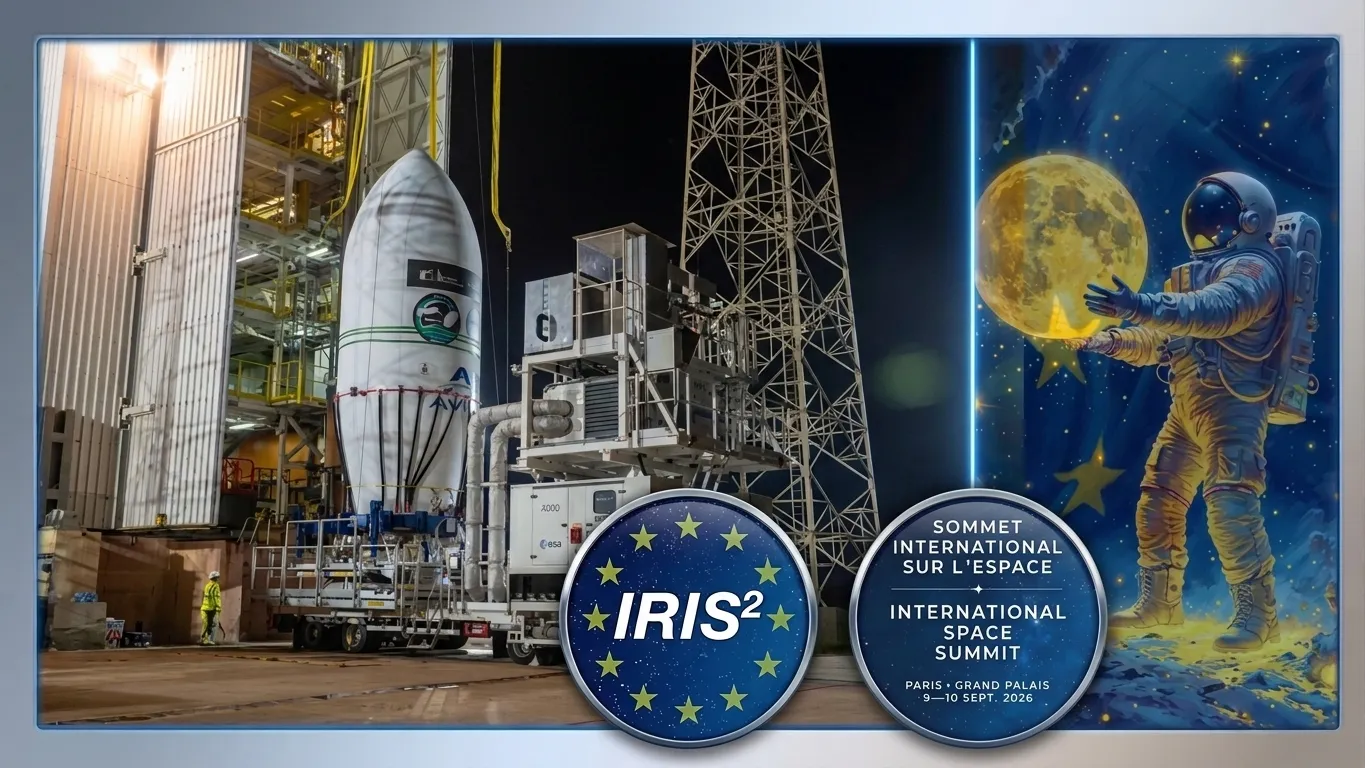
Collage by Olena Zelenina.
Ukraine became one of the central focuses of the first International Space Summit in Paris.
Against the backdrop of hybrid threats, cyberattacks on satellite infrastructure, and Russia's deployment of orbital weapons, the event, attended by over 90 heads of state and 120 countries, was dedicated to military security in space. Ukraine was drawn into key defense discussions — specifically regarding the testing of a European analog to Starlink and the protection of orbital space.
The End of "Orbital Pacifism":
Why Paris Gathered Space
Special Forces For years, attempts were made to pretend space was an apolitical arena. Paris put a decisive end to this. While Kremlin representatives, along with their allies from Tehran and Pyongyang, were demonstratively shown the door, the Ukrainian delegation found itself at the epicenter of decision-making.
The military dimension ceased to be a taboo. Russia turned near-Earth space into a combat zone back in February 2022 by attacking the Viasat network. Then came "kamikaze satellites," the blinding of optical systems with lasers, and drifting spies "Luch-1" and "Luch-2" tracking European spacecraft. Add to this the joint development between the RF and China — the "Rassvet" project, through which they hope to construct their own Starlink analog by the end of 2026.
The West's response was tough: NATO officially confirmed that the collective defense clause now applies in orbit as well.
European Alternative to Starlink:
Ukraine Joins Govsatcom and IRIS²
The main sensation of the summit for us is the transition from talks about aid to full-fledged technological integration. European Commissioner for Defense and Space Andrius Kubilius officially announced: Ukraine is beginning negotiations on joining European defense programs Govsatcom and IRIS².
IRIS² (Infrastructure for Resilience, Interconnection and Security by Satellite). Visualization from open sources.
What this means in practice, not on paper:
Instead of reliance on a single private operator — a proprietary European ultra-secure satellite system, IRIS². Its testing in partnership with Europeans was previously announced by Volodymyr Zelenskyy.
A joint intelligence contour: The Armed Forces of Ukraine and the armies of EU countries will operate within a single secure framework. This means direct exchange of intelligence data, stable communications under severe EW (electronic warfare), and real-time coordination of actions.
20 Billion Euros and Europe's Great Comeback Loop
Emmanuel Macron declared the summit "the beginning of a new era" and backed it up with figures: over 50 contracts totaling more than 20 billion euros were signed.
Among the largest deals are Amazon's contract with Arianespace for satellite constellation launches, the development of the Vortex S reusable spacecraft by Dassault Aviation and OHB, and the launch of a European marketplace for military-space technologies starting in 2027.
Europe's plan for the coming years:
2 years: Docking of the European Nyx freighter with the ISS.
5 years: Landing of the Argonaut scientific module on the Moon.
10 years: Launch of the first purely European crewed capsule from the Kourou spaceport.
The era when space was considered a neutral, quiet ocean has definitively passed. Now it is a high-tech outpost where Ukraine fights for its security alongside the planet's strongest players.
Ukrainian "Heart" for the European Vega C
Ukraine proves its practical capability in the space industry not only on the political track, but also directly in launch missions. Parallel to the summit, it became known that at the Kourou spaceport in French Guiana, preparations for the next launch of the European Vega C launch vehicle have reached the home stretch.
The launch is scheduled for September 15, 2026, at 04:21 Kyiv time. Specialists from the Italian company Avio have already successfully performed payload encapsulation — two powerful scientific spacecraft were placed under the main fairing:
Copernicus Sentinel-3C (1,250 kg): Sentinel of the Copernicus program for monitoring global ocean temperature and level, glaciers, and forest fires.
FLEX (Fluorescence Explorer): A unique ESA mission that will use the FLORIS spectrometer to assess plant stress levels and global biomass stocks via their infrared fluorescence.
Both satellites will operate in tandem in a sun-synchronous orbit (~815 km). But the main point for us is the fourth stage of the Vega C launch vehicle. Its liquid rocket engine assembly (RD-843) was traditionally developed and manufactured in Ukraine. This will be the second launch of Vega C in 2026 and the eighth in the entire operational history of this rocket, once again emphasizing the strategic importance of the Ukrainian industrial giant for European sovereign astronautics.

Comments
Some more relevant news for now