





















Russia Burns the Ukrainian Book: Not Just Words are Burning, Knowledge and the Future are Burning
All news | | 1,627 | Author: Olena Zelenina
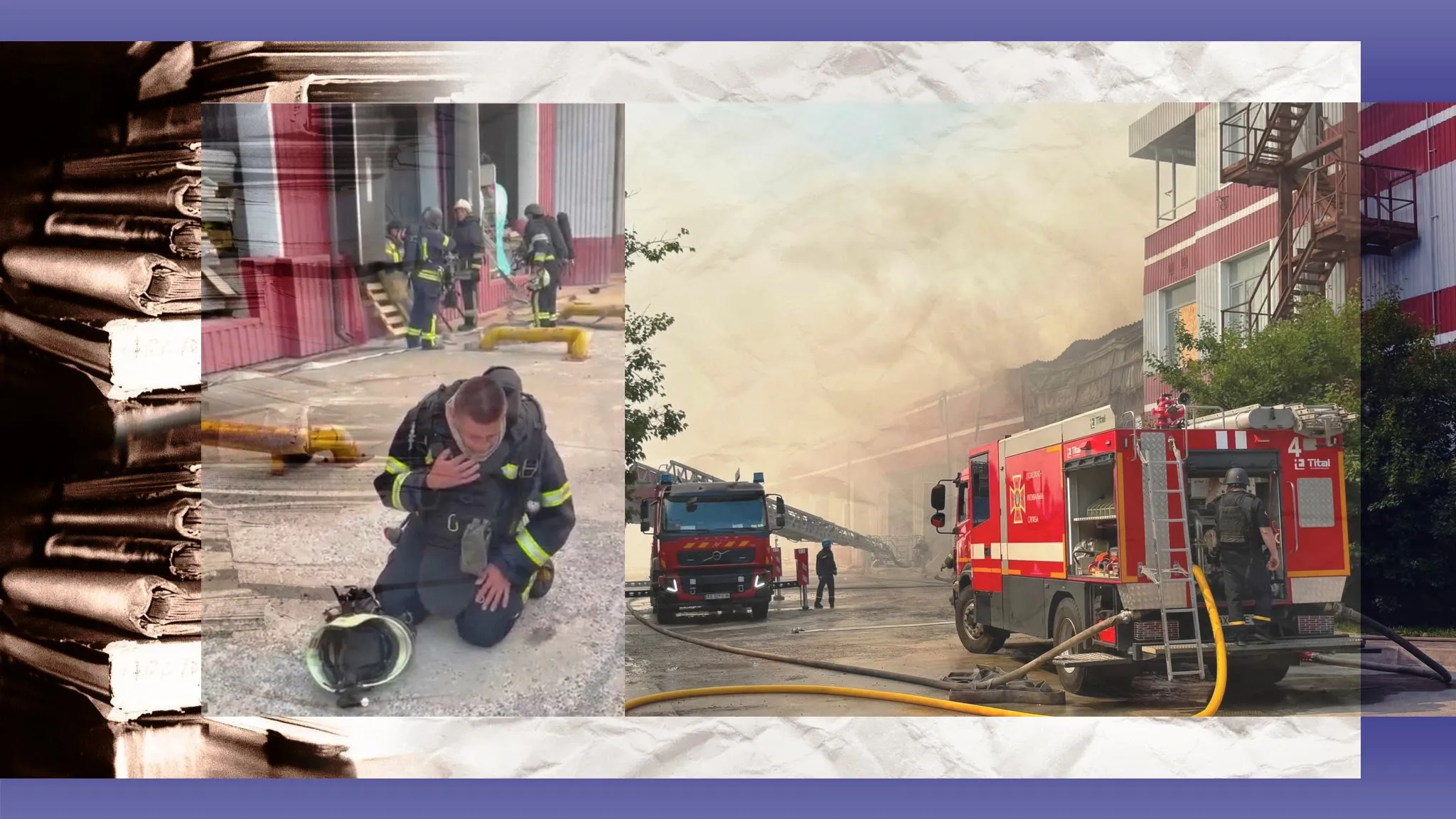
Collage by Olena Zelenina.
On August 1, 2026, Russian occupation forces carried out a massive attack with loitering munitions on Kharkiv, striking a large book storage-distribution center belonging to the "Ranok" publishing corporation and the "KnigoLand" bookstore chain.
A massive fire engulfed an area of about 10 thousand square meters, completely destroying millions of copies of fiction, children's, and educational literature. "This is another blow to the entire industry and Ukrainian culture. Ukrainian books cannot be bought abroad — this is the destruction of our identity," notes the publishing community.
Consequences of the Strike
on the Distribution Center in Kharkiv
Loss of Products: Millions of copies of books and school textbooks burned.
Blow to Publishers: The products of a whole range of publishing houses were stored at the logistics hub, including RNK-Ranok, "Fabula," "George," "Shche Odnu Storinku" [One More Page], Readberry, Korali books, Varvar, and others.
Suspension of Services: Due to the destruction and fire, the dispatch of internet orders for the "KnigoLand" chain and partner publishing houses has been temporarily suspended.
Colossal Damages: The estimated amount of damages reaches 300 million hryvnias. According to preliminary estimates, up to 20% of the total volume of book products in Ukraine has been destroyed.
Massive fires at book warehouses in Kharkiv and the destruction of printing houses in Kyiv are not accidental consequences of hostilities, but a conscious, systematic strategy of the aggressor country to destroy Ukrainian education, culture, and national identity. In just a few years of the full-scale invasion, the Ukrainian book market has suffered colossal losses, measured in millions of destroyed copies and hundreds of millions of hryvnias in damages. An analysis of recent events confirms: the enemy is aiming at the "heart" of the Ukrainian book.
Chronology of Terror: From Kharkiv to Kyiv
The Russian army systematically strikes key objects of the printing and logistics infrastructure, not sparing even iconic book trade locations.
Kharkiv Under Aim: Destruction of Production and Logistics Kharkiv is historically the main printing center of Ukraine, where the absolute majority of domestic books are printed. That is why the city became one of the first targets. On May 23, 2024, a Russian missile struck one of the largest printing complexes in Europe — the Kharkiv printing house "Factor-Druk." This barbaric act took the lives of 7 employees, more than 20 were injured. In the fire, more than 50 thousand books of the publishing houses "Vivat," "KSD," and many others burned.
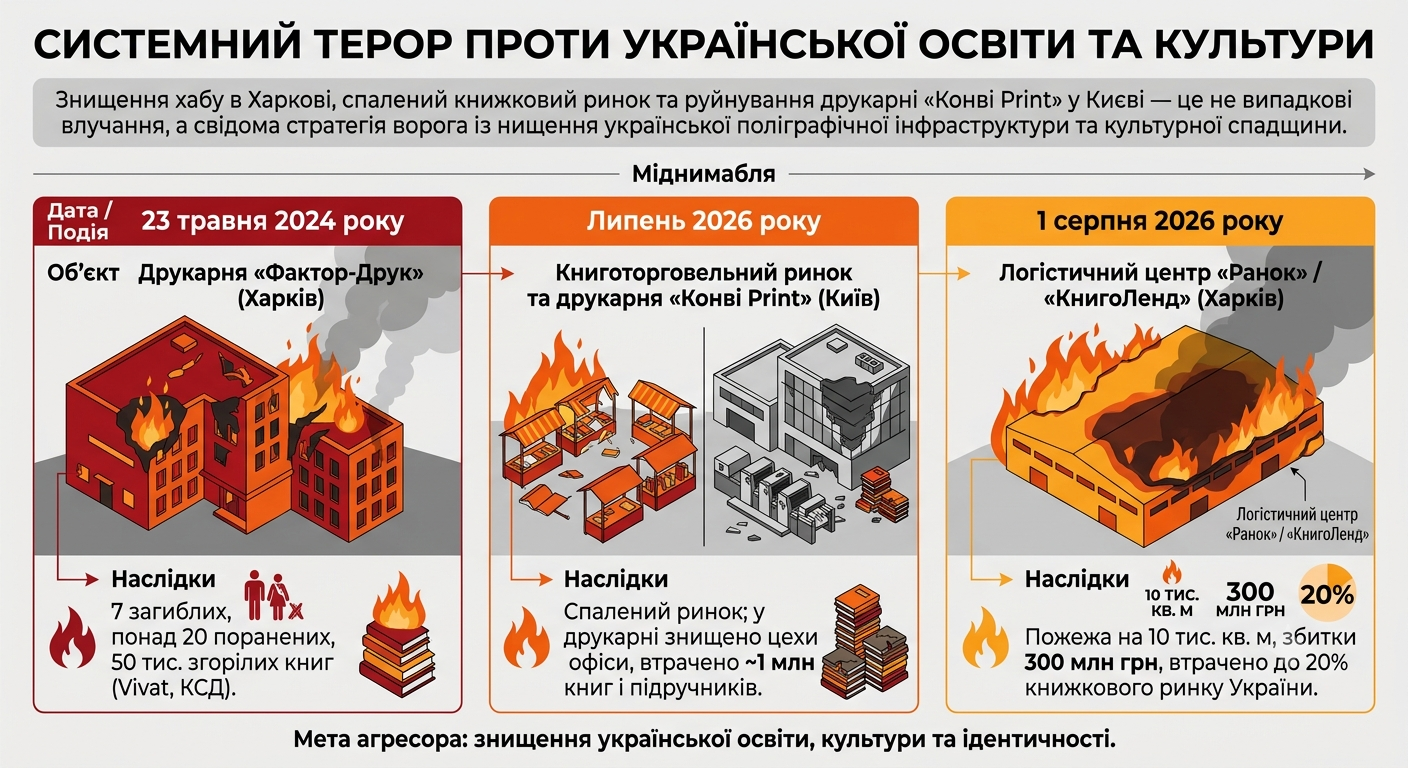
Russia is trying to paralyze the publishing process in Kyiv as well, striking printing houses and places of mass trade. As a result of a Russian ballistic attack on Kyiv, the "Konvi Print" full-cycle printing house and printing enterprise suffered heavy destruction. The massive production workshops of the Kyiv enterprise were left without a roof and walls, and the office premises burned to the ground. A significant part of the equipment was destroyed by fire or flooded with water during firefighting.
As a result of recent Russian rocket attacks on Kyiv, the legendary "Pochayna" (formerly "Petrivka") book market was seriously damaged. During night shellings, a fire broke out, destroying iconic trade rows with books and vinyl. Literature, including rare and second-hand editions, had been sold at this market for years, making the loss even more painful for Kyivans and book lovers.
The losses of logistics warehouses in Kyiv are also colossal. In particular, at the warehouses of large publishing houses and partners, such as BookChef, hundreds of thousands of copies of books burned.
Voice of Publishers:
About Losses and the Value of Life Victor Kruglov, CEO of the Kharkiv publishing house "Ranok," reported on the massive consequences of the enemy strike on Facebook.
He detailed the losses, emphasizing catastrophic figures. According to him, taking into account the books of the "Knigolav" publishing house that burned at another warehouse during the same attack, the total losses of the book market in just one night reached almost 1 million copies. Victor Kruglov on the losses: "You can buy anything abroad: clothes, food, gasoline. Ukrainian books cannot be bought. This is painful not only for our publishing house. This is a blow to the entire industry and Ukrainian culture." Among the publishers whose print run suffered in the Kyiv printing complex are "Ranok," "Gramota," "Litera LTD," "Linguist," "Knigolav," "Laboratoria," "Artbooks," "ASSA," "Kalamar," "Atena," "Aston," "BookChef," MISON, "Vyshcha Shkola" [Higher School], "Medytsyna" [Medicine], "Apriori," and many others. 250,000 textbooks for the 9th grade, ready for shipment to schools, were destroyed; textbooks for the 4th grade and books of leading Ukrainian publishing houses were damaged. Commenting on the consequences of the strikes, he emphasized that the most important thing is that people are alive.
Systematic strikes on publishing and logistics facilities in Kyiv and Kharkiv once again confirm that Russia is waging a purposeful war against Ukrainian education, culture, and identity. The particular cynicism of Russian attacks lies in the deliberate destruction of educational literature. Thousands of textbooks for schoolchildren that were to be delivered to schools are turning into ashes. This is a direct attempt by the enemy to disrupt the educational process in Ukraine and deprive Ukrainian children of access to education in their native language.
Russian terror against the Ukrainian book is another proof of the genocidal policy of the Kremlin. Despite colossal losses and destruction, Ukrainian publishers and printers continue their work, demonstrating incredible resilience. Support for Ukrainian book publishing today is not only a matter of economics, but also a matter of national security and the preservation of cultural heritage for future generations. The world must see these crimes and help Ukraine protect its right to its own book, language, and culture.

Comments
Some more relevant news for now