





















A "New Yalta" and a Shot in the Foot at the Finale: What Is Wrong with The Economist’s 2027 Forecast
Analytics | | 145 | Author: Olena Zelenina, Olexandr Sydorenko (caricature)
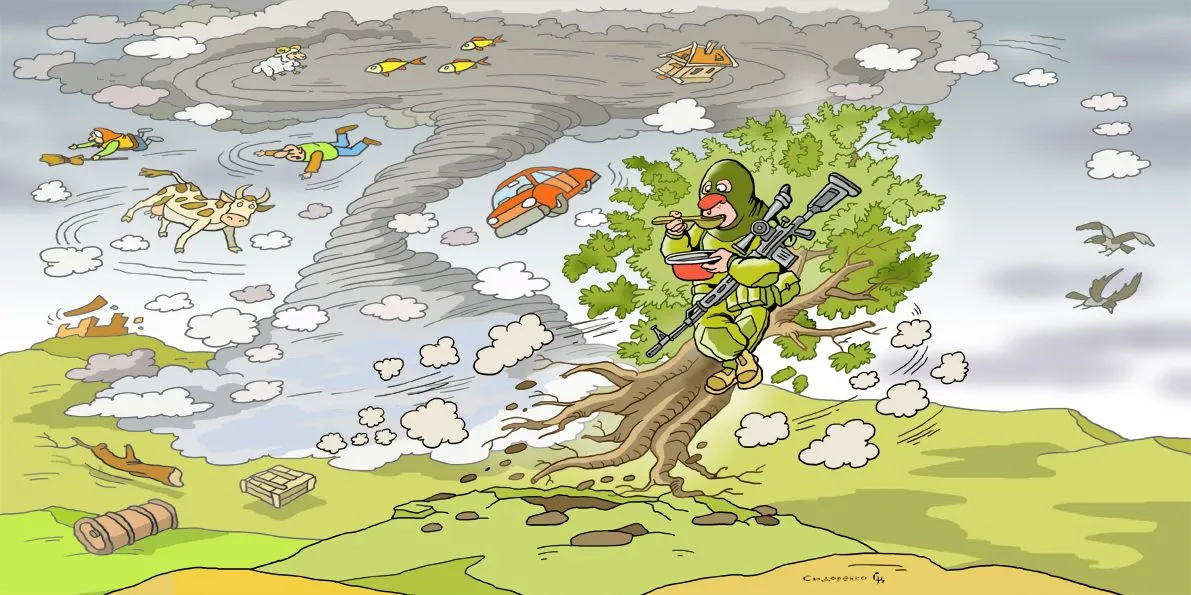
Cartoon by Olexandr Sydorenko.
Every year in late autumn, the British weekly The Economist releases its legendary special project The World Ahead—a global almanac of predictions for the coming year that sits as a desk reference in the offices of diplomats, bankers, and ministers around the world.
In the 2027 edition, the Russo-Ukrainian war is analyzed by Russia editor Arkady Ostrovsky in a piece with the telling title "The Russia-Ukraine conflict will grind on."
And the most intriguing thing about this column is the glaring chasm between the ruthless anatomy of the Kremlin's failures with which the author begins, and the strange, almost defeatist conclusion with which he crosses everything out at the end.
The Kremlin at a Dead End:
A Diagnosis from The Economist
For most of the text, Ostrovsky meticulously debunks the myth that time is supposedly on Moscow's side.
Nearly twenty years after his notorious 2007 Munich speech, Vladimir Putin still hallucinates about a "new world order" and a "new Yalta"—a grand division of the planet into spheres of influence among three players: himself, Donald Trump, and Xi Jinping.
Even at a Moscow exhibition of "Christian values," the Russian dictator stops next to a sculpture of Stalin, Roosevelt, and Churchill, explaining to children how the leaders of the most powerful nations decide the fate of the world after a war.
Yet The Economist aptly captures the core substitution: Yalta in 1945 was the result of an actual military victory, whereas Putin’s current "Yalta" is a desperate attempt to replace its complete absence with diplomatic bargaining.
The figures and facts cited by the publication look devastating for Moscow. The war, which has already lasted longer than the First World War, has cost Russia at least 370,000 dead and over a million wounded—more than any conflict since 1945.
In October alone, the Russian army lost 54,000 troops (an anti-record since 2022), while even managing to retreat in certain sectors. Capturing the entire Donbas—the objective set at the very start of the invasion—remains unachievable, and the author rates the chances of accomplishing it in 2027 as slim.
Unable to break Ukrainian defenses on the battlefield, the Kremlin has shifted its bet to terrorizing the rear and waging hybrid warfare against Europe.
Taking advantage of Ukraine's acute shortage of air-defense interceptors, Moscow is trying to destroy the heating and water supplies of major cities to make them unlivable and trigger a new wave of refugees that would undermine fragile political stability in the EU.
At the same time, Russia is ramping up "grey-zone" sabotage on the territory of European countries supporting Ukraine's defense industry—such as the incident involving an explosives-laden drone discovered in Leipzig. All of Putin’s hopes for 2027 rest on external "crutches": two more years of Trump’s presidency, upcoming elections in France, and the war in Iran, which is keeping oil prices high.
Meanwhile, Russia’s own home front is rapidly cracking. The oil-and-gas windfall reserves from the first three years of the war have been depleted—the slaughter is now financed by directly squeezing money out of the population and private businesses.
Economic growth has stalled, sign-up bonuses for contract soldiers are being slashed, and entire macro-regions—the Urals, Siberia, the Russian south—have already fallen into recession. Putin’s old "social contract" with the elites and society has been broken, and now the lack of resources is compensated solely by fear: the FSB has definitively become the country's dominant political force, and the average prison sentence has reached Stalinist proportions—11 years.
An Inexplicable Finale:
How One Sentence Kills the Entire Meaning
It would seem that after such a crushing diagnosis, the conclusion is obvious: the aggressor is running out of steam, bluffing, already waging a sabotage war on EU territory, and surviving only through terror, so the West merely needs to close the Ukrainian sky and press the regime until it collapses under the weight of its own crisis.
Yet this is precisely where the main bewilderment arises. At the end, Ostrovsky suddenly crosses out all of his preceding arguments with a single fatalistic phrase: "Neither Ukraine nor Russia can win the war of attrition he has unleashed. Both are losing."
In journalism, there is an ironclad rule of the final paragraph: a reader may forget casualty statistics or details of the recession in the Urals, but it is the closing line that sets the verdict with which they close the issue. And this finale sounds like a genuine shot in the foot to his own text.
For a weary Western voter or an indecisive politician in Washington or Berlin, the formula "no one can win" turns into a perfect indulgence for inaction. Why exert effort, allocate billions, and take risks if victory is impossible anyway? Let them keep exhausting each other somewhere in Eastern Europe—it does not concern us.
Thus, a single neatly turned metaphor destroys the author's own warnings about drones in Leipzig and the threat to the entire continent, substituting an "inevitable law of nature" for the real reason the war is dragging on (a deficit of Western resolve and weapons).
Lobbying for a "Freeze"
and the Interests of Runaway Businessmen
However, such rhetoric looks less and less like the ordinary naivety of a Western intellectual. Far too synchronously do these talking points align with the information campaign of an entire ecosystem of Russian "systemic liberals" and runaway businessmen in the West—from former officials like Alfred Koch to sanctioned oligarchs. Suffice it to recall the recent scandal surrounding The Economist's publication of a manifesto by Russian billionaire Andrey Melnichenko.
Even though the oligarch explicitly blackmailed the West (demanding recognition of Moscow’s right to bomb and seize its neighbors under the threat of a final Russian alliance with China), London commentators, including Ostrovsky, tried to discern in this the "pragmatic voice of systemic elites" with whom one could supposedly negotiate. The interest of this crowd in the West is entirely transparent: they need the legalization of their capital, the lifting of sanctions, and a return to the familiar business as usual with the "pragmatic" wing of the Russian leadership.
To achieve this, they must impose on the Western establishment the idea that defeating the Kremlin is impossible, Ukraine’s victory is a utopia, and the only rational way out is a "freeze" of the conflict and a compromise. It is this very thesis—whether consciously or through the shared environment of London circles—that respectable Western analysis often packages in the wrapper of an "objective view." And the price of such ambiguity is extraordinarily high. After all, The Economist is no niche blog, but a global "consensus machine," unlike more sober continental publications that call a spade a spade.
When a global brand stamps "both sides are losing" onto its 2027 forecast, it legitimizes the Western elites' fear of decisive action. Ultimately, across the entirety of The Economist’s high-profile 2027 forecast, only one thing remains undeniably true: the war indeed will not end on its own. Yet whether it ends in the aggressor's victory, endless ruin, or the collapse of the Kremlin regime depends not at all on the fatalistic aphorisms of London columnists, but on whether the West finally dares to give Ukraine the tools for a breakthrough.
The "Gromada Group" local media network works thanks to your trust.
Support independent regional journalism with a donation.


Comments
Some more relevant news for now