
















Silence on the Network: How Ukraine’s "Magic Key" Unplugged Bots from Kharkiv to Berlin
Analytics | | 251 | Author: Olena Zelenina, Olexandr Sydorenko (caricature)
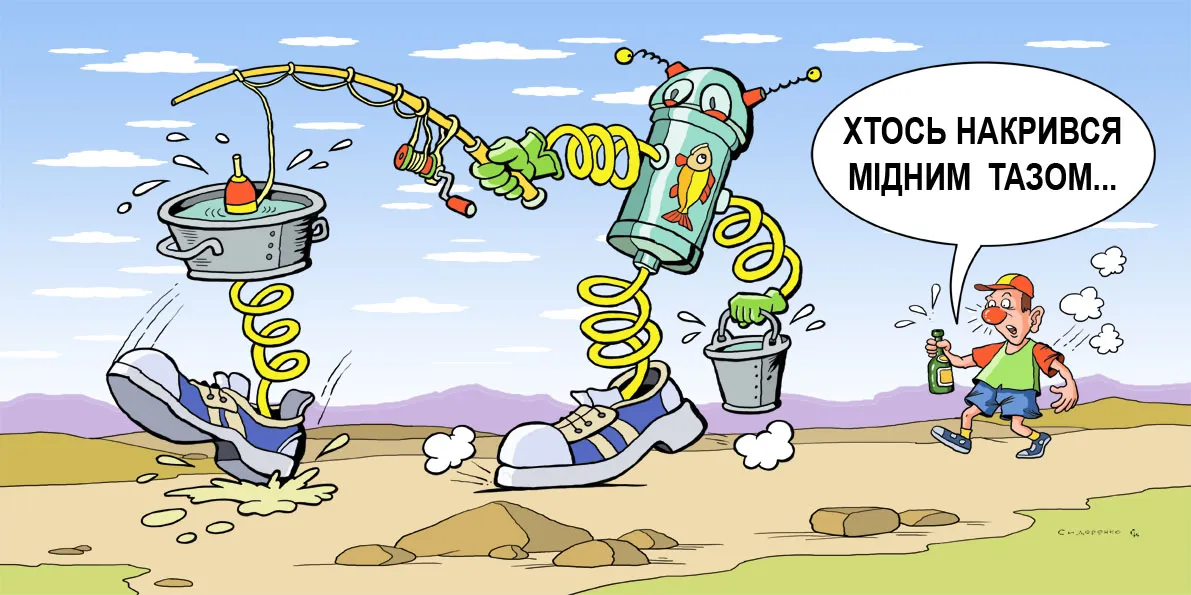
Cartoon by Olexandr Sydorenko.
In recent days, an extraordinary, almost anomalous silence has fallen over the global information space. Cybersecurity researcher Jeremiah Fowler was the first to draw attention to the graphs on the Cloudflare Radar analytical platform: Russian bot traffic originating from Yandex networks suddenly took a steep nosedive, plummeting to a mere 0.4% of its usual peak.
While diplomats spend years gathering for solemn summits, allocating millions in grants to counter hybrid threats, and expressing yet another round of deep concern, the Defense Forces of Ukraine have discovered a miraculous and delightfully concise "magic key" to Russian propaganda.
The recipe turned out to be as simple as all things brilliant: instead of endlessly debunking fake news, you simply unplug the power where those fakes are born.
Reports from the Digital Front
The reason for this digital coma became clear very quickly.
It turned out that a series of targeted visits by Ukrainian drones to Russian data centers in the Ryazan, Kaluga, and Vladimir regions (where the company was forced to admit a total shutdown of the facility) had a remarkably therapeutic effect on world politics.
The impact was instantaneous and astonishing. Across the globe, far-right figures, far-left agitators, and self-proclaimed "peace advocates" suddenly ran out of talking points. As if by magic:
Ratings for the German far-right party AfD (Alternative for Germany) dropped by an impressive 56% within 24 hours.
A whole army of "outraged Polish farmers" who had been calling for blockades around the clock suddenly evaporated from social media, along with the "Ukrainian-speaking patriots" who were passionately inciting revenge against Warsaw.
An offline silence descended upon the accounts of vocal MAGA supporters, while feeds suddenly saw a sharp decline in followers of France's Marine Le Pen and Italian general Vannacci.
It seems the legendary Soviet dissident and human rights defender Vladimir Bukovsky was absolutely right when he once remarked that a couple of cruise missiles directed at the Lubyanka could reduce international terrorism by about eighty percent. Ukraine is now testing this hypothesis in practice—with direct fire.
British "Enlightenment" Ten Years Late
Hand in hand with this "digital miracle," old Britain finally woke up. A mere ten years after the Brexit vote, Prime Minister Andy Burnham solemnly confirmed: "Yes, I received a clear answer — there was Russian interference."
Ten years! Thank you for noticing. Back in 2012–2013, the author of these lines happened to witness a telling public debate between Kharkiv and Belgorod political scientists. While Ukrainian analysts relied on logic and considered the idea of the EU collapsing or Britain leaving to be absolute nonsense, Belgorod "experts" were already confidently asserting: London will leave.
This was no prediction by Nostradamus—it was simply the broadcast of a new Kremlin directive. It was during those exact years that Moscow began systematically laying the groundwork for the deconstruction of the West: in 2013, the infamous St. Petersburg "troll factory" was established, media monstrosities like Sputnik were launched, and Russian oligarchs generously showered the
British establishment with "dirty cash." The Belgorod analysts were merely voicing the Kremlin's dream, for which an influence infrastructure on social media was already being built at full throttle.
It took the British a decade to officially recognize what was obvious in the Slobozhanshchyna region right on the eve of Euromaidan. Meanwhile, Bukovsky—who paid for such observations and warnings with years of persecution, KGB defamation campaigns, and his own health—could now only smile bitterly.
But the most interesting part of this story is the future…
Experts are already speculating: if the "movement" against data centers continues, Russia faces not just a minor glitch, but a full-blown digital coma. After all, nearly three-quarters of all Russian server capacity is concentrated in a few critical "nodes."
Forecasts suggest: if something happens to the Kalininskiy Data Center near the Tver Nuclear Power Plant, GoSulusgi, the Ministry of Health, Rosreestr, and the RTK-Cloud will all go down.
If IXcellerate MOS5 or DataPro III get tired, banks, marketplaces, logistics, heavy industry, and insurance companies will grind to a halt.
And if things heat up at Sber’s Mega Data Center in Balakovo or Skolkovo, SberBank Online, biometrics, and the Christofari supercomputer—along with GigaChat and Kandinsky—will be forced into a long vacation.
The most exquisite part is that Russians simply have nowhere to back up this data: if a few key facilities are lost, the remaining server sites will instantly drown under the surge of requests.
It seems Ukraine has invented a new standard of cybersecurity: why spend years decrypting enemy code and de-anonymizing troll farms when you can simply turn off their power outlet?
And while European institutions gather for yet another committee meeting, Ukrainian drone operators prove once again: the best anti-disinformation shield is a well-calibrated flame of "bavovna."
The "Gromada Group" local media network works thanks to your trust.
Support independent regional journalism with a donation.

Comments
Some more relevant news for now