




Kirsty Coventry: Sincere Sympathy or a Crisis of Olympic Values?
Blogs | 12 February, 2026 at 12:42 | 3,042 | Author: By Olena Zelenina
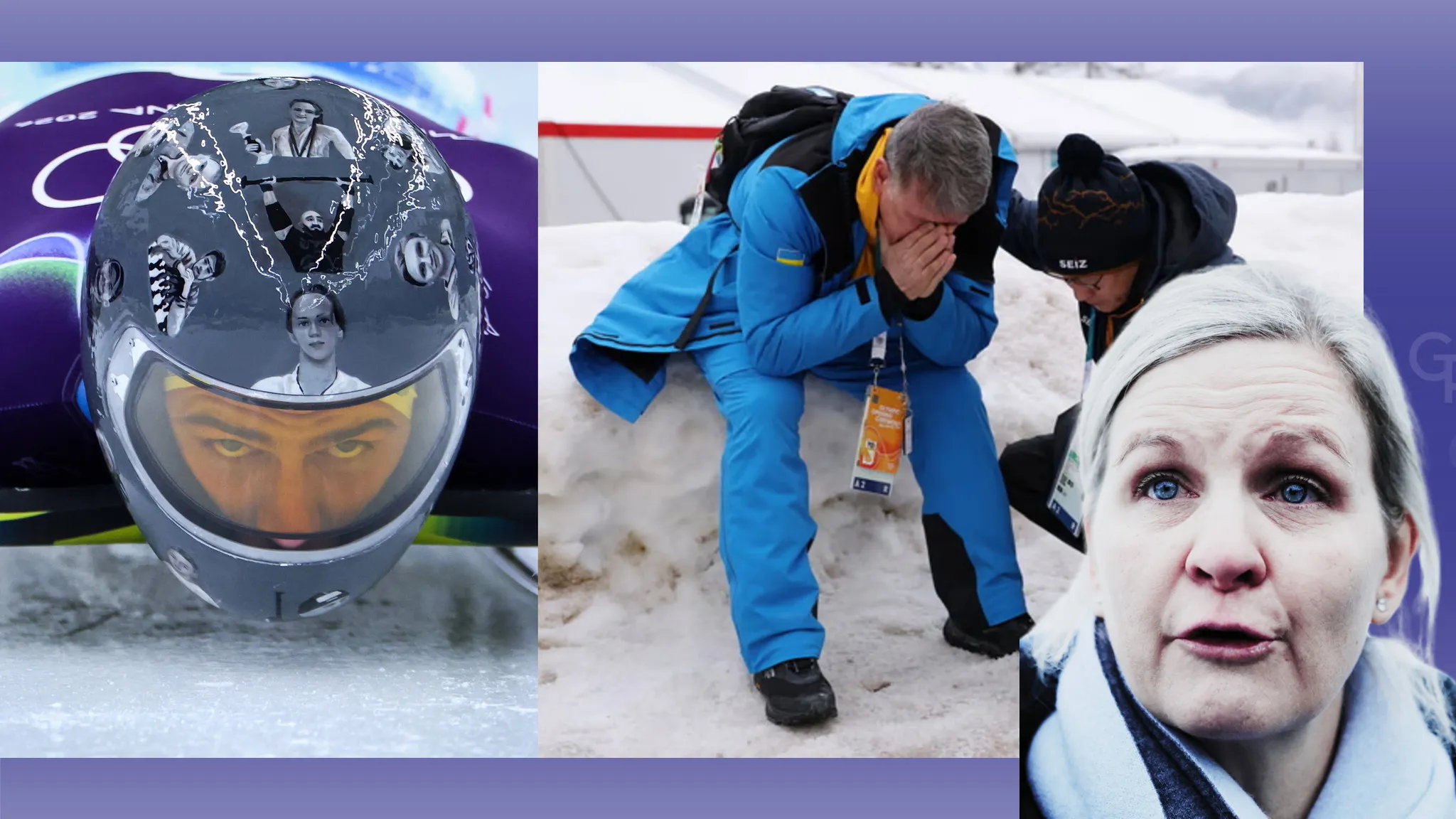
Collage by Olena Zelenina.
Today, on Thursday morning, February 12, Ukrainian athlete Vladyslav Heraskevych received devastating news: he has been disqualified by the IOC and stripped of his accreditation, meaning he will be forced to leave the Games.
His "Helmet of Memory," which features portraits of 24 athletes who died due to Russian aggression, was deemed a violation of rules regarding political statements at the Olympics. The helmet was decorated by Kyiv-based artist Iryna Prots, who has known Heraskevych since childhood.
"The world is becoming more indifferent every day," she said. "That is why I took on this work—to remind the world that we had athletes who should have been here."
The skeleton tournament, in which Heraskevych was a medal contender, continues without him.
Media outlets report that the President of the International Olympic Committee, Kirsty Coventry, waited for Heraskevych at the start of the track when he arrived at approximately 8:15 AM on Thursday, February 12—about 75 minutes before the start of the men's skeleton competition.
They went into a private area and spoke briefly, but Coventry did not change Heraskevych's mind. The day before, in an Instagram address, the athlete emphasized that he did not seek a scandal and proposed an end to the conflict.
He had asked the IOC to:
Lift the ban on the "Helmet of Memory";
Apologize for the pressure exerted over the past few days;
As a sign of solidarity, donate electric generators to Ukrainian sports facilities suffering from shelling.
Following the announcement of his disqualification, Vladyslav Heraskevych, citing the decision of the International Bobsleigh and Skeleton Federation, briefly addressed journalists, stating that he would file an appeal with the Court of Arbitration for Sport (CAS).
"It’s hard to say or express in words. It is emptiness," he said.
Vladyslav Heraskevych's father and coach, Mykhailo Heraskevych, consoles his son after his disqualification from the competition. Photo: Richard Heathcote/Getty Images
Coventry spoke with journalists after the meeting, tears streaming down her face as she spoke.
"This is a message of memory, and no one disputes that," Coventry said. The IOC added that it had made its decision "with regret."
Hromada Reference: Kirsty Coventry (born September 16, 1983) is a Zimbabwean swimmer, Olympic champion, politician, and sports administrator.
Analysis: Erosion of Meaning The incident between IOC President Kirsty Coventry and Ukrainian skeleton racer Vladyslav Heraskevych has become iconic not because of protocol violations, but because it exposed the erosion of the meanings upon which the Olympic movement was built.
The Olympic Charter proclaims sport as an instrument of peace and the protection of human dignity. The policy of "neutrality" attempts to sit on two chairs: preventing direct propaganda while avoiding the exclusion of athletes.
Heraskevych directly points out that attempting to find a compromise where basic human rights are at stake is a discredit to the very idea of Olympism. For example, at the 2026 Olympic Games, athletes from aggressor countries are admitted under neutral status.
Thirteen "neutral" athletes from Russia traverse the Milan-Turin tracks to the cheers of Russian fans, while the Russian press writes breathlessly about "ours at the Olympics" and sends a landing party of "Z-journalists" like Tereshchenko from TASS, known for his reports from occupied Mariupol.
Meanwhile, the Ukrainian skeletonist is banned from wearing a helmet with portraits of Ukrainian athletes killed in the war because, once again, "sport is beyond politics."
Kirsty Coventry is an outstanding athlete herself. Her tears may be an admission that the IOC’s bureaucratic machine is unable to accept the pain of athletes, and she understands this as a human being, but as an official, she is bound by protocols.
Or, perhaps, her tears are a way to avoid concrete answers? An emotional response blocks further rational discussion: it is difficult to attack a crying person with arguments.
In any case, if the head of an organization cannot restrain her emotions when discussing basic principles (discrimination, war, fair play), it signals a deep internal rift within the committee.
For Vladyslav Heraskevych, this became a "moment of truth." He effectively forced the IOC leadership to acknowledge the presence of a deep moral trauma within the sports community. If values (peace, friendship, solidarity) are violated, then no game can be considered "fair."
The IOC is trying to maintain organizational integrity and universality. But when institutions place "universality" above "morality," values turn into empty slogans.
This incident also calls into question the legitimacy of many IOC decisions on the eve of the Winter Olympics. If the IOC President cries from the realization of injustice, how does the organization plan to provide a "safe and fair environment" for all participants?
Coventry's tears did not close the question of discredit; rather, they brought it to a new level. Now, what matters to the sporting world is not how sincerely the president cried, but whether real changes in the regulations for admission and the protection of athlete rights will follow these emotions.
...Meanwhile, as bloggers note, the official Games website is selling "Legacy" series T-shirts with symbols of the 1936 Olympics in Nazi Berlin, featuring an ancient/Aryan athlete and a chariot, imperial fonts, and a design in the spirit of Leni Riefenstahl. Only the swastika is missing. The product remains on the site even after being reported by the German press.

Comments
Some more relevant news for now