










Kharkiv’s Imprint at the Heart of CERN: How Physicists at the Large Hadron Collider Caught a "Ghost"
Life | | 2,362 | Author: Olena Zelenina
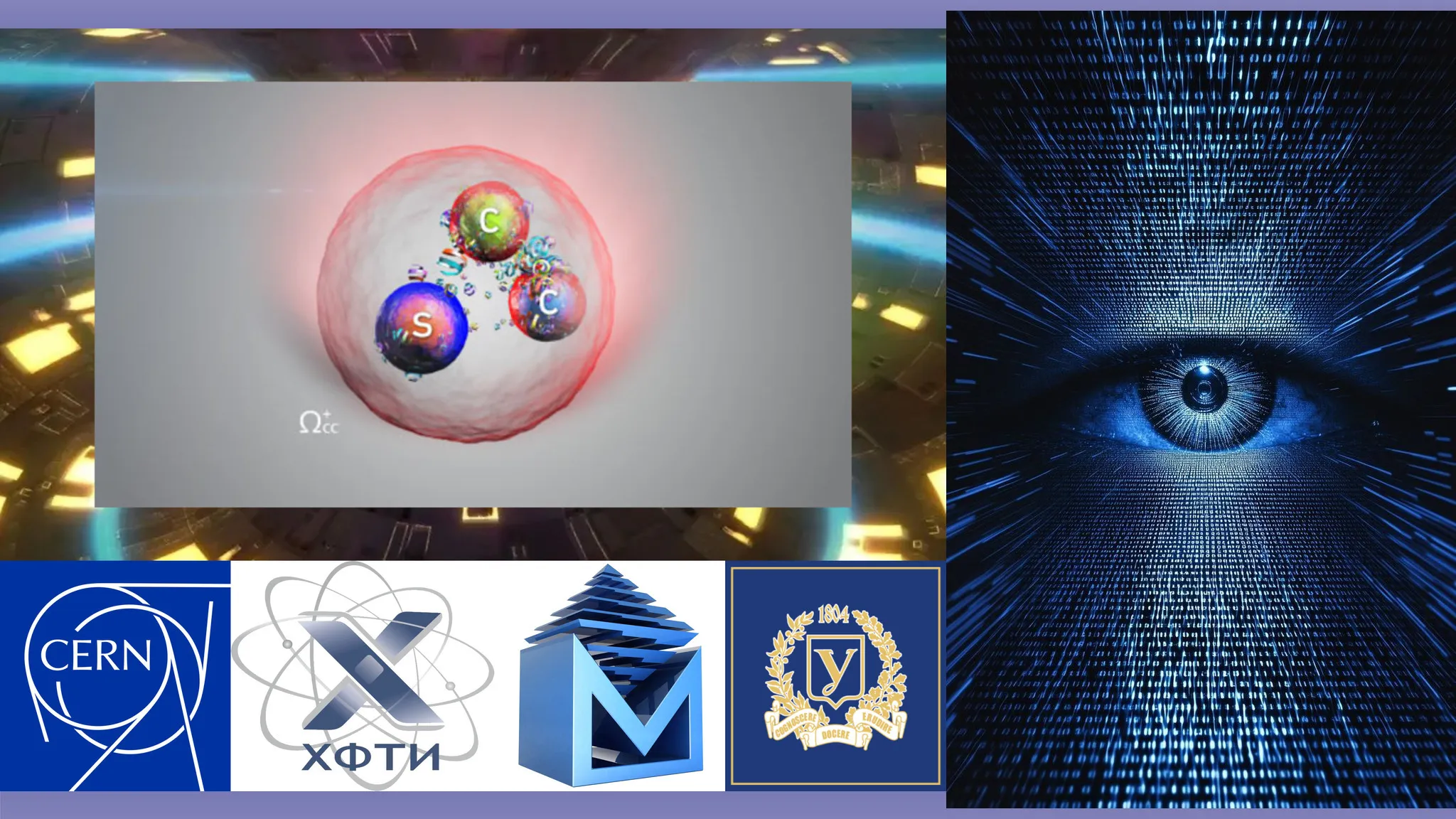
Collage by Elena Zelenina.
The LHCb international collaboration at CERN has officially announced a sensation: the elusive “ghost” of the microworld has been caught — the superheavy particle “Omega-cc-plus,” which scientists have been searching for for over 50 years. And this historical puzzle of a global scale was also being put together in Kharkiv!
Imagine that you are assembling a highly complex puzzle of the Universe, where theoretical calculations have detailed the shape of the final piece for over sixty years, but you just do not have it in your hands. This was precisely the state of pleasant anticipation and immense intellectual tension shared by nuclear physicists worldwide. And now, finally, the international LHCb collaboration, operating at the Large Hadron Collider at the European Organization for Nuclear Research (CERN), has officially announced that the "ghost" has been caught, and the last missing member of a mysterious particle family has been found.
Drawing by Daniel Dominguez / CERN.
English Summary
The article highlights a major breakthrough at CERN, where the LHCb collaboration discovered the $\Omega_{cc}^+$ (Omega-cc-plus) baryon, the third and final particle predicted by decades-old theoretical models of doubly charmed baryons. Composed of two heavy charm quarks and one strange quark, this newly discovered heavy particle helps scientists deeply investigate the strong nuclear force that holds matter together.
The piece places a significant emphasis on the crucial contribution of Ukrainian science, particularly the prominent Kharkiv scientific school. Leading institutions—such as the National Science Center "Kharkiv Institute of Physics and Technology," the Institute for Single Crystals of the NAS of Ukraine, and V. N. Karazin Kharkiv National University—alongside their colleagues from Kyiv, have been integral parts of the LHCb collaboration since its inception, providing key detector technologies, advanced materials, and big data analysis.
Read more in the Ukrainian edition....

Comments
Some more relevant news for now