




Beauty of Defiance: How Leonid Lohvynenko Saw People in the War
Life | | 156 | Author: Olena Zelenina
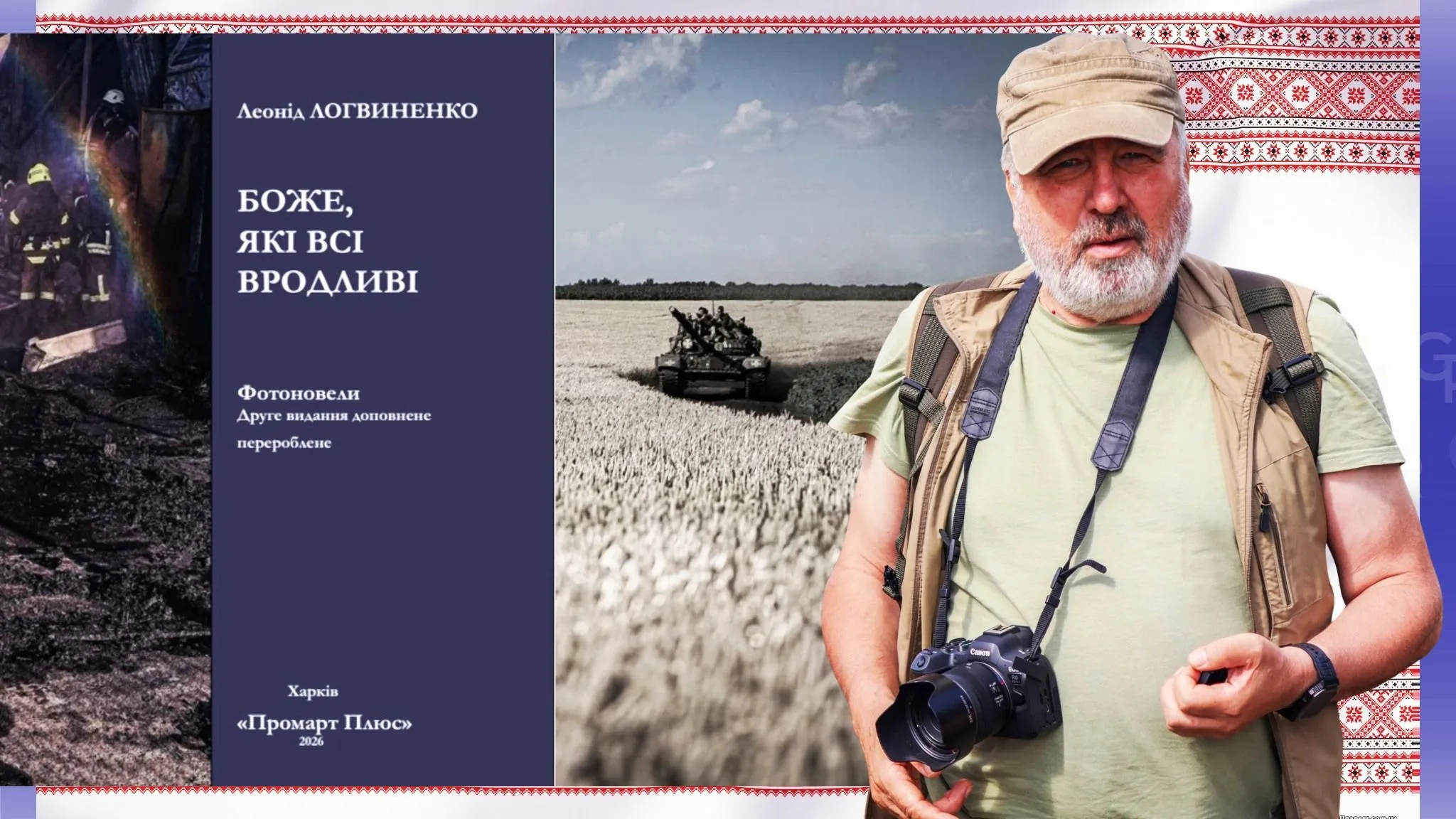
Collage by Olena Zelenina.
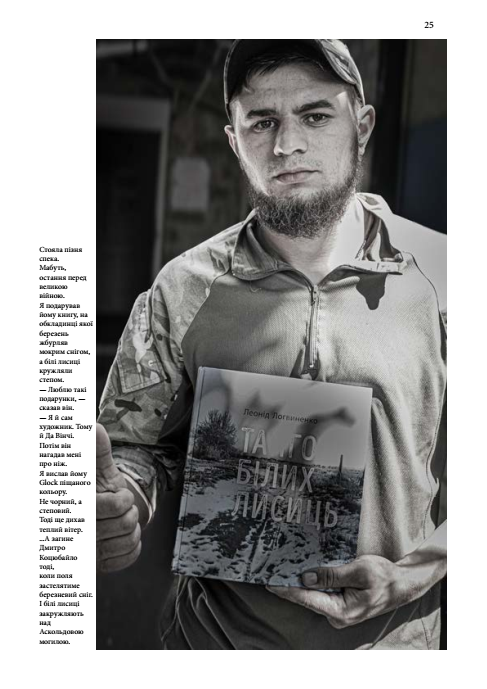
"It was the late heat. Probably the last one before the big war. I gave him a book, on the cover of which March was flinging wet snow, and white foxes were circling the steppe..."
— I love such gifts, — he said.
— I am an artist myself. That's why [callsign] Da Vinci.
Then he reminded me about the knife. I sent him a sand-colored Glock. Not black, but steppe-colored.
Then the warm wind was still breathing.
...And Dmytro Kotsiubailo will die when March snow carpets the fields. And white foxes will circle over Askold's Grave.
The book by our colleague — Kharkiv journalist and photo artist Leonid Lohvynenko "God, How Handsome Everyone Is" (second supplemented and revised edition, Kharkiv: "Promart Plus", 2026) is a poignant documentary-artistic hybrid of a photo album and short prose.
This publication captures Russian aggression against Ukraine through the prism of human destinies, pain, courage, and the indestructible existential beauty of people who found themselves on the front lines and in frontline cities.
Photo-Novellas as a Space of Memory
The book is built on a unique synthesis of visual and verbal elements. As the author himself notes, the texts here are not just captions for photographs. Each spread combines a deep, concise text (a five-to-seven-line novella) and an expressive portrait or genre frame.
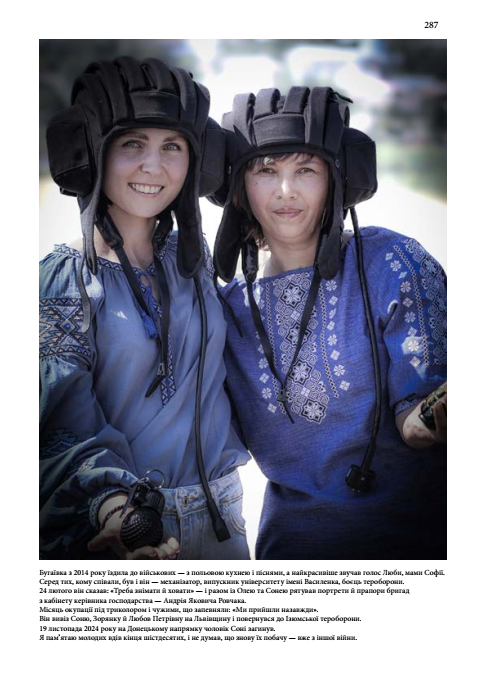
Chronologically, the book covers the period from the beginning of the hybrid war in 2014 to the full-scale invasion and subsequent years of resistance.
The author's lens captures military personnel, volunteers, medics, chaplains, cultural figures, and ordinary residents of the Kharkiv region, Donbas, and other corners of Ukraine.
Photography and text coexist on equal terms, creating a common field of memory where official dry reports are erased and pure human experience remains.
How Yesterday's Teachers, Artists, Entrepreneurs, and Students
Become Warriors
The title of the book — "God, How Handsome Everyone Is" — is devoid of irony. It is the exhalation of a person looking at the exhausted, soot-stained, tired, but unconquerable faces of defenders and civilians.
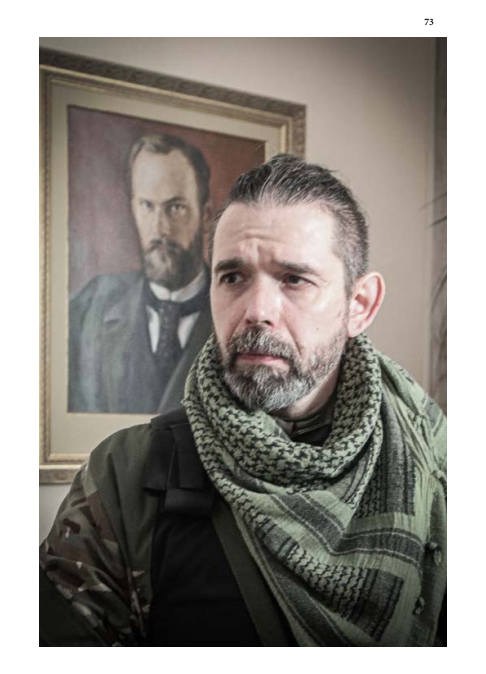
Beauty here is understood not in an aesthetic, glossy sense, but as the beauty of dignity, stubbornness, and inner light that does not fade even in the darkest shelters, trenches, and ruins.
The author shows how yesterday's teachers, artists, entrepreneurs, and students become soldiers and volunteers ("Sensei", "Skif", "Kripysh", etc.). The book is full of the bitterness of losses — many heroes captured on its pages have already fallen (Da Vinci, Oleh and Yevhen Hromadsky, Serhiy Pushchenko, and others). The author aims to save their names from oblivion.
Culture as a Shield
The pages of the book are permeated with the images of Kharkiv musicians, poets, artists, and priests (Father Viktor Marynchak, violinist Ihor Chernyayev, poets and writers Lina Kostenko, Oksana Zabuzhko, and Serhiy Zhadan), who prove that the spirit of resistance lives in word, music, and faith.
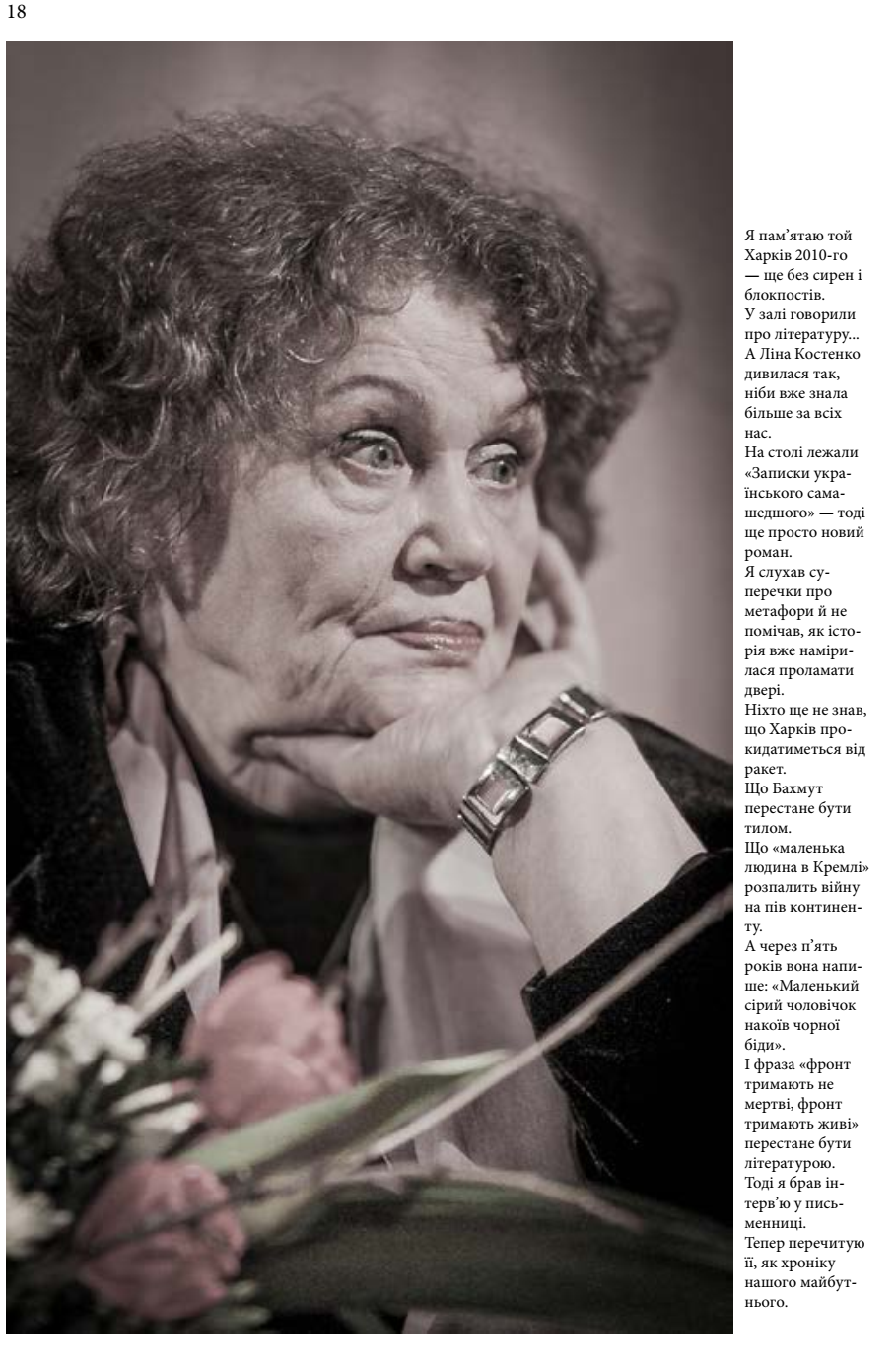
I remember that Kharkiv of 2010 — still without sirens and checkpoints. People in the hall were talking about literature... And Lina Kostenko looked as if she already knew more than all of us.
"Notes of a Ukrainian Madman" lay on the table — back then just a new novel.
I listened to disputes about metaphors and didn't notice how history had already intended to break down the doors.
No one yet knew that Kharkiv would wake up to missiles. That Bakhmut would cease to be the rear. That the "little man in the Kremlin" would ignite a war across half a continent.
And five years later she will write: "The little gray man has wrought black trouble."
And the phrase "the front is not held by the dead, the front is held by the living" will cease to be literature.
Back then I was interviewing the writer. Now I reread her as a chronicle of our future.
As an experienced journalist, the author avoids excessive pathos. His novellas are sketches from nature that harmoniously combine harsh trench prose and lyrical depth.
"God, How Handsome Everyone Is" is not just a chronicle photo album about the war, but a deep philosophical statement about Ukrainian resistance.
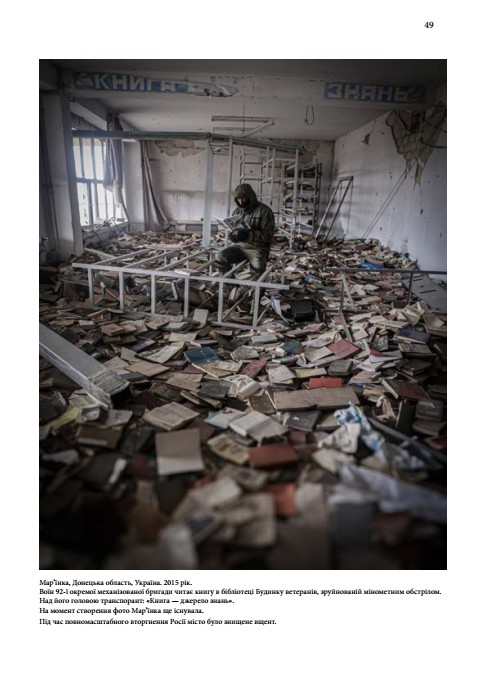
The book leaves a heavy yet bright aftertaste. It reminds us that behind every dry statistical figure of losses lies a unique human universe, and Ukraine's victory is forged from the daily courage of ordinary people who chose light over darkness.
Leonid Lohvynenko: "I HAVE BEEN IN THIS WAR FOR A LONG TIME"
Based on the material by Larysa Salimonovych "I have been in this war for a long time." Ukrayina Moloda newspaper, February 12, 2025:
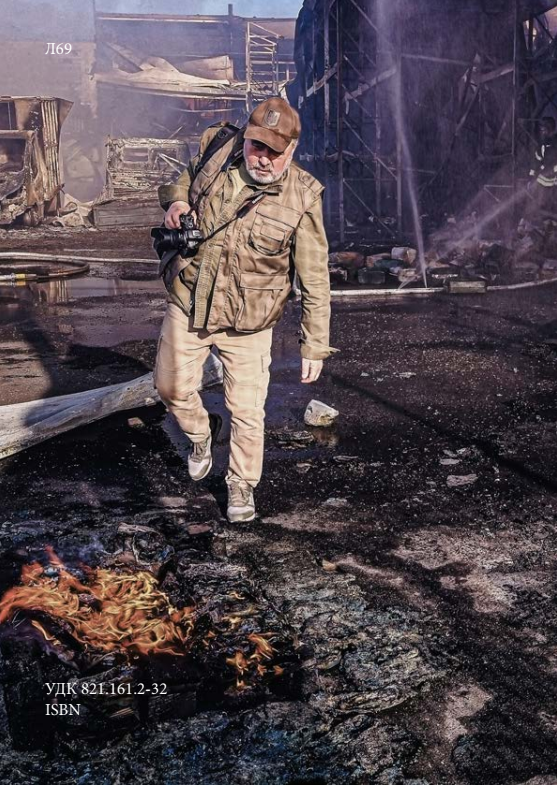
On the night of February 23–24, Leonid Lohvynenko, together with Vasyl Ryabko, the frontman of the "Papa Karlo" band, was recording a musical dedication to "orcs" — to the tune of Shevchenko's "Testament". The file named "When I Die" magically refused to save.
The recording only succeeded after it was renamed to "Testament".
A few hours later, explosions began. Leonid took his camera bag and walked across the field toward Tsyркуни — to the place where conscripts of the 92nd Brigade of the Armed Forces of Ukraine and National Guardsmen were halting the offensive on Kharkiv.
His war, which began back during the Revolution of Dignity, entered its hot phase.
Today, the frontline geography of his photographs includes Sloviansk, Debaltseve, Shyrokyne, Lyman, Pokrovsk, and the entire line of the Kharkiv region.
What he saw was first gathered in the book "Lunar Sonata of the War," which was awarded the International Prize of the Welychkovsky-Shwabinsky Foundation in New York.
Then came "Kharkiv Maidan," "Tango of White Foxes," the trilogy "Shadow of the War," "The Call of the Silver Wolf." The next book — "Mara" — is about the unmanned systems battalion of the 66th Brigade, about the guys who are no longer here. The knights of drones led by "King Arthur" cleared the land with methodical precision. All young. All handsome.
On March 1, 2022, he ran to the destroyed building of the Kharkiv Regional State Administration. Just yesterday, weapons were being handed out to volunteers here, and now blood-stained bodies were being carried out.
"I screamed, I screamed in my sleep again..." — he would write in the poem "Scream."
Tired fighters look out from his portraits. "They said there were few orcs there, but it turned out to be a battalion," he recalls the story of "Lyova," who, heavily wounded, returned to the front again.
"Did the war change you?" he is asked. "I don't know. I've been in this war for a very long time. You're just there — and that's it."
Neither songs nor the word should fall silent yet.
The "Gromada Group" local media network works thanks to your trust.


Comments
Some more relevant news for now