


























Sperm whale language is similar to Chinese
Life | | 1,606 | 4 min reading | Author: Oleg Peregon
Images from Wikipedia
Long ago, it was believed that language was a uniquely human trait, not common to other creatures. But step by step, science has disproved this notion. It turned out that some animals also have languages. The languages of ants, bees, dolphins, and some other members of the global fauna have been discovered. And now it’s the turn of the sea giants — sperm whales. These colossal creatures, it turns out, don’t just have their own language — their communication bears a resemblance to our own, human, language.
The Guardian has just reported on this research, citing the scientific journals “Ceti” and ”Proceedings B” It turns out that scientists from the “Cetacean Translation Initiative” have been “eavesdropping” on sperm whales’ conversations for several years and are using artificial intelligence to try to decipher their language. And the language of these giants turned out to be complex and, in some ways, even similar to human language.
Long ago, biologists believed that language was a trait unique to humans. However, research over the past two centuries has shown that a wide variety of animals possess languages of varying complexity and levels. However, it is more accurate to speak not about language as such, but about “biocommunication,” since individuals of different species use not only sounds but also secretions from special glands, electrical discharges, various postures, or even touching one another to communicate with each other.
When we walk into the forest or visit meadows, fields, parks, and so on, we hear the chatter of birds. To an inattentive person, this sounds like meaningless noise. However, in reality, every sound in this variety has some meaning. Usually, birds’ language is quite primitive; it consists only of a few standard messages: “This is my territory” (something like “Occupied,” as visitors to rural restrooms shout—apologies for the comparison). Or “Alarm! Danger! Run for your life!” Sounds that are expressions of love or courtship are very common among various animals. Scientists have discovered that there are birds that sing for aesthetic pleasure (one example is our famous nightingale), but usually even among such vocal birds, there is gender inequality. The male nightingale truly has a voice and a love for singing. But his female can only make certain signals of a purely pragmatic nature. She might warn her mate and chicks of danger, call out to the male singer, or respond to her suitor’s courtship when they first meet. That’s all.
Of course, there are far more complex languages in the animal world. In 1973, for example, Karl von Frisch won the Nobel Prize for deciphering the “bee dance,” discovering that it is a unique language through which one bee communicates to others where to find food. Another Nobel laureate, Konrad Lorenz, studied goose communication. And in the 1960s and 1970s, there was a real breakthrough in understanding monkey communication. Around the same time, researchers realized that the complex whistles and clicks of dolphins were not merely physiological sounds, but a communication system—that is, a language. An intelligent language.
A real breakthrough in this field of science was the use of artificial intelligence and neural networks capable of processing large amounts of data to decipher animal language. And also—the emergence of highly sensitive hydroacoustic devices capable of operating autonomously and unnoticed by the animal itself.
So, recent studies have shown that it’s not just land-dwelling creatures that have a language. Sea and ocean dwellers can also “chatter” among themselves. The common expression “dumb as a fish” proves to be false. However, most underwater sounds are indeed inaudible to the human ear. Special equipment is needed to detect them. Some fish make sounds by clacking their bones on each other. Some press their air bladders or release air bubbles in specific ways to convey information to their community. Communication among aquatic mammals is more difficult. Dolphins and their relatives — killer whales — have a highly developed language capable of conveying a vast amount of diverse information. Even more complex (and by far the most developed among animals) is the language of sperm whales. It bears some resemblance to the communication of dolphins and killer whales but far surpasses it.
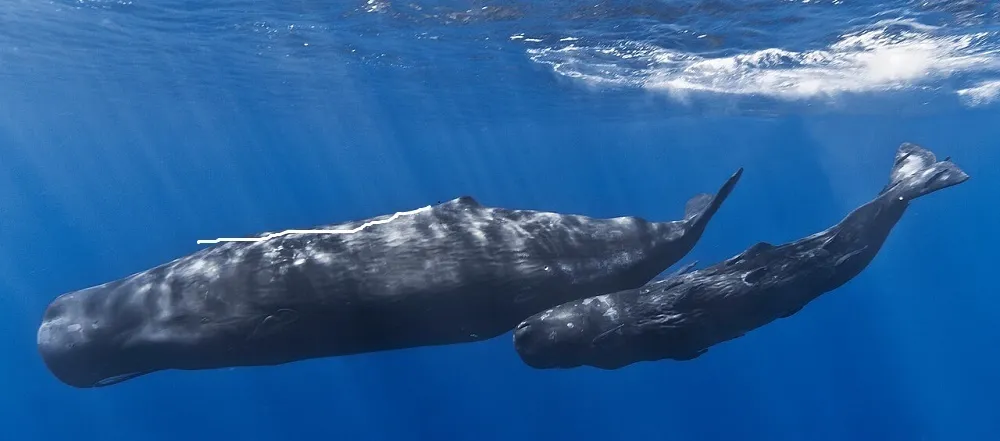
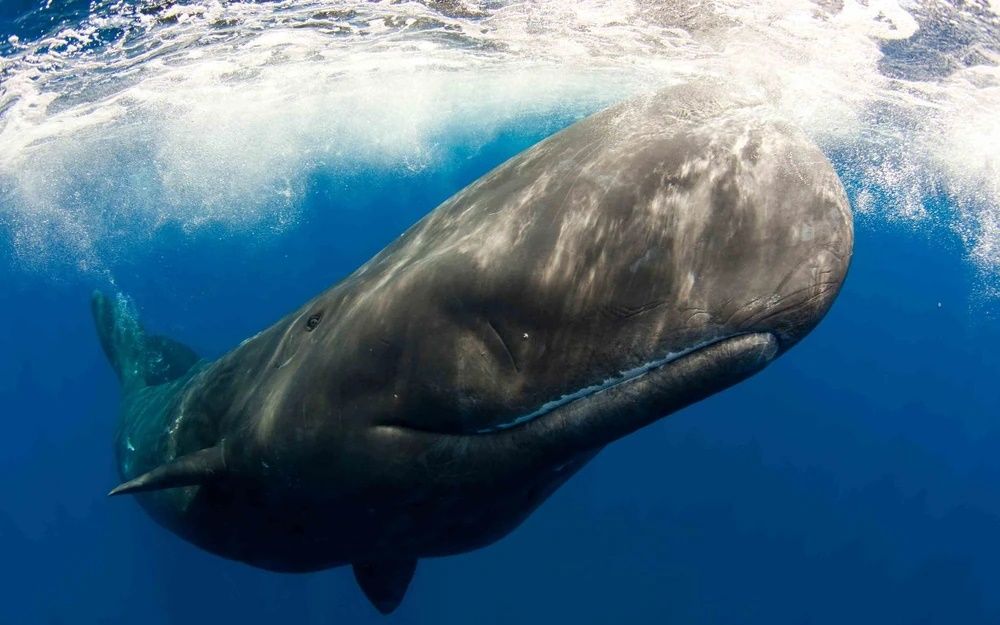
The sperm whale is the largest member of the toothed whales, or, as they are also called, the dolphin-like whales. Males of this species can reach a length of 20 meters and weigh more than 50 tons. Females of this species are significantly smaller—their length usually does not exceed 13 meters. This giant needs a language, if only because it lives in pods; typically, groups of hundreds to thousands of individuals stay together, helping one another hunt, defend against predatory killer whales, and solve other urgent problems. The sperm whale is also the animal world’s record-holder for diving depth; in search of prey, it can dive to 2,000 meters, holding its breath for as long as an hour and a half.
Scientists have discovered that sperm whales’ communication is based on their ability to “click” by forcing air through their nasal passages, which causes structures in their heads to vibrate. This sound reflects off the frontal bone and is focused through the spermaceti organ, emerging “into the ether” as a loud click. The animal can vary the tempo, rhythm, and duration of the clicks, creating a “phonetic alphabet,” much like how humans use vowels and consonants. Thanks to computer technology, scientists have managed to partially decipher this “alphabet” and even compare it with human languages. And they have discovered some similarities between whale language and human languages such as Chinese, Latin, and Slovenian. Of course, this is not about the formal sound of these languages, since the clicks of sperm whales sound more like Morse code than human speech. What is meant here are the patterns of using vowel sounds to express concepts. Moreover, these whales have been found to use intonation—that is, rising or falling tones, just like humans who affirm, deny, or demand something by changing the intonation of their words.
But some of the sperm whales’ sounds have already been deciphered. It has been determined that the most important part of their communication is identification. Who you are and where you’re from—that’s what matters to this community. Sperm whales also have specific codes for identifying themselves, so that those around them know exactly who is “speaking.” Since these whales live in large pods, each one develops its own “dialect” or “accent,” so a sperm whale can tell from a great distance who is “one of us” and who is “a stranger.” Another group of signals relates to coordinated actions, such as hunting. Diving to great depths, where near-total darkness reigns, only through synchronized, coordinated actions can these determined hunters achieve their goal. Their favorite prey is giant squid, which they must track down, catch up to, and defeat in battle. Thus, the language of these animals includes sounds for coordinating direction of movement, signaling the start of an ascent to the surface to breathe, and so on. Third in prevalence are utterances related to family relationships and raising young. Mothers and “nannies” (other females who help look after the young) constantly communicate with their charges. The young, in turn, cannot speak at first and make indistinct sounds that seem to have no meaning. Learning progresses slowly. By the age of two, the animal has already mastered the language of its relatives. However, the calf learns to utter a cry like “Mom, I’m here” much earlier.
Of course, sperm whales have alarm calls to warn others of orca attacks, emotional cries, and certain as-yet-ununderstood vocalizations that may be of a more abstract nature. It is even possible that they are capable of communicating with one another on topics less practical than those of other animals. However, humans are not yet able to communicate with sperm whales. According to scientists’ estimates, it will take at least another five years to partially decipher the basic concepts of sperm whale language. But whether we will be able to convey any information to one another after that remains unknown.

Comments
Some more relevant news for now