




















Francis Halzen's Neutrino Revolution: The 2026 Nobel Prize in Physics and the Ukrainian-Kharkiv Footprint in the Study of the Universe
Life | 07 October, 2026 at 17:02 | 258 | Author: Olena Zelenina
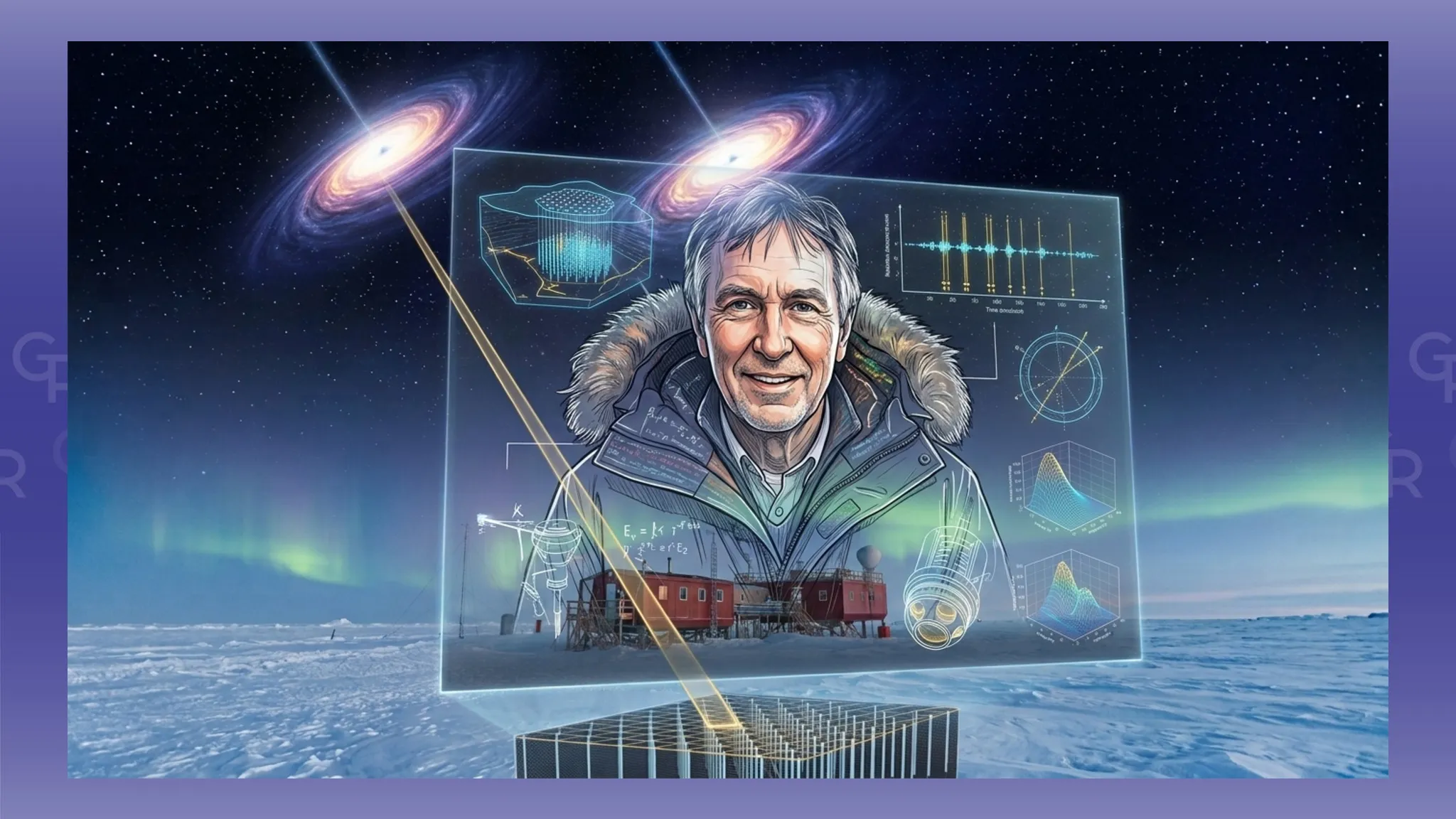
Illustration: Gemini AI, based on a custom prompt.
The Ghost Hunter of Antarctica: How Francis Halzen Turned Southern Ice into a Telescope?
Imagine a particle so elusive that billions of these "ghosts" pass right through your pinky finger every second without leaving a trace. They fly through planets, walls, and our own bodies, virtually without interacting with matter. These are neutrinos.
For decades, astronomers dreamed of capturing these particles. After all, while light is blocked by cosmic dust and charged particles are deflected by magnetic fields, neutrinos speed through the Universe along a perfectly straight line, preserving precise information about the location and catastrophic events of their origin.
The Royal Swedish Academy of Sciences awarded the 2026 Nobel Prize in Physics to Belgian-American physicist Francis Halzen of the University of Wisconsin–Madison.
The formulation of the Nobel Committee sounds inspiring: "For decisive contributions to the IceCube Neutrino Observatory and the discovery of high-energy neutrinos of astrophysical origin".
The Ukrainian Dimension: From IceCube Open Data to Particle Theory in Kharkiv
The creation of the neutrino observatory at the South Pole is a victory of international science, into which the work of Ukrainian researchers is organically integrated. Although the detector itself is located deep within the Antarctic ice, the processing of its data and the theoretical interpretation of the results reach far beyond the continent.
The Ukrainian astrophysical school is actively involved in working with open data from the IceCube Observatory. Scientists from the Bogolyubov Institute for Theoretical Physics of the National Academy of Sciences of Ukraine (Kyiv) and the Kyiv Academic University study high-energy neutrino signals from distant Seyfert galaxies and local sources in the Milky Way. In addition, domestic specialists participate in global programs of multimessenger astronomy, cross-referencing IceCube neutrino "bursts" with data from cosmic gamma-ray telescopes.
If we speak of Kharkiv, its contribution lies in the realm of fundamental theory. The Kharkiv physics school serves as an important link in neutrino research.
NSC "Kharkiv Institute of Physics and Technology" (Akhiezer Institute for Theoretical Physics): Kharkiv theorists develop mathematical models of lepton interaction with nuclear matter and physics beyond the Standard Model. It is precisely such calculations that allow for a more accurate interpretation of the rare neutrino collision events recorded by IceCube sensors.
V. N. Karazin Kharkiv National University: Physicists and alumni of Karazin University participate in international collaborations studying high-energy physics, developing theoretical tools to explore the fundamental properties of particles.
Thanks to the combination of Francis Halzen's Antarctic experiments and the fundamental work of theorists around the world — including in Ukraine — humanity is gradually learning to read the neutrino map of the Universe.
Read more in the Ukrainian edition....

Comments
Some more relevant news for now