


















Odyssey of Kharkiv's "Big Science": the City's Unique Laboratories Captivated the Heart of a French Photographer
Life | | 2,340 | Author: Olena Zelenina
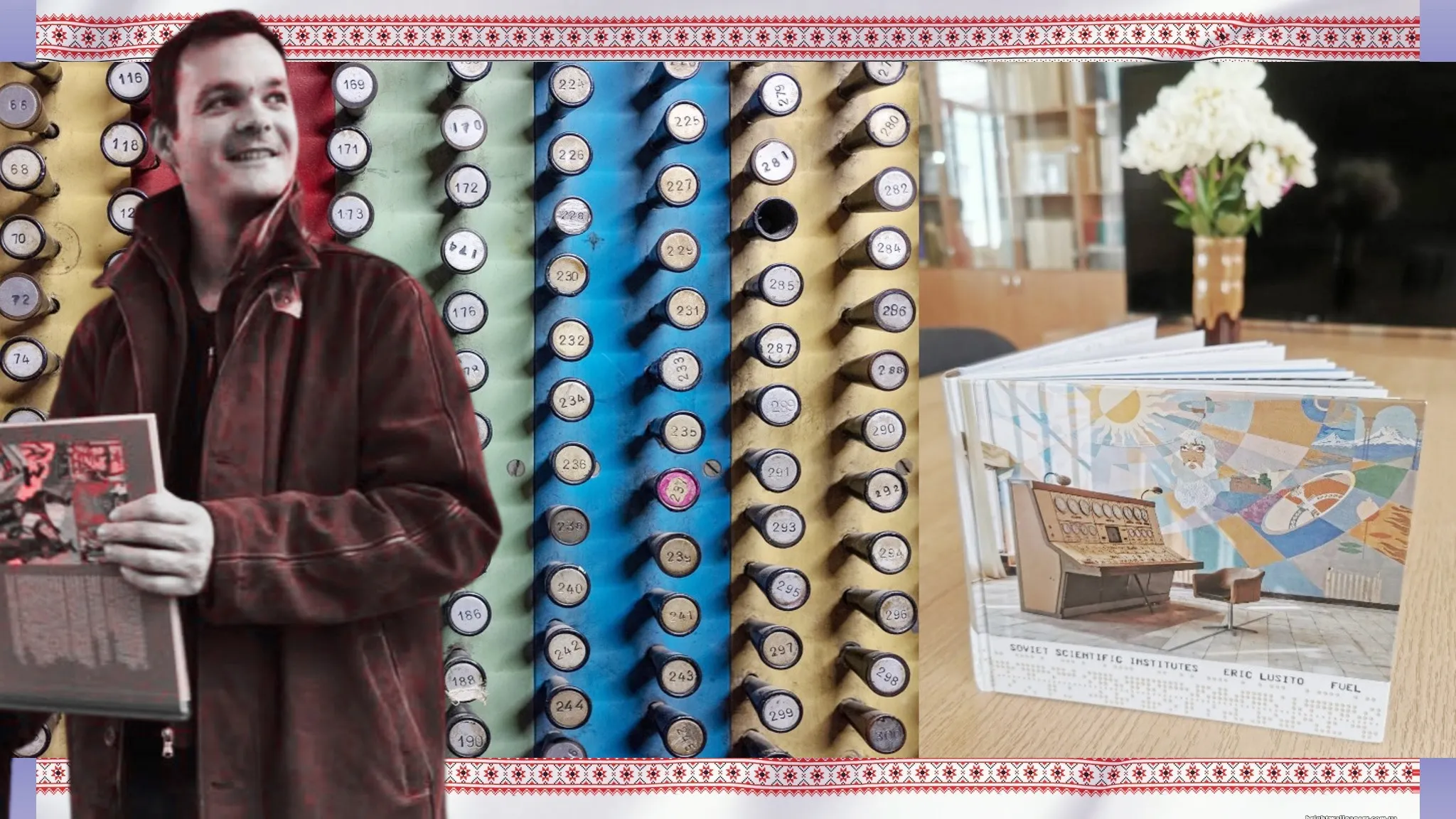
Collage by Olena Zelenina.
When you pick up this book, your fingers feel the unusual texture of the cover. This is not Braille — it is embossing in the form of an old punched tape that once launched the first Soviet computers. Above it is a photograph resembling either the control panel of a bizarre spaceship or a gigantic mechanical piano, where instead of keys, there are hundreds of multi-colored toggle switches, signal lamps, and round dials.
This is how readers are greeted by the monograph "Soviet Scientific Institutes" by the famous French photographer and architectural researcher Éric Lusito, which has just been published by the British publishing house FUEL Publishing. Recently, the author personally visited Kharkiv, coming to the walls of the indomitable Korolenkivka — the Kharkiv State Scientific Library named after V. G. Korolenko. Éric met with the library director Nataliia Petrenko and presented his unique tome as a gift to the city. A city that became the main heart, ideological core, and true visual discovery of this international publication.
Kharkiv Scale: 10 out of 22
For four years, Éric Lusito carried out a quiet but monumental expedition through the former Soviet bloc. He was looking for traces of "big science" — those closed, shrouded in secrecy and military mysteries "utopian worlds" where the scientific might of a superpower was once forged. The photographer's route lay through Armenia, Uzbekistan, Kazakhstan, Georgia, Latvia, Romania, and Hungary.
But the most important, deepest stop on this map was Ukraine. And in Ukraine — Kharkiv.
In total, the book includes 22 scientific institutes from eight countries of the world. Exactly half of them — 10 leading institutions — are Kharkiv scientific centers. This figure is not just a statistic. It is the recognition of Kharkiv as a world metropolis of science, a city of powerful research schools where technologies that outstripped time were created, captured through the lens of a foreign artist.
The focus of the French master captured the legendary centers of high technologies:
· National Science Center "Kharkiv Institute of Physics and Technology" (KIPT) and its Institute of Plasma Physics;
· B. Verkin ILTPE (Institute for Low Temperature Physics and Engineering) with its low-temperature secrets;
· O. Ya. Usikov Institute of Radiophysics and Electronics;
· Institute of Radio Astronomy;
· STC "Institute for Single Crystals" and the Institute for Scintillation Materials;
· Absolutely cosmic objects of the Kharkiv Polytechnic (NTU "KhPI") — the Institute of Ionosphere, the legendary Research and Design Institute "Lightning" ("Molniya"), and the majestic High Voltage Laboratory (High Voltage Testing Hall);
· Radiophysical Observatory of the V. N. Karazin National University.
Between Jules Verne and Kubrick:
The Aesthetics of Scientific Megastructures
Éric Lusito's photographs are devoid of dry documentality. It is pure, deep poetry of iron, concrete, and human stubbornness. Synchrotrons, cyclotrons, stellarators, giant radio telescopes, and cascades of transformers of "Lightning" look in his photos as if they came straight from the pages of science fiction novels by Herbert Wells or Jules Verne.
Western reviewers are already comparing these interiors to the sets of Stanley Kubrick's films. Imagine it: rusty lines of entangled metal structures against the background of harsh landscapes resembling art objects of contemporary land art. And inside — an amazing cosmos: red, yellow, blue, and green pipes, retro-telephones, faded Soviet posters, and portraits of the founding fathers like Igor Kurchatov.
But the main thing is — this world is not dead. Time here seems compressed and folded. Under these gigantic panels, in the halls that survived the catastrophic lack of funding in the 90s (when prominent scientists received 5 dollars a month but did not abandon their control panels), life is still buzzing. Among the monumental metal, where sometimes a lonely dog wanders or accidental cattle grazes, walk living, real "Professors Calculus" — Kharkiv scientists who dedicated their lives to saving their institutions.
The Spirit of Science Under Shellfire
The presentation of the book at the Korolenko Library gathered more than 100 people: academicians, young researchers, representatives of KhPI, Karazin University, KNURE, the planetarium, and the city community. It was a warm, touching meeting of colleagues and like-minded people. At it, they spoke not about the past. They spoke about the present.
After all, the ideological core of the book, as Éric Lusito himself emphasized, became precisely the current activity of Kharkiv scientists in the conditions of a full-scale war. These laboratories today suffer from strikes, damage from arrivals, and suffer from power outages. Some objects sustained heavy wounds from Russian missiles. But science in Kharkiv continues "to be made." It pulses in the debris of history, proving an incredible level of resilience.
Éric Lusito did not just document this feat — he converted his admiration into real support. In the book itself, the author placed links to charitable funds helping Ukrainians. Moreover, a grand tour awaits the publication ahead: Éric plans a series of presentations in key European cities. His photographs will become a powerful cultural and scientific ambassador of Kharkiv in the West, reminding the world of the superhuman price that stands behind every Ukrainian discovery today.
Kharkiv science is cool. It has deep roots, unique visual majesty, and a reinforced concrete character that cannot be broken by any shellfire.
More illustrations in the Ukrainian original.

Comments
Some more relevant news for now