













An Island of Lifelong Respect: The Phenomenon of the People’s Ukrainian Academy
Life | | 2,650 | Author: By Olena Zelenina
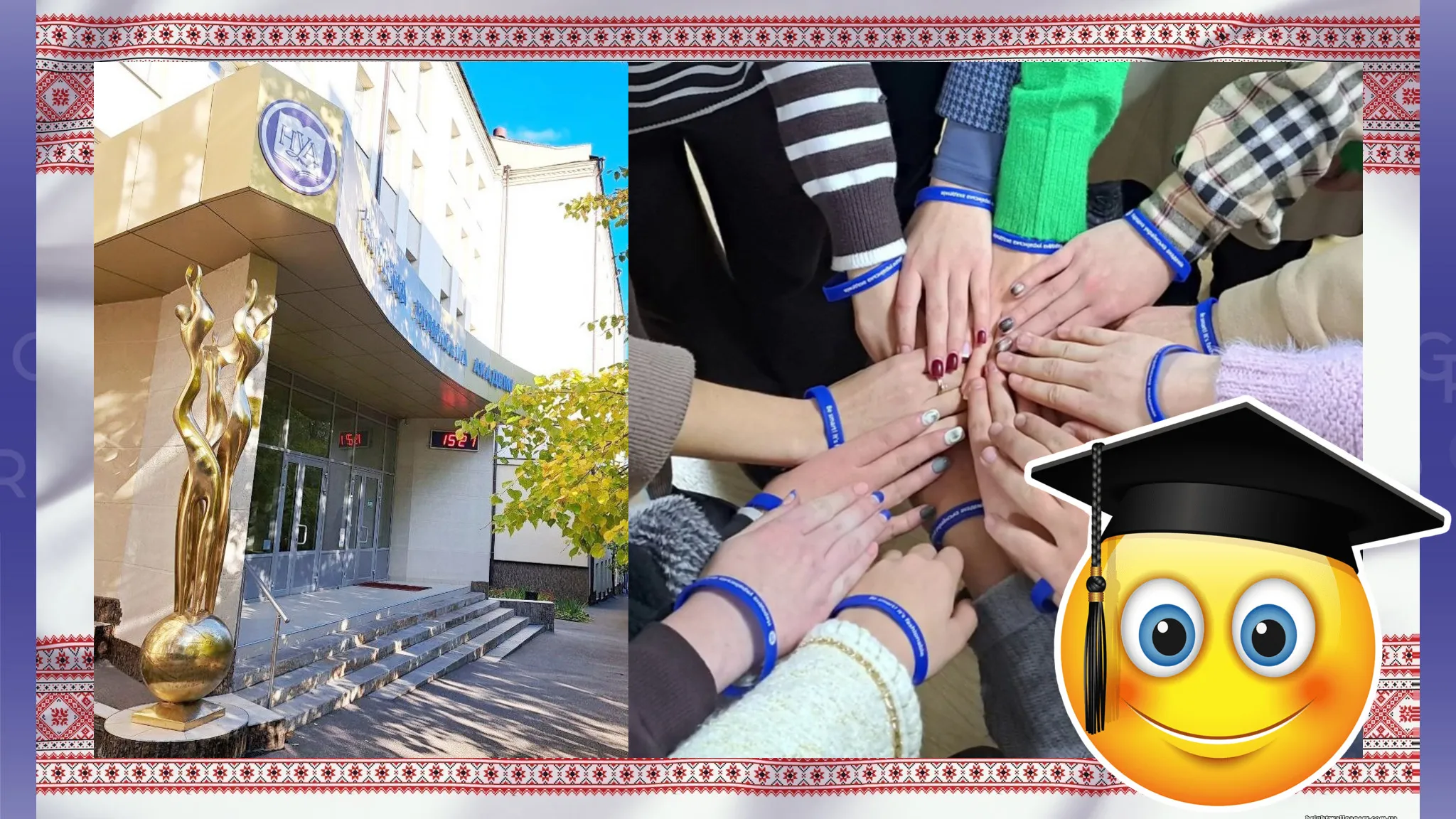
Collage by Olena Zelenina.
Did you know that at the Kharkiv Humanitarian University "People’s Ukrainian Academy," graduation is celebrated four times during a single academic year? For most traditional higher education institutions, graduation is a final period, a farewell, and a closed door. But for PUA, it is a vibrant, almost family-like confirmation of a unique philosophy—lifelong education, to which they have remained faithful for three and a half decades.
May 1991. The country stood on the brink of colossal tectonic shifts. It was then, just a few months before Ukraine’s declaration of independence, that the decision to establish the Academy was signed. Thus began the countdown of days, months, and years for an educational experiment that was incredibly bold for its time. In the beginning, every year felt like a miracle. The sheer audacity of the concept was striking: the simultaneous opening of a private lyceum (which was the first to begin classes), a higher education school, and a Children's Sunday School, which later evolved into the Children’s School of Early Development, well-known to many Kharkiv residents.
Over time, the countdown of achievements shifted to decades. And today, in May 2026, the Academy celebrates its 35th anniversary. It is an age when the first toddlers who once learned to piece together their very first words here are already bringing their own children to PUA.
Four Chords of a Single Marathon
Since education at the Academy begins in early childhood, its annual graduation marathon is a distinct form of art. The marathon is opened by the most heartwarming graduates—the little ones from the Children’s School of Early Development (where children aged 1.5 to 6 are nurtured using specialized, author-designed programs). Next, the baton is passed to the ambitious Master’s students. A bit later, the community bids farewell to the eleventh-graders of the private lyceum, which specializes in advanced foreign language studies. The final chord is struck with the graduation of the Humanitarian University’s Bachelor’s students.
Add to this the Center for Additional Education, which provides adult learning and postgraduate training, and you get a complete circle of continuous learning. These are four steps that guide a person upward without ever severing their connection to their Alma Mater.
The Mission of PUA is to shape a modern, intelligent individual capable of achieving life success through intellect, a universal understanding of professionalism, general culture, and humanistic values amid constant social shifts.
The Academy’s motto remains unchanged: “Education. Intelligence. Culture.”
Behind these words stands a unique educational module, the likes of which no one else has managed to create in Kharkiv—a city with deeply rooted academic traditions.
"Our Own Island" and Its Faces
Analyzing the path traveled, the Rector of the Academy, Doctor of Historical Sciences, Professor Kateryna Astakhova, notes that over these years, the team has succeeded in becoming an organic, inseparable part of the broader Kharkiv educational ecosystem. At the same time, PUA has built "its own island"—a space distinct from other educational structures. Not better, not worse—just fundamentally different.
This island possesses its own symbolism and traditions. A chapel has been built here, the "Flame of Knowledge" monument has been erected, and major publishing projects come to life here. These include collections of essays such as "Teacher, Before Your Name...", "Essays on the Rectors of Kharkiv Higher Education Institutions," and a unique six-volume collection of previously unpublished heritage by the prominent historian Dmytro Bahaliy. Every year, the Academy hosts a profound, institution-wide genealogical contest titled "The History of My Family," helping the youth reconnect with their roots.
A special point of pride is student self-governance. The PUA Student Union, established in 1997, became the first self-governing student organization in Kharkiv during the era of independent Ukraine. Its leaders once competed for the titles of "Student Mayor of Kharkiv," and in 2006, the Academy’s student committee won a prestigious award from the Cabinet of Ministers of Ukraine. Helping orphanages, volunteering as counselors in summer camps, the Political Club, the "Comilfo" club, the "Lik" Literary Club, the English and Euro Clubs—all of this has shaped generations of city leaders.
This April marked the 30th anniversary of the Student Union, which remains a driving force for many civic initiatives today.
This drive for leadership extends far beyond student committees—it translates into serious scientific achievement and seamless integration into the European and global educational space. A prime example of this is the recent triumph of third-year Business Management students, Daryna Norik and Andrii Kovshov. They secured 3rd place in the International Contest of Student Scientific Works held under the auspices of the Black Sea Universities Network—a prestigious association linking 110 higher education institutions across 12 countries in the Black Sea region.
Their research paper, titled "Justifying Adaptation Strategies for Logistics Systems of Ukrainian Companies in Wartime" (supervised by Associate Professor O. V. Prokopishyna, PhD in Economics), triumphed in the "Economics and Management" section, which featured 97 entries from both Ukrainian and international universities this year. In the finals, Andrii Kovshov brilliantly defended the study in English, field-testing his high-level training by answering six complex questions from the international jury and raising critical transport infrastructure issues shared by both the Kharkiv region and the broader Black Sea area.
Furthermore, the presentation designed by Daryna Norik in a striking black-and-white retro style—an aesthetic the PUA student team had previously tested during the "Underground Tech" hackathon in October—stood out spectacularly among the 26 finalist projects. This is precisely the caliber of preparation that allows PUA students to hold their own on the global stage.
The Test of War: When Values Save Walls
Perhaps the true success of any long-term project is measured by its resilience and its capacity to preserve and transmit values under any circumstances. For PUA, the core guiding category has always been respect—respect for the individual, for knowledge, for family, for one's native city, and for the country.
PUA has always been deeply attuned to the city's atmosphere. It was the Academy that once initiated the famous outdoor festival "Books and Coffee" right on Lermontovska Street (which today symbolically bears the name of the prominent Ukrainian writer of the Executed Renaissance, Maik Yohansen). In 2020 and 2021, this festival brought thousands of Kharkiv residents together around literature, music, and live communication, proving that an academy can be more than just lecture halls—it can serve as an open cultural hub for a great metropolis.
These bonds and values faced their harshest test during the full-scale war. When a Russian missile strike severely damaged the Academy's building in 2022, restoring the complex seemed an unimaginably daunting task. Yet, that very "island" corporate spirit prevailed. Thanks to the tremendous solidarity, mobilization, and financial support of alumni from various generations, the battered campus was not simply rebuilt—it was made better and more modern than it was before the strike.
On the eve of the 35th anniversary, the Academy opened an exhibition titled "The History of PUA in Faces" and published a photo album called "Faces of Time." This is not merely a tribute to the jubilee; it reflects a deep understanding that any complex institution rests entirely on its people—on the professionalism, attitude, and level of responsibility of every teacher, employee, lyceum pupil, and student.
Today, the Museum of PUA History carefully preserves the past, while the library shelves are enriched with monographs analyzing this unique and country-exclusive experience of lifelong education. But does the Academy, carrying such a substantial legacy, still know how to dream?
Looking back at the experience of the recent, incredibly difficult war years, one can confidently say: yes. PUA has not only stood its ground; it is planning for the future. On the eve of the new academic year, the community dreams of what every Ukrainian dreams of: a just peace on our land, the complete reconstruction of a wounded but unyielding Kharkiv, and the return of faculty and students scattered across the globe to their native classrooms.
The main task of this great team remains exactly what it was 35 years ago—not merely in words, but through the daily, tangible practice of respect: to help a person find themselves, understand their own identity, prepare for the encounter with a vast world, stand firm against its winds, and ultimately—discover how to be happy.

Comments
Some more relevant news for now