


























Sensation in Micro-World Physics: How New Exotic Particles Were Discovered
Life | | 1,773 | Author: Olena Zelenina
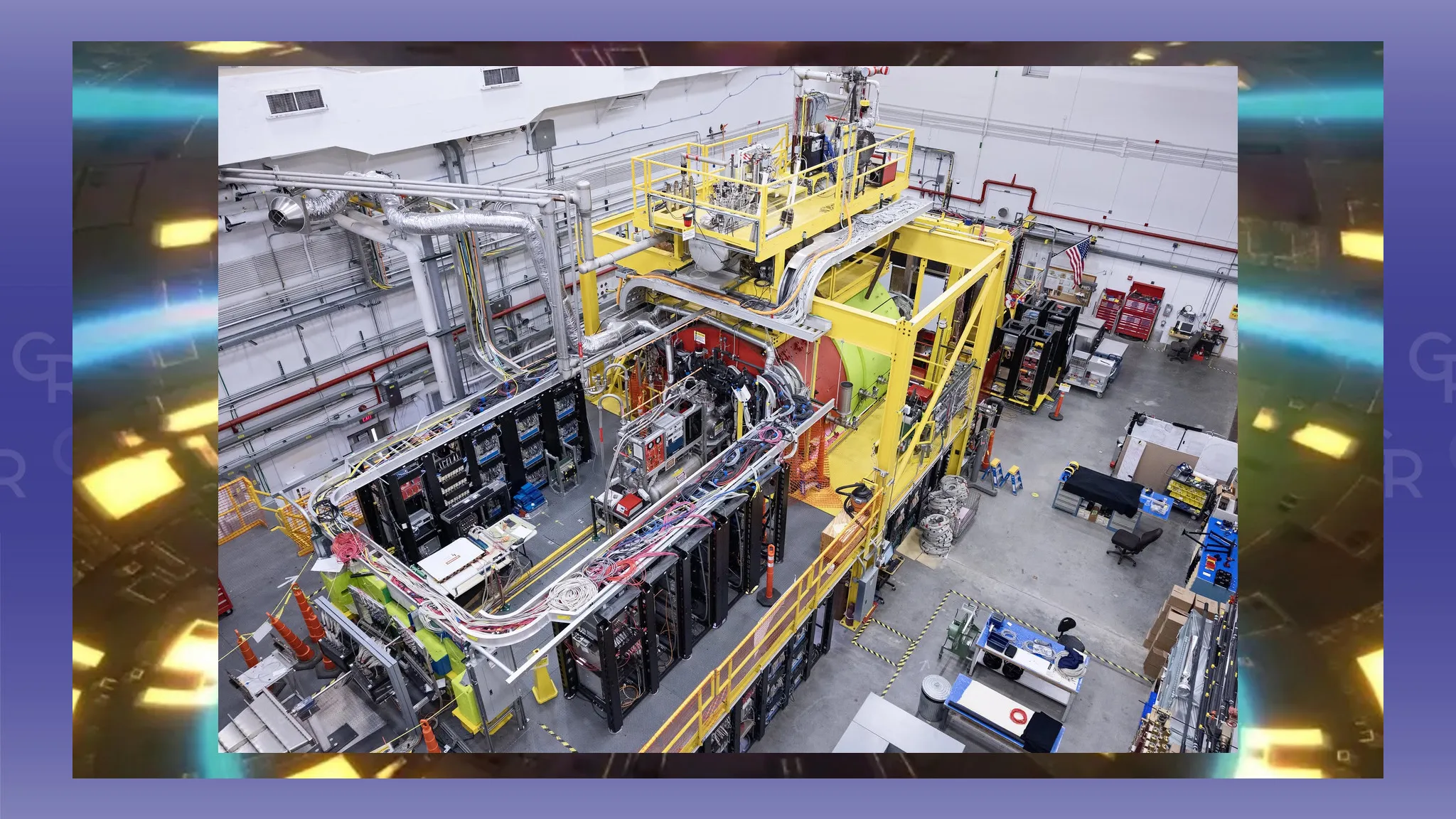
Photo by Jeffersonian Lab/Eileen Devlin). Collage by Olena Zelenina.
An international team of scientists from the GlueX research program has announced a fundamental discovery: during experiments on the powerful CEBAF accelerator at the Thomas Jefferson National Accelerator Facility (Virginia, USA), two new exotic particles were recorded — Y(2240) and X(1830).
These structures do not fit into the usual quantum picture of the world and open a new page in understanding the structure of matter.
How Was the Experiment Conducted?
Inside the accelerator, scientists directed a powerful beam of electrons onto a thin diamond wafer. This allowed them to convert them into a stream of high-energy photons (particles of light). When this photon beam collided with liquid hydrogen protons, the instruments recorded the emergence of structures unknown to science.
Interestingly, the discovery came as a surprise to the physicists themselves. They were looking for a completely different hypothetical object, Y(2175), but stumbled upon new states of matter instead. For the first particle, Y(2240), scientists have already obtained the so-called "gold standard" of confirmation (5 sigma), which corresponds to a result purity and reliability of 99.9994%.
At the Thomas Jefferson National Accelerator Facility, this result was commented on as follows:
"We don’t always find what we expect when we look inside matter. Set out to find one exotic particle candidate, we found evidence of two unexpected structures instead. This findings could offer new clues about exotic particles and help us better understand the role gluons — carriers of the strong nuclear force — play in the formation of matter."
What Makes the Finding Unique, and What Does "Glue" Have to Do With It? In the ordinary world, protons and neutrons consist of three quarks, and most known mesons consist of a "quark + antiquark" pair.
The newly discovered particles are arranged much more complexly. In addition to quarks, gluons (from the English word glue) play a key role in them. These are fundamental particles that usually act as a passive "binding material" and hold atomic nuclei together through the strong nuclear force.
Excited gluon fields operate within the discovered particles. Physicists assume that gluons here do not act merely as "glue," but actively participate in forming a new, hybrid form of matter.
Kharkiv Context: The School Exploring the Subatomic World Global fundamental research at the Jefferson Lab has a long and strong connection with the Kharkiv school of nuclear physics. Scientists from the National Science Center "Kharkiv Institute of Physics and Technology" (NSC KIPT) have a multi-year history of direct scientific cooperation with Jefferson Lab, participating in research on photonuclear reactions, the development of concepts for polarized targets, and experimental systems.
Today, alumni and researchers of the Kharkiv physics school work both inside Ukraine and as part of international research groups around the world (particularly in the USA and CERN), making their contribution to unraveling the secrets of fundamental matter.
What Does This Change for Science?
Theorists are already analyzing a massive array of GlueX experimental data to understand whether the modern Standard Model of physics can explain these phenomena, or if science will have to revise basic theories.
Researchers compare the current moment to the scientific boom of the mid-20th century, when physicists discovered new elements of the micro-world one after another. Science is effectively entering a new era of studying a whole "zoo" of exotic states of matter that will help unlock the secrets of how the Universe formed in the first microseconds after the Big Bang.
What Does This Discovery Change for Us?
Fundamental discoveries in high-energy physics do not yield immediate everyday benefits on the day of discovery. They enrich our understanding of the nature of the Universe while simultaneously creating a foundation for future technologies.
Recording these particles requires extreme conditions (diamond targets, ultrasensitive scintillation detectors, high-speed electronics). Technologies created for particle physics eventually transition into:
- Medicine: Radiation cancer therapy (proton and ion therapy), more precise PET/CT scanners.
- Materials Science: Creation of ultra-high-strength or heat-resistant materials.
- IT and Data Analysis: Algorithms for processing massive datasets (Big Data) developed for GlueX find applications in the civilian sector.

Comments
Some more relevant news for now