

























The Shadow of “Dau” in Venice: How Russian Money and Kharkiv Sets Stirred World Cinema Once Again
Life | | 1,931 | Author: Olena Zeleninа

Collage by Olena Zelenina.
The international film community is shaking once again from a high-profile scandal surrounding the 83rd Venice Film Festival. The official demarche by the Ministry of Foreign Affairs and the Ministry of Culture of Ukraine was triggered by the inclusion of the latest offspring of the controversial project "Dau" by Russian director Ilya Khrzhanovsky in the festival program.
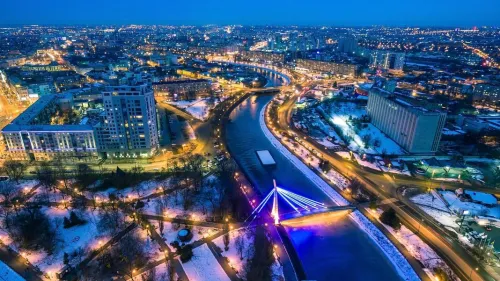
What adds particular cynicism to this story is that this large-scale totalitarian experiment was filmed for years in Kharkiv — a city that Russians are today deliberately erasing with aerial bombs and missiles.
Personal Memory:
A Secret Under Non-Disclosure
For me, this story is not just a dry news item. A good acquaintance of mine, a retired Kharkiv scientist, took a direct part in the filming at the time. Possessing a refined, intelligent appearance and a characteristic pointed beard, he fitted the typecasting perfectly and played... himself — a Kharkiv scientist (only from the 1930s).
Immediately after the shooting was completed, I approached him with a request for a extensive interview from behind the scenes of this mysterious cinematic machine. However, I received a firm refusal: all extras and actors had signed a strict non-disclosure agreement until the moment the film was released for general distribution.
The movie never appeared in Ukrainian distribution. The world premiere of this art giant erupted only years later — in Paris and at the Berlinale (a screening in London was canceled altogether by local authorities over ethical concerns). And only then, when the veil of secrecy fell, a wave of shocking accusations against the director washed over the global cultural space.
Ethical Hell:
What Was Hidden Behind Non-Disclosures?
It turned out that under the guise of "historical arthouse about Soviet totalitarianism," Khrzhanovsky had built a genuine psychological hell in Kharkiv. In the Western and Ukrainian press, the project was instantly dubbed a "totalitarian Truman Show" and "abusive cultism."
"Gromada" BACKGROUND NOTE
The Truman Show is a iconic 1998 American dystopian film starring Jim Carrey, which became a global metaphor for living under total control and covert surveillance.
In film criticism and the media, this comparison is used in a negative, sinister context.
To film "Dau," an isolated "Institute" was built in Kharkiv, where participants lived according to the laws of the 1930s–1950s USSR, wore Soviet underwear, used money from that era, and were subjected to searches.
People were filmed 24/7 by hidden cameras, and director Ilya Khrzhanovsky, like the producer in The Truman Show, simulated stressful, abusive, and dangerous situations for them, manipulating their real emotions.
The main difference is only that the characters of "Dau" were voluntarily and involuntarily plunged into a psychological experiment where the director acted as an almighty and unchecked demiurge.
The freshest and loudest wave of outrage erupted over the involvement of children from a Kharkiv orphanage in the filming. The director was accused of abusing orphans for the sake of "naturalism" in autopsies and medical experiments on camera, which led to the opening of criminal proceedings in Ukraine.
"Gromada" BACKGROUND NOTE
Following the public release of the films Dau. Natasha and Dau. Degeneration, the Commissioner of the President of Ukraine for Children's Rights, Mykola Kuleba, appealed to the police. The
Prosecutor's Office of Kharkiv Region opened criminal proceedings under articles on torture (Part 2 of Article 127 of the Criminal Code) and the manufacture or distribution of works promoting a cult of violence and cruelty (Part 3 of Article 300 of the Criminal Code of Ukraine). This concerned the involvement of infants from a Kharkiv orphanage in the filming, on whom medical sensors and devices were used on camera, causing them to cry.
Forensic psychological-diagnostic and comprehensive educational-developmental expertises were conducted. Based on the experts' conclusions, the police stated that there was no corpus delicti in the actions of the filmmakers — no physical harm or torture of infants was recorded, and the filming took place with the participation and under the supervision of guardians/educators.
Despite the closure of the legal case in Ukraine, the ethical debate surrounding the project in the international and Ukrainian film community has not subsided in the slightest: for many critics, the fact of using orphans in dark psychological experiments remained a heavy moral precedent regardless of purely procedural police decisions.
Western critics and participants themselves also directly accused the creators of using unsimulated porn, real fights involving far-right radicals, and psychological terror against people who were kept in isolation for weeks.
Khrzhanovsky effectively created a closed psychological cult funded by Russian oligarchs, where he experimented with human dignity with impunity.
Why Is "Dau" Surfacing Again
if Filming Ended Long Ago?
"Dau" is not a single film, but a massive archive of over 700 hours of film footage shot in Kharkiv back in the late 2000s.
For years, the creators of the project have been "slicing" new autonomous films out of this outdated archive. Against the backdrop of the isolation of official Russian culture, producers are attempting to push these "editing scraps" onto Western venues under the guise of "independent European arthouse about totalitarianism."
Cultural Blindness or Conscious Cynicism?
Today, a clear geopolitical trail is added to this ethical hell. Ukrainian agencies note that pushing such a product into European festivals during a bloody war is an open manual for laundering bloody capital.
Sanctioned Million-Dollar Cash: The 25-million-euro project was financed by Russian businessman Sergei Adoniev, who is under heavy US and Ukrainian sanctions.
VTB in the Shadow of the Conductor's Stand: A key participant in the film, conductor Teodor Currentzis, and his orchestra MusicAeterna sit on direct payrolls from the sanctioned Russian bank VTB.
Official Kyiv emphasizes that this is not about censorship, but about refusing "cultural blindness."
At a time when Kharkiv is fighting for its right to survive under Russian bombs, using its past sets to launder bloody Russian capital in Venice is a textbook example of how Russian "soft power" tries to sneak onto the international stage through the back door of European arthouse.

Comments
Some more relevant news for now