


If You Want to Win the Nobel Prize in Chemistry, Speak at the Kharkiv Chemical Seminar First
Life | | 1,447 | Author: By Olena Stakhova
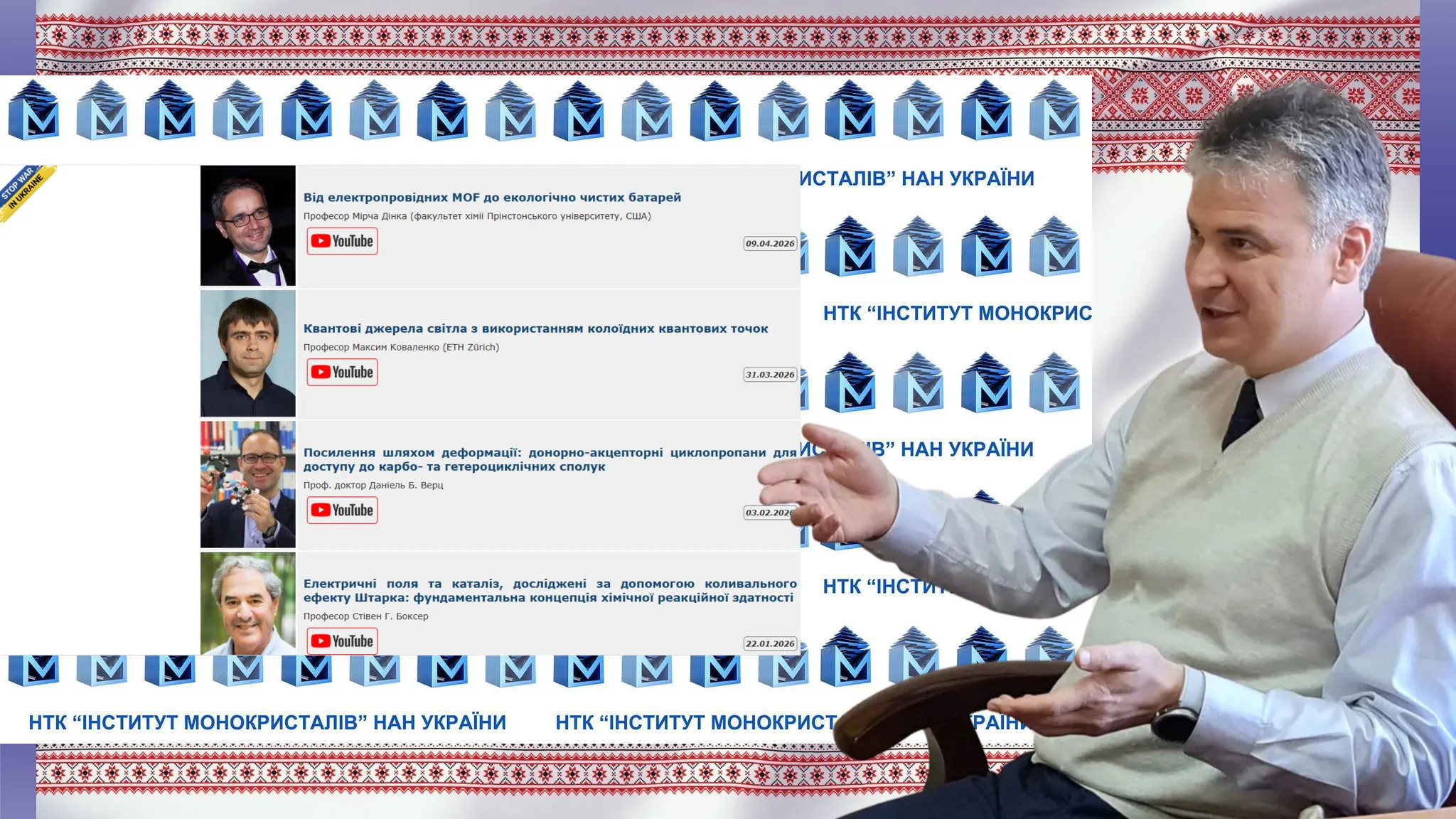
Collage by Olena Zelenina.
While global thought leaders debate the future of technology, Kharkiv — a city living under the sound of sirens but never losing its scientific drive — has created a true "forge" for Nobel laureates. The Kharkiv Chemical Seminar project has received national recognition, winning the National Academy of Sciences of Ukraine (NASU) award "For the Popularization of Science."
A Magnet for the Elite
and Chemistry's "Major League"
The Presidium of the NASU has approved the Committee's decision: Kharkiv scientists won in the category of "Best Science-Education Project of the Year." The project's authors and managers — Academician Valentin Chebanov (First Deputy Director General for Research at the "Institute for Single Crystals," NASU), Larysa Serostanova, and Marharyta Cherniakova — have successfully transformed a local initiative into a global scientific hub.
The Kharkiv Chemical Seminar is more than just a series of lectures. It is a space where students from Karazin University or PhD candidates from "KhPI" can engage in direct dialogue with the people currently writing the textbooks of chemistry. The wartime transition to an online format has not weakened the community; instead, it has expanded its borders. Today, it is a unique ecosystem governed by logic and the belief that Ukrainian science is an integral part of global progress.
Kharkiv’s Nobel "Prophecy"
A joke has emerged among scientists: if you want a Nobel Prize, speak in Kharkiv first. These are not empty words.
A prime example is the 2025 Nobel Prize in Chemistry, awarded to Susumu Kitagawa, Richard Robson, and Omar Yaghi for the creation of Metal-Organic Frameworks (MOFs). Remarkably, Omar Yaghi spoke at the Kharkiv Chemical Seminar long before his triumph in Stockholm. Back then, he described seemingly fantastic things: how MOFs could extract water even from the driest desert air.
Ukraine began actively working on metal-organic frameworks several years ago. Today, it has become a mainstream topic for us,
emphasizes Academician Valentin Chebanov.
Currently, Ukrainian specialists are working to integrate domestic developments into global practice. This includes using MOFs in energy-efficient air conditioning systems and scaling their production for industrial use.
From Energy to "Smart" Patches
The seminar's scope is breathtaking, covering everything from industrial reactors to the future of medicine. For instance, Nobel laureate Jean-Marie Lehn (University of Strasbourg) presented ideas in Kharkiv regarding adaptive materials for organ treatment.
Imagine:
Supramolecular systems: that the human body does not reject.
Innovative patches: that close surgical incisions without a single stitch.
Targeted drug delivery: to specific cells within the body.
Ukraine on the Map of Innovation
The President of the NASU, Academician Anatolii Zahorodnii, noted that this year’s competition was exceptionally prestigious. The jury included not only scientists but also media authorities like Alla Mazur, Oleh Panyuta, and the science journalist for Gromada, Olena Zelenina (last year's NASU winner for science communication).
The victory of the Kharkiv team among 25 powerful entries confirms that Kharkiv remains an intellectual capital, even under the most difficult conditions. While new global stars prepare their presentations for the Kharkiv Chemical Seminar, Ukrainian science continues to prove: we are not just observers; we are major league players. As the legendary Lev Landau, who once worked in Kharkiv, famously said: "Everything scientific in chemistry is physics; the rest is just cooking."
And in this "scientific kitchen" in Kharkiv, world-scale discoveries are being prepared today.

Comments
Some more relevant news for now