





















Either We Meet a Dinosaur, or We Don't: A 50/50 Peace — From Trump’s Secret Balls to a Rickety Tower in Sarzhyn Yar
Articles | | 2,468 | Author: Olena Zelenina, Olexandr Sydorenko (caricature)
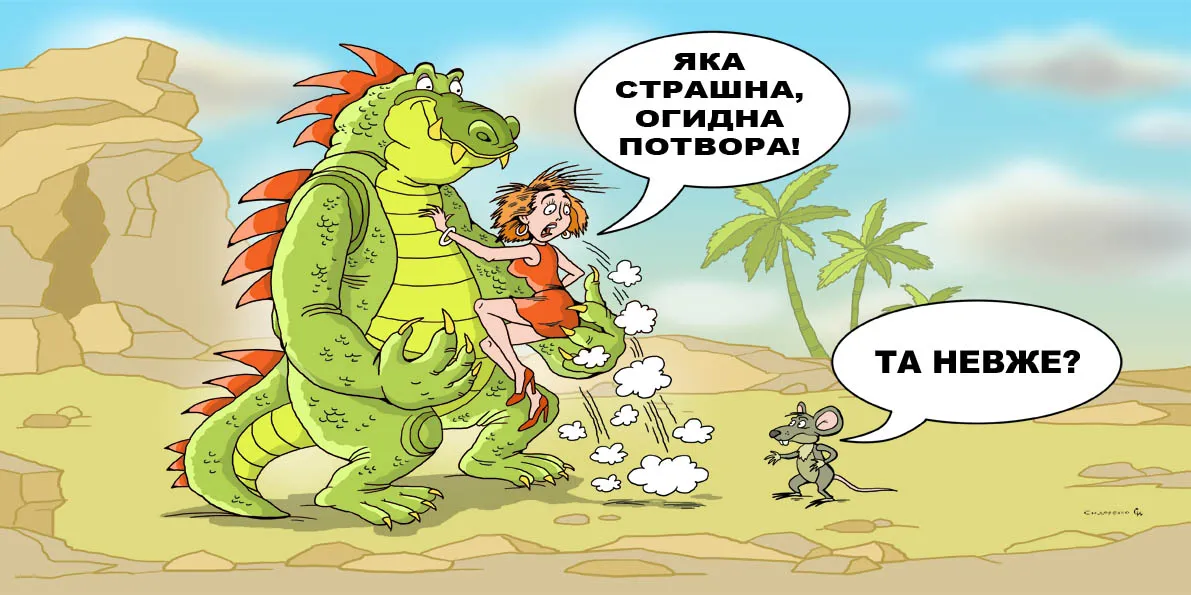
Cartoon by Olexandr Sydorenko.
A blonde is asked: “What is the probability that today, when you walk outside, you’ll meet a living dinosaur?” She replies: “50/50!” Everyone is in shock; mathematicians and scientists clutch their heads: “How is it 50/50?! Where did that number come from?!” The blonde calmly explains: “Well, it’s simple: either I meet one, or I don't.”
Why is this joke so popular? The whole point lies in the comical blending of the number of outcomes with their actual likelihood. From the perspective of formal logic, there are indeed two outcomes, but in real life, the probability of these events is far from equal.
Today's military-analytical rhetoric in the media often boils down to the well-known paradox of "either I meet a dinosaur, or I don't." Behind a multitude of complex terms, insider leaks, and satellite maps, expert forecasts regarding timelines or turning points on the frontlines of the Russo-Ukrainian War frequently hold the same practical value as reading tea leaves.
While analysts debate a 50/50 chance of diplomatic breakthroughs, real life delivers plot lines that make any joke pale in comparison.
A vivid example of how official Washington seeks ways out of behind-the-scenes deadlocks is the story of the "ballroom diplomat," whose secret mission to St. Petersburg was remembered less for negotiations and more for the smoke from a Ukrainian drone.
Key Takeaways from the Media Review
Financial Times. The "Ballroom Diplomat" and Smoke Over the Neva: Rodney Mims Cook Jr., head of the US Commission of Fine Arts overseeing Trump's luxury ballroom project, undertook a covert diplomatic mission to St. Petersburg under the guise of attending an art forum. The mission reached an ironic climax when Cook witnessed a Ukrainian drone strike on a local oil refinery right near the Winter Palace, vividly exposing the reality of war over backstage maneuvers.
The Telegraph — CIA Warning on Escalation: US intelligence assesses that the risk of Putin launching direct or hybrid aggression against NATO (including secret drone base deployment, Baltic pressure, and Syria/Sahel operations) has reached its highest level since the full-scale invasion began.
The Telegraph — The "Wheat War": Russia continues using food as a weapon by targeting Ukrainian ports and dumping stolen grain. Analysts warn that artificial grain shortages threaten severe instability and potential social upheavals in the Middle East and Africa.
Sky News — NATO Airspace Violations: Russian airspace incursions over NATO's eastern flank are deliberate tests of Western resolve, probing whether the Alliance will dare to shoot down targets over its territory or remain passive.
The Guardian — Kharkiv as a Cultural Fortress: Reviewing Charlotte Higgins's Ukrainian Lessons: Art in a Time of War, the piece highlights Kharkiv—from poetry readings in underground bars to a man building a fragile stone tower in Sarzhyn Yar—showing how art transforms into a vital act of endurance and resistance.
Radio France Internationale (RFI) — A War on Words: Russian missile strikes specifically target Ukrainian printing presses and publishers (such as Kharkiv's Factor-Druk) in an attempt to erase Ukrainian identity, yet publishers continue rebuilding and adapting despite the destruction.
Neue Zürcher Zeitung (NZZ) — FIFA’s Autocracy: Gianni Infantino has turned FIFA into an autocratic monarchy by suppressing debate, securing votes through financial hand-outs to poorer federations, and leaving the institution vulnerable to influence from authoritarian regimes—a dynamic that risks enabling the return of Russian sports lobbying.
Read more in the Ukrainian edition....

Comments
Some more relevant news for now