











Kharkiv in the "Artemis Accords": A country that stops looking at the sky will eventually lose its land
Articles | | 2,253 | Author: By Olena Zelenina
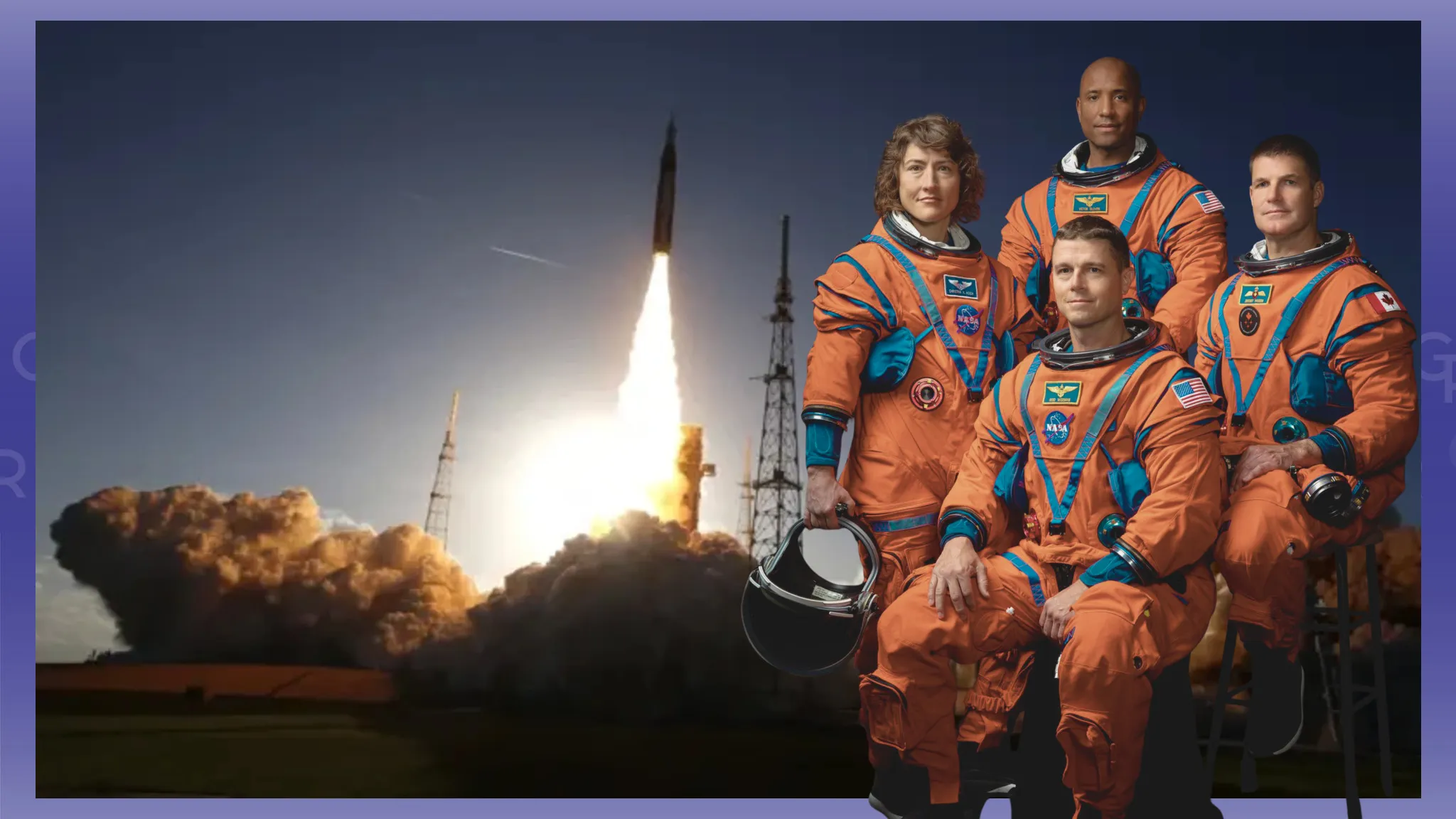
Collage by Olena Zelenina.
The United States has taken a historic step in space exploration: for the first time since 1972, a manned spacecraft has headed to the Moon. The Space Launch System (SLS) rocket, carrying the Orion spacecraft, successfully launched from Cape Canaveral, Florida, ushering in a new era of NASA's Artemis program—a program in which Kharkiv enterprises are active participants.
On board are four astronauts representing international cooperation and new standards of inclusivity in space: Commander Reid Wiseman and his crew—Christina Koch (the first woman to orbit the Moon), Victor Glover (the first person of color), and Jeremy Hansen (the first Canadian astronaut). Launch Director Charlie Blackwell-Thompson sent off the crew with words that they carry with them the "hopes and dreams of a new generation."
This flight is not merely a return to past achievements but a strategic bridgehead for a future journey to Mars. As Commander Wiseman noted, watching the moonrise from orbit: "The view is just beautiful!" The astronauts call this mission a "mission for everyone." "We go for all humanity," declared Jeremy Hansen before the start.
Ukraine and Kharkiv in the Artemis Accords: More Than Politics Few remember, but Ukraine became the ninth signatory country of the Artemis Accords back in 2020. This is not just a declaration of friendship; it is an entry ticket to the global space market. Despite the Great War, we remain in the game.
When you hear about the Gateway station modules or the Blue Ghost lunar lander by Firefly Aerospace, know that there is a share of Ukrainian intellectual labor there. Our engineers develop landing systems and engines within international cooperation. Despite constant shelling, the core structure of the first stage of the Antares launch vehicle and part of the ground equipment were developed by the Yuzhnoye Design Office and manufactured by Yuzhmash (Dnipro) in cooperation with Ukrainian enterprises: Kyivprylad (Kyiv), Hartron-Arkos (Kharkiv), Hartron-Yukom (Zaporizhzhia), Chesara Telemetry, and Rapid (Chernihiv), commissioned by Northrop Grumman (USA).
The preparation, testing, and launch of the Antares LV were carried out with the participation of specialists from Yuzhnoye, Yuzhmash, and Hartron-Arkos. Scientists in Kharkiv continue to study the behavior of metals and superconductors in space—critical knowledge for building future lunar bases.
Between the "Unnecessary" Moon and Ukrainian "Hartron" Yet, fierce debates rage worldwide: is the juice worth the squeeze? According to polls by The New York Times, many Americans would prefer to see these billions spent on climate change or asteroid defense. It is hard to explain a launch cost of $4.1 billion when there are so many problems on Earth.
For Ukraine, participation in Artemis is insurance against technological degradation. When the orientation systems of Kharkiv's Hartron are integrated into global projects, we remain a nation that creates the future. Beyond prestige, NASA Administrator Jared Isaacman points to economic potential: mining Helium-3 on the Moon could become a revolutionary fuel for future fusion reactors on Earth. Control over the resources of the future will determine the sovereignty of states in the 21st century.
The Moon or the Earth? History teaches us: technologies from "unnecessary" space always return to Earth. Water purification, solar energy, and new materials were all born in space labs. For Ukraine, it is also a security issue: dual-use technologies refined in space will tomorrow become the basis for protecting our skies.
A country that stops looking at the sky will eventually lose its land. Even if our contribution today consists of "invisible" algorithms and complex circuit boards from a shelled Kharkiv, they must fly to the Moon.
This material was created within the framework of the project of the Institute of Mass Information with the support of the Ministry of Foreign Affairs of the Netherlands.

Comments
Some more relevant news for now