


















The Molecular Constructor of the Future: How a Center of Advanced Technologies is Being Built in Kharkiv
Articles | | 308 | Author: Olena Zelenina
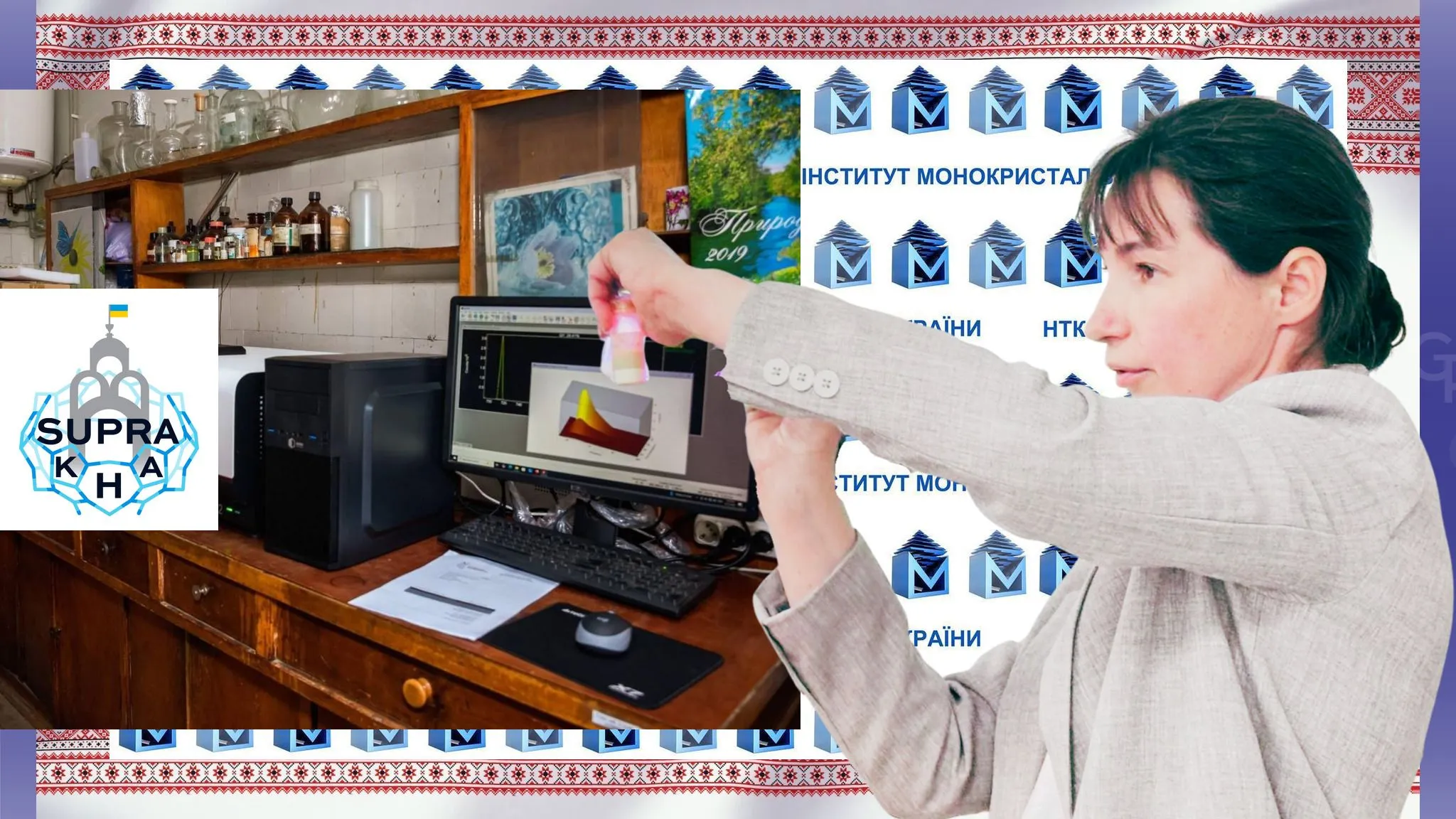
Collage by Olena Zelenina.
Why do certain molecules selectively recognize others? How can molecules be forced to assemble into complex structures with predetermined properties? Is it possible to learn how to control such interactions in order to create new materials, develop sensitive sensors, or help medicine study biological processes more precisely?
Despite the full-scale war that has fundamentally changed life in Ukraine, Kharkiv scientists continue to explore the world, seek answers to complex questions, and create new technologies.
"Chemistry Beyond the Molecule"
And scientific research is not confined within laboratory walls: curiosity about how the world is structured is inherent to anyone who has ever pondered the nature of familiar things.
Imagine trying to connect two pieces of a "chemical constructor." Classical chemistry acts radically: it stitches atoms together permanently using strong covalent bonds.
However, nature works differently. Our DNA, enzymes, and cell receptors hold together thanks to weak but precise "handshakes"—non-covalent interactions, meaning without the formation of "classical" chemical bonds.
The science that investigates these molecular ensembles has been named supramolecular chemistry, or "chemistry beyond the molecule."
By the way, this expression belongs to one of the founders of supramolecular chemistry, Nobel laureate Jean-Marie Lehn.
Understanding how molecules interact with each other opens the path to creating new "smart" materials and technologies of the future capable of even changing our daily lives.
This was told to "Gromada" by Olha Kolosova, PhD in Chemical Sciences, Senior Researcher, and Head of the Center for Collective Use of Scientific Equipment "Molecular and Supramolecular Functional Materials" at the STC "Institute for Single Crystals" of the NAS of Ukraine.
Three Amazing Nobel Stories
Over recent decades, this amazing field has brought its researchers at least three Nobel Prizes.
1987: The Molecular Key and Lock. It all started with a scientific accident. In 1967, American chemist Charles Pedersen accidentally obtained a strange compound resembling a crown (hence it was named a crown ether). It turned out that this "crown" can selectively trap ions of certain metals within its cavity like a trap.
Later, French scientist Jean-Marie Lehn and American Donald Cram turned this accidental discovery into a whole philosophy.
They learned to create artificial host-molecules that could recognize specific guest-molecules based on the "key-and-lock" principle. It was Jean-Marie Lehn who named this discipline, which in 1987 brought the trio of scientists the Nobel Prize. They proved that molecules can "communicate" with each other without merging into a single structure.
2016: Molecular Machines. If we already know how molecules recognize each other, why not assemble a robot from them?
In 2016, the Nobel Prize in Chemistry was awarded to Jean-Pierre Sauvage, Fraser Stoddart, and Bernard Feringa for the creation of molecular machines. They revolutionized the field by connecting molecules not with a chemical bond, but mechanically—like links in a chain or rings in illusionists' magic tricks.
Using the principles of supramolecular self-assembly, scientists forced the parts of future machines to independently find their places.
As a result, the world saw the world's smallest motors, elevators, and even a tiny four-wheel-drive "car" measuring just a few nanometers.
Information poster: The 2016 Nobel Prize in Chemistry, awarded for the design and synthesis of molecular machines—the world's smallest machines. The Royal Swedish Academy of Sciences.
GROMADA BACKGROUNDIn 1999, Dutch chemist Bernard Feringa led the first research to create a molecular motor that continuously rotates in the same direction. In 2011, his group created a four-wheel-drive nanocar: a molecular chassis holding four motors that functioned as wheels.
Commenting on the Nobel Prize, he said: "I feel a bit like the Wright brothers, who made their first flight a hundred years ago, and people said: why do we need a flying machine? And now we have a Boeing 747 and an Airbus."
"The possibilities are immense."
Today, these technologies pave the way to "smart" drugs that will deliver active substances precisely to a target, such as a tumor.
2025: Metal-Organic Frameworks (MOFs). And quite recently, in 2025, we witnessed another triumph of the supramolecular approach: the Nobel Prize in Chemistry was awarded to Susumu Kitagawa, Richard Robson, and Omar Yaghi for the development of metal-organic frameworks (MOFs).
They took metal ions as nodes and organic molecules as struts in the necessary proportions and allowed them to assemble independently into three-dimensional lattices.
The result was incredibly beautiful "scaffolding" at the molecular level.
The main advantage of MOFs is their fantastic porosity. If one gram of such powder were unfolded, its surface area could cover an entire football field!
These supramolecular structures can work as super-absorbents: they capture carbon dioxide from the air, store hydrogen for ecological transport, and help extract water even from dry desert air.
"SupraKha": Infrastructure for Research
Today, knowledge about molecular recognition, complex formation, and the control of substance properties is already finding application in the creation of new drug delivery systems, diagnostic tools, molecular sensors, and materials for high-tech industries.
An important step in the development of this field in Ukraine was the infrastructure project "SupraKha" (SupraKha), implemented by the team of the Institute of Chemistry of Functional Materials at the STC "Institute for Single Crystals" of the NASU with the support of the National Research Foundation of Ukraine.
The project, whose very acronym hints at the implementation team's love for their hometown of Kharkiv, aims not only at conducting advanced research in the field of supramolecular chemistry, but also at creating modern research infrastructure accessible to the broader scientific community of Ukraine.
– "The scientific component of 'SupraKha' focuses on creating new supramolecular systems for biomedical and veterinary applications," explains Olha Kolosova. – "We are talking, in particular, about host-guest type complexes, rotaxanes, and pseudorotaxanes—molecular structures in which the properties of individual components, dyes, or drugs are improved through interaction with macrocyclic compounds."
To form such systems, researchers use molecular receptors, specifically cucurbiturils and cyclodextrins, capable of selectively interacting with other molecules. Such research has two important applied vectors.
The first is the creation of new fluorescent compounds and systems that can increase the sensitivity and reliability of biomedical research. The second is the development of supramolecular complexes with biologically active substances whose properties potentially allow for improved bioavailability and controlled release of active components in veterinary drugs.
"The possibilities are immense."
A Center of Collective Use for Ukrainian Science
– "Such systems require comprehensive experimental research before they can find practical application," says Olha Kolosova. – "That is why creating modern scientific infrastructure is of decisive importance—first and foremost, equipping laboratories with high-tech equipment capable of ensuring a comprehensive study of molecular interactions, structure, optical properties, and functional characteristics of new materials."
The procurement and commissioning of state-of-the-art scientific instruments, the organization of trainings, scientific seminars, and professional exchanges create conditions for the development of research in supramolecular chemistry and the emergence of new scientific results.
That is why one of the key outcomes of the "SupraKha" infrastructure project was the creation of the Center for Collective Use of Scientific Equipment (CCUSE) "Molecular and Supramolecular Functional Materials."
Although more than twenty CCUSEs already operate at universities and institutions of the National Academy of Sciences of Ukraine, this Center stands out because it brings together for the first time a complex of modern methods specifically oriented toward studying molecular and supramolecular systems—ranging from establishing compound structures to studying their interactions, optical properties, and behavior in biological environments.
It is intended to become a long-term resource for scientists from various institutions, foster interdisciplinary cooperation, and help young researchers master modern experimental approaches.
This is especially important for Ukraine, where the effective use of existing scientific potential, shared access to high-cost equipment, and cooperation between institutions create additional opportunities for developing competitive science.
Six "Workhorses" for Comprehensive Research
According to the Head, the scientific basis of the Center consists of six instruments, four of which were purchased under the "SupraKha" project. They complement each other and cover different stages of researching molecular and functional materials:
Nuclear magnetic resonance allows a glimpse inside the molecule. The Varian 400-MR spectrometer makes it possible to study the molecular structure of organic and other compounds, establish the chemical environment of atoms, and verify whether a synthesized substance matches the expected structure. This method is especially important for developing new organic dyes, pharmaceutical compounds, and molecular systems with complex architecture.
Liquid chromatography with mass spectrometry makes it possible to determine what is contained in a sample. The Shimadzu LCMS-2020 system combines the separation of a mixture into individual components with the determination of their mass-spectrometric signal. This helps identify compounds, estimate their molecular weight, monitor purity, and perform quantitative analysis under appropriate conditions and methodologies. Such studies are necessary for controlling the synthesis of new substances, analyzing complex mixtures, and developing analytical methods.
Spectrofluorimetry investigates the light properties of substances. The Edinburgh Instruments FS5 spectrofluorimeter makes it possible to study the absorption and emission of light by luminescent compounds, particularly in the visible and near-infrared ranges. This is important for creating fluorescent labels, optical sensors, and materials for bioimaging. Measuring optical characteristics also helps assess the environmental impact on molecular behavior and determine the prospects of new
luminophores for specific applications. Isothermal titration calorimetry measures the strength of molecular interaction. The Thermal Hazard Technology μRC microcalorimeter allows for the study of thermal effects accompanying the interaction of substances. Based on such measurements, thermodynamic binding parameters can be determined, including molecular affinity for one another, and ascertaining how energetically favorable complex formation is. This method is particularly valuable for studying host-guest systems, molecular receptors, and promising sensor materials.
Fluorescence microscopy makes it possible to see the distribution of luminescent objects. The ZEISS Axiovert 5 microscope with a Axiocam 807 mono digital camera visualizes fluorescently labeled biological objects, studies the distribution of luminescent compounds, and characterizes functional materials and nanostructures. This opens opportunities for interdisciplinary research at the intersection of chemistry, biology, and materials science.
Lyophilization is used to preserve a sample for further research. The Martin Christ Alpha 3-4 LSCbasic laboratory lyophilizer ensures the drying of frozen samples by removing water as vapor without passing through the liquid phase. Under a correctly selected regimen, this helps preserve the properties of sensitive biological, pharmaceutical, and chemical materials, facilitating their transportation and long-term storage.
– "Together, these instruments create the foundation for a comprehensive approach: a synthesized substance can be characterized by structure, composition, and purity, its optical properties investigated, its interaction with other molecules measured, and, if necessary, its distribution in a biological system studied," emphasizes Olha Kolosova. – "The specific set of methods will depend on sample properties and the set scientific task."
More Than Just Equipment:
What Is the Benefit to Society?
We can conclude that the combination of modern instruments, specialists' competence, and openness to interinstitutional cooperation creates conditions for research that is difficult to accomplish using a single method or within a single laboratory.
The Center is designed to support both fundamental quests that expand our understanding of the molecular world and applied developments capable of eventually finding application in medicine, pharmacy, analytical chemistry, and materials science.
– "Practical significance is not limited to laboratory measurements," continues the Head of the Center. – "Its activities can help solve tasks important for medicine, pharmacy, ecology, industry, and the training of young scientists."
Access to modern equipment and specialists' consultations will help researchers from other institutions implement projects requiring specialized methods.
The creation of the CCUSE "Molecular and Supramolecular Functional Materials" is a step toward more efficient use of scientific infrastructure and strengthening interaction among research teams in Ukraine.
After all, the path to the technologies of the future often begins with something very small—an individual molecule, its properties and interactions. And the ability to explore this world at a modern scientific level is an important prerequisite for new discoveries.
The "Gromada Group" local media network works thanks to your trust.


Comments
Some more relevant news for now