








One Hundred Kilometers Between Three Fires: How Krasnokutsk Community Transformed Wartime Challenges into Management Creativity
Articles | 22 May, 2026 at 18:17 | 1,897 | Author: Olena Zelenina
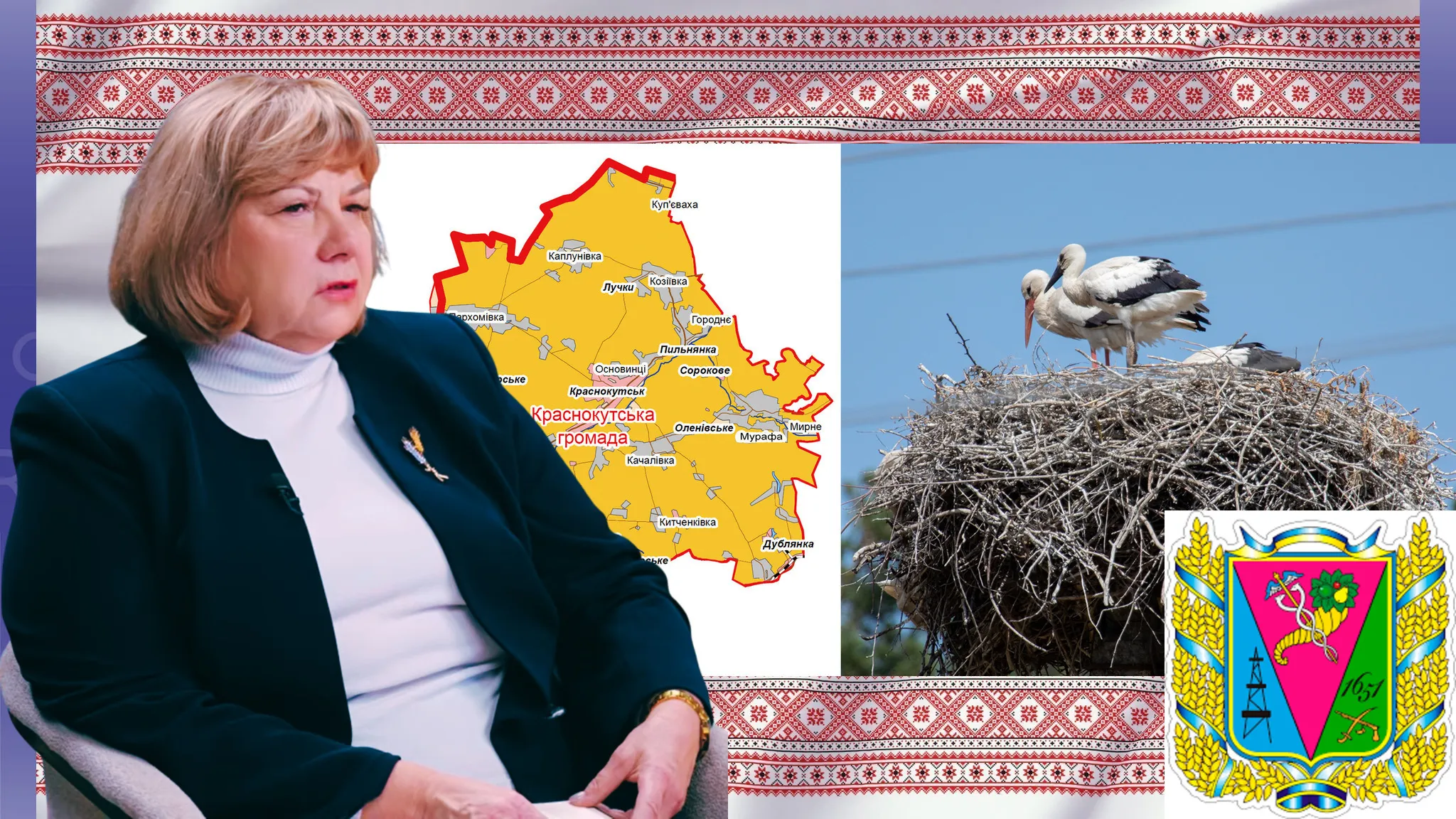
Collage by Olena Zelenina.
"If it weren't for this very war, if it weren't for the losses, all communities of Ukraine would be developing at an incredible pace today, having such colossal support from international partners and European Union countries. But even so, despite everything, we are not just standing still — we are moving forward, attracting donors, and learning to live anew".
These words by Iryna Karabut, the head of the Krasnokutsk Settlement Council of the Kharkiv Oblast, spoken on the air of the analytical program "Voice of the Community" of the Kharkiv Press Club (authored and hosted by Oleksandr Shvets), describe the modern philosophy of Ukrainian local self-government in the best possible way.
Today, Krasnokutshchyna has found itself as a unique, one-hundred-kilometer "equidistant" center between three large regional cities — Kharkiv, Sumy, and Poltava. Such a geographical position in the conditions of a full-scale invasion and intensification of hostilities in the border area has turned the community into a strategic humanitarian, social, and infrastructural hub, where every management step requires genuine creativity, courage, and non-standard approaches.
New Breath and an "Economic Miracle"
Despite the Loss of Giants
Life under the constant sounds of sirens and explosions, regular arrivals of enemy drones — this is a reality that, it would seem, should have paralyzed any initiative.
The situation is complicated by the fact that the enemy purposefully strikes civilian enterprises, which are the main taxpayers to the local budget. In particular, the famous Sakhalinske oil and gas condensate field — one of the largest in Ukraine, located on the territory of the community — suffered serious blows.
The Rashists have already attacked it with drones for the fourth time, causing the community to lose over 9 million hryvnias in rent payments every month, which used to be the main driver of development.
Despite security risks, local authorities, together with state bodies, promptly liquidate the consequences of attacks, and, as the head of the community shared exclusively, they managed to solve a critical problem: to restore gas supply to over a hundred private homes in one of the adjacent villages, whose residents had remained without blue fuel for a long time due to the shelling of the industrial zone.
However, the real revelation of the broadcast was the fact that the internal reshaping of the community occurred thanks to people who lost everything because of the war. At one time, Krasnokutshchyna registered about 24 thousand internally displaced persons from Kharkiv, Kupiansk, Donetsk, and Luhansk regions. Later, the flow decreased by half, but due to the recent fierce shelling of Bohodukhiv and the border Velyka Pysarivka, the number of refugees is rapidly growing again.
But instead of becoming a burden, the displaced people turned into a driving force of the local economy. Many of them adapted, started their own businesses from scratch here, found employment in farms or medical institutions. By their own efforts, they are rebooting the community, becoming new conscientious taxpayers.
Social Creativity:
Elevators for Bedridden Patients and Inter-Municipal Agreements
The aging of the population and the colossal influx of lonely elderly people evacuated from the zone of active hostilities posed a daunting task for local social services.
The inpatient department of the Center for the Provision of Social Services, which was previously designed for only 30 people, had to be urgently expanded. Utilizing local budget funds, a capital renovation was carried out here, elevators and special lifts were installed, kitchen and dining room equipment was completely updated, and the staff was doubled, as two-thirds of the current residents of the institution are bedridden patients from the de-occupied or destroyed Zolochiv, Derhachi, and Kharkiv.
Since maintaining one person in the hospital costs over 15 thousand hryvnias per month, Krasnokutsk introduced an absolutely unique practice for Ukraine of inter-municipal partnership in the social sphere.
When neighboring frontline communities have nowhere to evacuate and shelter a lonely helpless person, the Krasnokutsk Settlement Council concludes an official agreement with them, and the community from which the displaced person arrived transfers a targeted subvention for their maintenance. This allows saving lives and removing the critical financial burden from a single local budget.
In parallel with this, the municipal sphere is withstanding colossal pressure. The community authorities recall how in the first years of the war, the volume of solid municipal waste increased several times due to the massive influx of people.
Even under these conditions, Krasnokutsk was able to completely update its fleet of specialized equipment (partially with its own funds, partially thanks to German and American partners) and radically expand the organized waste collection network, covering almost all starostats. At the same time, the settlement council took on the lion's share of costs: if the tariff for residents is only 25 hryvnias per person, the real cost of waste removal to the waste processing plant in Bohodukhiv reaches 140 hryvnias, and this difference is fully subsidized by the community.
Ecological Brand
and Presses in Forest Belts
Another innovation of Krasnokutshchyna is total digitalization and grant work. The department of strategic development and municipal initiatives created in the settlement council has actually become a free consulting center for local small businesses, farmers, and veterans. The council's specialists write grant applications for farmers by their own efforts, helping them survive, buy equipment, and clear land bordering the Sumy Oblast from mines.
An absolutely new and unexpected managerial move for the frontline region was the launch of a pilot project on separate collection and pressing of waste, initiated by a displaced woman from Kharkiv, Maryna Oleksiienko. Today, in the settlements of the community, alongside regular bins, mobile locations are appearing with simple but effective presses for plastic and aluminum, created by local inventors.
Utility workers collect these raw materials and hand them over to recyclers, earning money, and the forest belts and forests, where trash had been brought for decades before, have finally been cleared. Community police officers actively hunt down violators who try to act the old way — this institution, along with the new State Emergency Service officer-rescuer service, is considered one of the most successful reforms in the state here.
Moreover, with the support of the Ministry of Foreign Affairs of Slovenia, a unique ecological project "EcoCommunity" was implemented in the Krasnokutsk Lyceum. Modern composters and an educational greenhouse were installed here, and an obligatory condition was the use of equipment labeled "Made in Ukraine". The school children collect leaves themselves, turn them into compost for school flower beds, and, most importantly, bring up a new eco-culture in their parents.
Road Impasse of Decentralization
Analyzing the decentralization reform, the community agrees with expert opinions on the need to introduce the institution of prefects on the French model for constructive supervision over the legality of decisions, rather than punitive control. At the same time, local self-government faces serious infrastructural injustice, which turns into a logistical dead end during the war.
Three major highways of state importance and a network of local roads between villages pass through the territory of Krasnokutshchyna. Currently, all of them are in a critical, unsatisfactory condition, as they have not seen major repairs for four to five years. However, the entire storm of criticism and emotional dissatisfaction from drivers, the military, and civilians falls precisely on the head of the community.
"We are inundated with letters from the military who need high-quality logistics for evacuation and equipment movement, but the law clearly forbids us to spend local budget funds on balance objects of the state. In 2023, having a solid state subsidy of 34 million hryvnias, we fully gave it away in the form of a subvention to higher structures just to make the strategic road from Krasnokutsk to the Kyiv–Kharkiv–Dovzhanskyi highway passable", – Iryna Karabut shares her managerial pain.
The way out of this situation, according to the leadership of the community, should be the final chord of decentralization: transferring local roads directly to the balance of communities together with a proportional redistribution of Road Fund resources.
Then, on the ground, they will clearly understand which path for a school bus or military evacuation needs to be patched immediately, without waiting for approvals from offices in the capital or the regional center.
Despite all the challenges, the Krasnokutsk community demonstrates amazing resilience. They are not just waiting for victory here, but daily clawing out the right to a normal ecological, social, and cultural future, proving that the greatest value of Slobozhanshchyna is and remains its cool, unyielding, and resourceful people.

Comments
Some more relevant news for now