


























The Threat of the New "High-Tech Barbarism": Clip Thinking and Mathematical Trauma
Articles | | 1,891 | Author: Olena Zelenina
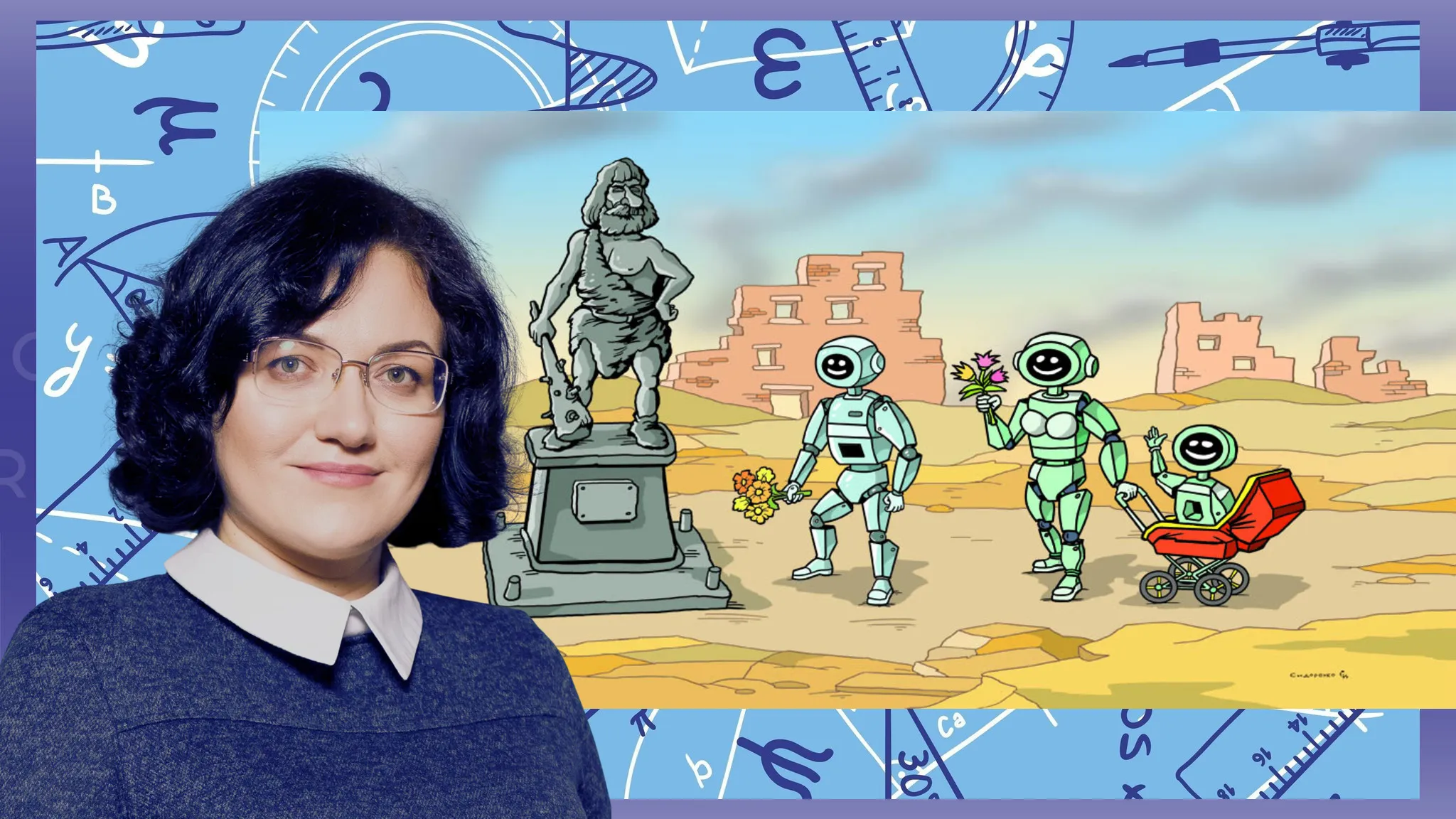
Cartoon by Olexandr Sydorenko. Collage by Olena Zelenina.
Today, when all public discourse has been reduced to tactical survival, we risk missing a quiet but catastrophic surrender on another front—the intellectual one.
The modern world has found itself in a bizarre trap. On one hand, artificial intelligence generates texts in seconds, Google knows everything, and an answer to any question is always right at our fingertips. On the other hand, instant access to information has played a cruel joke on us, subtly killing our ability to think independently. Behind the beautiful facade of the digital era lies a quiet but catastrophic fading of foundational knowledge.
This harsh but honest diagnosis of our society was delivered by the renowned mathematician and Corresponding Member of the NAS of Ukraine, Olena Vaneeva, alongside Academician Volodymyr Semynozhenko on the broadcast of the program “About Science. Competently”. Their conversation is not just another round of grumbling about "bad textbooks," but a resounding alarm: the crisis of thinking has already become a real threat to the country's future.
Information Car Crash:
A Prediction That Became Our Reality
To explain what is happening to the brains of the new generation, Olena Vaneeva recalls the French philosopher Paul Virilio (1932–2018). He was called a "technological pessimist," and for good reason. Virilio’s core idea is simple and sobering: every brilliant invention brings along its own unique catastrophe.
Invent the railway? You get train wrecks. Harness the atom? You get Chernobyl. Create the internet? Welcome to the world of what the philosopher back in the late '90s dubbed an "information accident" (or information car crash).
When data flies at us at the speed of light, and a total surplus of information rages around us, the human brain simply switches into emergency mode. Streams of news and facts fly straight through without sticking in the head or transforming into durable knowledge. Olena Vaneeva describes this very accurately:
"We have found ourselves in a situation where there is too much information, it is accessible too fast, and the brain simply stops processing it. It just flies right past."
University professors see the results of this "information car crash" every single year. Applicants come to higher education institutions with stellar National Multi-Subject Test (NMT) scores (180 and above), yet they are completely helpless when it comes to turning on logic and finding cause-and-effect relationships.
Our testing system has bred masters of quick guessing but has completely atrophied the skill of figuring out a problem from scratch.
"We now have a 'clip' generation growing up. They know how to pass tests, but they absolutely do not know how to think systemically," Vaneeva states.
Knowledge has been replaced by the mere ability to click a mouse at the right time.
The Dopamine Trap:
When TikTok Defeats the Textbook
Why is it so hard to get a teenager to study? Because the structure of life success has been turned completely upside down. Once, brains and education were the ultimate social elevator. Today, the world is dominated by a ruthless "attention economy." For the first time, humanity lives in an era where cheap pleasure is just a click away.
"Gromada" Fact Sheet:
"Dopamine traps" (addictions) refer to modern quick pleasures—scrolling social media feeds, playing video games, or consuming sweets—which trigger a sharp but short-lived spike in dopamine. Over time, the brain gets used to these "easy" doses, leading to a lost capacity to derive pleasure from long-term, critical endeavors (like studying or working). This condition is known as dopamine dependence.
When a child sees yet another blogger making millions off of pure shock value or sheer foolishness, the rational motivation to study vanishes. Why spend years grinding away at the granite of science if you can just shoot a trendy video and get everything all at once? Complex thinking requires effort and long-term work for a delayed result, while social networks dole out dopamine by the wagonload right here and now.
Even a turned-off phone just lying face down on a school desk continues to eat away at a child's mental capacity. Instead of listening to the teacher, the teenager spends a massive amount of mental energy simply resisting the urge to grab the gadget. School is losing this war for attention on every single front.
The Mathematical Simulacrum
and "High-Tech Barbarism"
This blow has hit the exact sciences the hardest. Mathematics is a rigid, linear thing. If you miss the foundational logical steps, moving forward is impossible. Yet, modern curricula try to turn learning into some sort of entertaining carnival, artificially simplifying everything. Volodymyr Semynozhenko could not hide his emotions during the broadcast:
"I opened one of the modern textbooks for primary school and was horrified: there is no logic, there are no axioms—children are forced to just guess! This isn't education; it's some kind of wildness."
The situation was pushed over the edge by online learning. The generation that grew up on Zoom has stopped reading textbooks altogether. Why strain yourself to derive a formula if artificial intelligence will spit out a ready-made solution in a fraction of a second? Children have become virtuosos of Ctrl+C / Ctrl+V, mindlessly copying numbers from screens into notebooks. Mathematics, which was always the ultimate "fitness for the brain," has turned into a source of stress and "mathematical trauma."
And this is where the main paradox of the era arises, clearly articulated by Volodymyr Semynozhenko:
"We are standing on the threshold of a new 'high-tech barbarism,' where people use hyper-complex technologies but themselves lose the ability to understand how they work."
The Parental Alibi
and the Horizon of Planning
Blaming everything solely on teachers or the Ministry of Education is a convenient position, but a dishonest one. The root of the trouble often sits right at home. Psychologists are sounding the alarm over the syndrome of "absence during presence." Parents are technically next to their children, but they themselves are glued to their phones. Shoving a tablet into a nine-month-old's hands in a stroller just to keep them quiet is manually hooking them onto a dopamine needle before they even learn to speak. No talks about the benefits of books will ever work if a child sees their mom and dad every day with faces illuminated by smartphone screens.
At the state level, the situation is no better. Political elites live in short sprints from election to election—looking just 5 years ahead. Yet, systemic investments in education and foundational science yield real returns only after 10–20 years. There is no demand for long-term strategies; populism reigns supreme, and funding for schools and universities is slashed without mercy.
The war has exposed this hole in the system with maximum brutality. Yes, our MilitaryTech sector is currently working miracles due to sheer enthusiasm and entrepreneurial grit. But at the same time, we have hit a brick wall—a catastrophic deficit of engineers, physicists, and designers.
Scientists believe that if the state does not wake up immediately, start creating spaces free from digital noise in schools and kindergartens, and return education to its research-driven, foundational character, we risk losing the future. The information accident has already happened; the cars have already crashed. The only question left is whether we can clear the wreckage before the consequences become irreversible.
Perspective of a Science Reviewer:
Students Trapped Between Two Fires
Listening to these esteemed scientists, I thought a lot about why I myself disliked mathematics back in the day and failed to master it properly. Looking back at all my subsequent life experience, I certainly cannot complain about a lack of logical thinking or analytical skills in the humanities—I am doing completely fine in that regard.
Why, then, did that mathematical barrier appear? I am convinced that writing everything off solely to modern gadgets and clip perception is a massive oversimplification. The problem of the degradation of mathematical thinking in mainstream schools has far deeper roots, and they were planted long ago.
I finished secondary school in 1974 (long before gadgets existed; I was a typical bookish child) and remember clearly that even then, the Soviet school system—with the exception of a few elite physics-and-math tracks—was lagging catastrophically.
My older brother, who is 12 years my senior, achieved excellent, foundational results in mathematics. However, he studied under a completely different methodology, using old, logically structured textbooks, and was taught by strong educators of the "old school."
My generation, on the other hand, bore the brunt of an experiment that broke school education in many ways—the so-called "Kolmogorov Reform" at the turn of the 1970s.
Soviet reformers decided to push the school curriculum closer to high academic science. Proven, comprehensible textbooks were pulled from schools and replaced with artificially complicated volumes written in university-level jargon.
They became completely unreadable for the average student. I remember torturing myself over the principle: you look at the book, but you see nothing but a blank wall.
My brain, raised on images and living words, refused to see any sense in the endless a,b,c, or x 2 . They couldn't be touched by hand or expressed emotionally. For me, a die-hard humanist, a letter squared or cubed sounded like pure absurdity—after all, letters form words capable of evoking tears or delight, but how on earth do you multiply a 'word' by itself?
And what about the school zero? We were told it means 'nothing.' But there is no such thing as nothingness in nature; the visible world is always filled with something! And if what we have defined as zero does not actually exist in nature, how can an dynamic negative number even emerge from this conventional void? How can something that isn't there be negative?
It seemed like utter nonsense and a mockery of common sense. It is absolutely impossible for a teenager to fathom how all these 'negative nothings' and letters raised to the power of a gazillion have any bearing on determining the structural strength of their house's foundation, calculating flight trajectories to the Moon and Mars, or, ultimately, the successful operation of the processor inside their own computer.
It was right then, at that school desk, that a tectonic rift opened up for me between the surrounding world and abstract formulas.
I have a secret to confess: I haven't bridged it to this day. Even now, when facing complex mathematical webs, I feel not just confusion, but that same childhood, almost mystical dread of the incomprehensible
This textbook crisis collided with a deep crisis in pedagogical institutes, which back then were attracting far from the most talented applicants. A weak teacher, armed with an incomprehensible book, simply killed the interest in the subject for millions of schoolchildren. I remember how our math teacher used to scream at us, unable to beat what she considered "obvious" into the class's heads. For her, the class was divided into 1% "capable" and 99% "stupid kids."
By the way, the Soviet authorities themselves understood this failure of the mainstream school perfectly well. That is why they frantically began developing specialized classes and schools, artificially pulling the best educators there to salvage the future brainpower for the defense complex.
How is it now? A Peek Under the Covers of Modern Math Textbooks
In short, a global battle is currently raging between two approaches: "entertain and simplify" versus "load and structure." The situation across different countries looks starkly contrasting.
Trends of "Simplification" and Clip Perceptions (Western Europe and USA): In many Western countries, textbooks try to be as "child-friendly" as possible to avoid causing stress or that very same "mathematical trauma."
The books resemble bright magazines or social media feeds—lots of pictures, comics, "fun fact" callouts, and very little continuous text.
They try to anchor mathematics heavily to everyday life (e.g., "calculate the discount percentage on a pizza"). Because of this, academic depth, abstract thinking, and the logic of deriving formulas are frequently lost. Children are handed ready-made algorithms and recipes rather than a true understanding of the essence.
The East Asian Miracle (Singapore, Shanghai, Japan): These countries consistently dominate international educational rankings (like PISA), and their textbooks reflect an entirely different philosophy.
Take the Singapore Math method: here, textbooks are built on the "Concrete → Visual → Abstract" principle. First, a topic is explained using real, physical objects; then they draw blocks or diagrams; and only after that do they move on to formulas. They are not complex in form, but they are incredibly deep in their logic.
The focus is strictly on depth! A Singaporean textbook might chew on just three topics for half a year, but it ensures the child understands them down to the molecular level.
Eastern Europe and the Post-Soviet Space (including Ukraine): Here, we are witnessing a textbook identity crisis, exactly as mentioned by the National Academy of Sciences experts.PDF
The old Soviet school of my time leaned toward an overly complex, dry academic delivery, where a middle school textbook read like a university monograph. Today, in an attempt to Europeanize education and make it "simpler," authors often throw out the logical chains and axioms altogether. The logic of presentation gets lost, assignments turn into a "guessing game," and teachers are forced to hunt for supplemental materials just to patch up the holes in the curriculum.
The paradox is that modern textbooks are often simultaneously too primitive and completely incomprehensible.This is why we see such a paradoxical picture today. Parents who want to give their children a future are forced to seek salvation in... private entities. I see this firsthand in the upbringing of my granddaughter.
Look at that! Decades have passed, children have changed, gadgets and technologies have arrived, and textbooks are seemingly new (regardless of whether they are bad or good)—yet the school ‘math teacher’ is still standing in the classroom, yelling at the 99% of ‘dumb kids’ just like before.
However, the paradox of modern times is that these branded ‘failing students,’ who cannot recite trigonometric formulas by heart, often possess colossal practical skills. They can build a computer from scratch, perfectly matching the processor to the motherboard, write basic code for their own video game all by themselves, or lightning-fast find and verify information online.
They aren't dumb; their practical intelligence has already adapted to the digital world. But the rigid, stagnant system still considers rote-memorized theory to be the sole measure of intellect. And while the teacher is losing her voice over an unlearned integral, she doesn't even realize that she herself is helpless before these ‘failing students’—since, more often than not, she can't even adjust the sound in Zoom or delete yet another virus from her cluttered Viber without their help.
Parents are forced to hire tutors out of their own pockets, enroll their children in commercial IT clubs, private schools, or "mental arithmetic" classes.
An involuntary question arises: why have the very skills on which the creation of domestic drones, missiles, and electronic warfare (EW) systems depend become a financial burden for moms and dads, rather than a basic, free standard in every public school?
This is precisely why I would not join the chorus of critics slamming today's National Multi-Subject Test (NMT). The NMT is actually a fair chance and an honest ticket to the future for many talented young people who lack big financial resources or connections.
The problem is not just with exams and gadgets. The real issue lies in textbooks, methodologies, and educators who have stopped teaching children how to think. This is not some detached philosophical musing. Abstract thinking is the human brain's ability to encode the surrounding world into numbers, signs, formulas, and symbols. I believe it can and must be trained.
To keep from becoming these exact "tech-savages," Olena Vaneeva outlined a critical mathematical minimum without which it is simply impossible to survive in society today:
Probability Theory: This is our shield against fейks and panic. Without an understanding of risks, society becomes the ideal victim for media manipulation, panicking over isolated, sensationalized news stories.
Compound Interest: Basic financial literacy. The very thing that saves people from predatory microloans and "quick cash" traps.
Fractions and Progressions: Understanding how processes grow exponentially. This is vital for adequately evaluating the scale of anything—from biological pandemics to economic crises.
Because this training underpins far more than meets the eye. Recently, on the program 'About Science. Competently', Academician Volodymyr Semynozhenko unleashed a stunning flight of thought, launching mathematics right into the orbit of geopolitics and international relations:
‘If we lose our mathematical culture, we lose the ability to understand future trends; we become dependent and mere tools in the hands of others. Mathematics is an element of our agency in the world.’
This is precisely our admission ticket to the premier league. A person who wasn't taught in school to see the architecture behind hidden processes is doomed to just mindlessly tap on a gadget screen, completely oblivious to who is switching the pictures and why.

Comments
Some more relevant news for now