














Not Just the Stars: How Ukrainian Astronomers Save Our GPS and Unravel the Mysteries of "Cosmic Cannibalism"
Articles | | 1,231 | Author: By Olena Zelenina
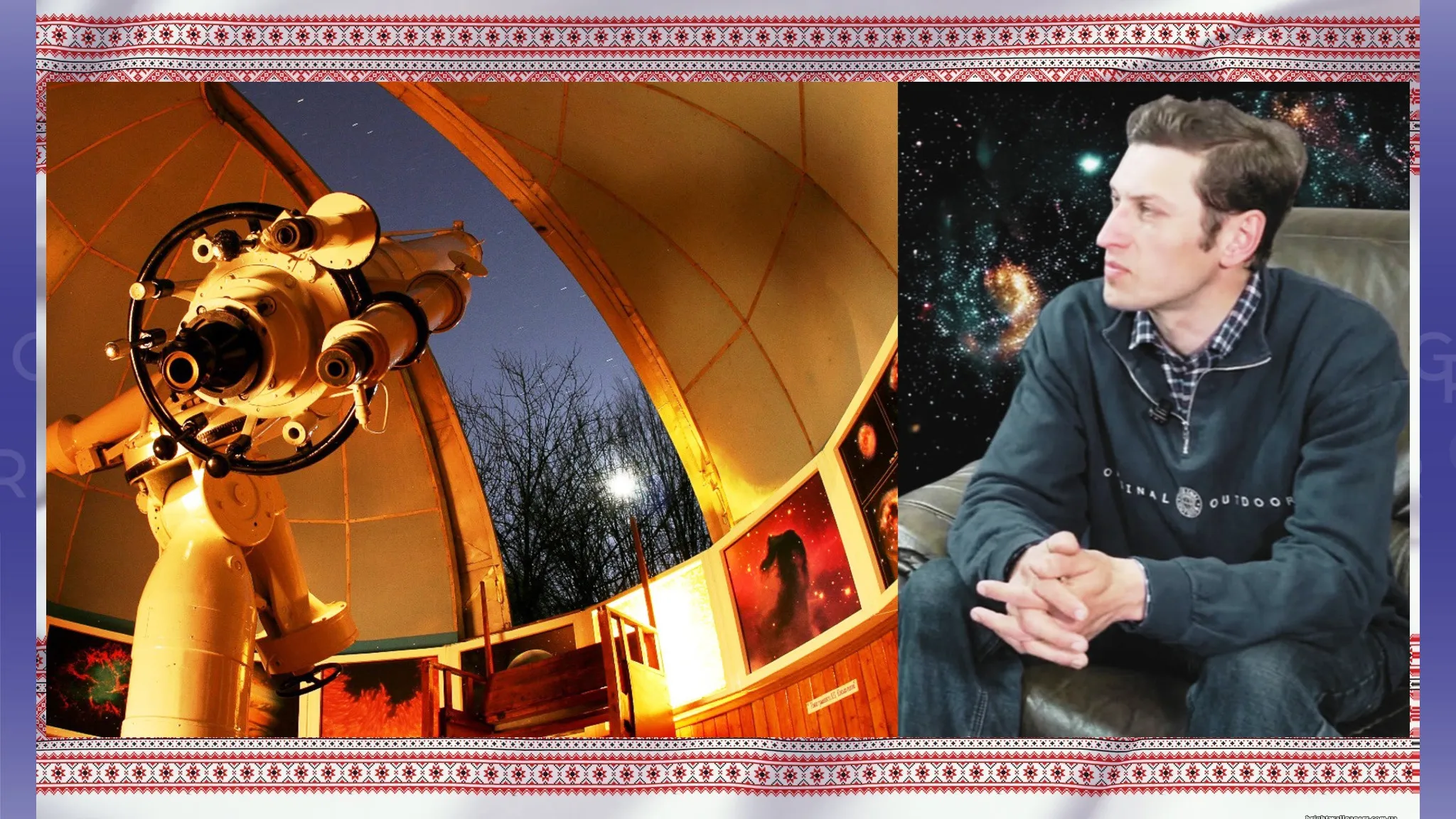
Collage by Olena Zelenina.
When we hear the word "astronomy," our imagination usually conjures up distant galaxies and the romance of the night sky. However, today this science is not just about contemplating eternity, but serves as the foundation of our daily safety.
In an interview for the program "About Science Competently," Mykhailo Lashko, head of the laboratory at the Main Astronomical Observatory of the National Academy of Sciences (NAS) of Ukraine, told the host—Academician Volodymyr Semynozhenko—why the modern world risks plunging into chaos without the work of astronomers.
Why Satellites Would Fall
Without Astronomers
Most of us take GPS navigation for granted, but few know that the operation of this system directly depends on ground-based observatories. Mykhailo Lashko explains: the Earth rotates unevenly; its movement varies constantly.
"If we do not monitor the Earth's rotation, one fine day the satellites will simply fall and burn up in the atmosphere. We will be left without communication, internet, and navigation."
The Main Astronomical Observatory operates a laser positioning station that refines satellite orbits daily, allowing us to use smartphones and maps without interruption.
Galactic Cannibalism
and the Bombardment of Earth
One of the most impressive studies by Ukrainian scientists concerns events from the deep past that changed the appearance of our system. Astronomers modeled the movement of globular star clusters—objects up to 13 billion years old.
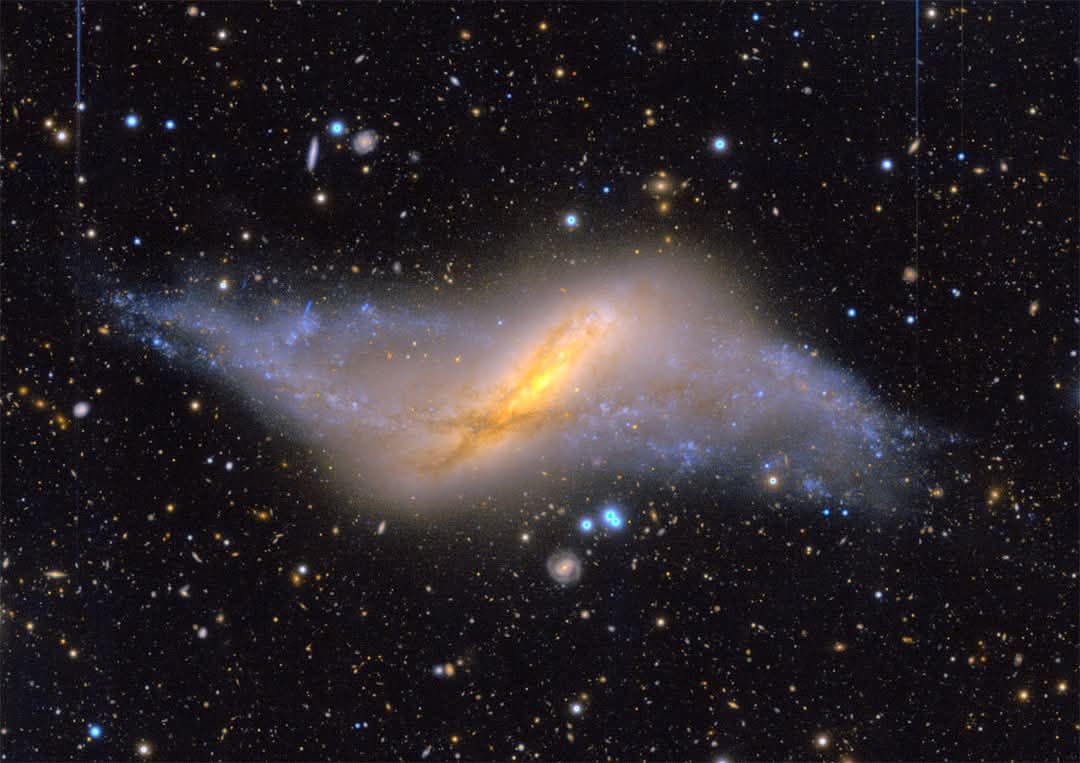
A group of Ukrainian scientists has discovered new polar-ring galaxies. The illustration shows perhaps the most popular polar-ring galaxy on the web – NGC 660 (photo from the Subaru telescope). Source: Main Astronomical Observatory of the NAS of Ukraine.
It turned out that about 300–330 million years ago, one of these clusters (with a mass of hundreds of thousands of stars) passed at a dangerously close distance to the Solar System—only 30–60 light-years away.
This gravitational "shake-up" caused powerful disturbances. Huge blocks of ice and rock were sent into the inner layers of our system, staging a "massive bombardment" of the planets. The very craters we see on the Moon today are largely scars from that ancient event, which led to changes in Earth's biodiversity.
Exocomets and Global Recognition
Ukrainian science remains integrated into the global community. In 2020, specialists from the observatory, in collaboration with foreign colleagues, discovered a new type of object—exocomets (comets in other star systems). This discovery was published in the prestigious journal Nature, confirming the high status of the Ukrainian astronomical school.
Space Junk:
A Threat from Elon Musk?
A problem becoming critical is orbital clutter. Since the 1980s, cases have been recorded where tiny fragments (only a few millimeters wide) at enormous speeds pierce the hulls of spacecraft and solar panels.
Scientists are particularly concerned about the Starlink project. Mykhailo Lashko notes that thousands of Elon Musk's bright satellites create serious obstacles for ground observations:
Visual Noise: Satellites "light up" frames, making it difficult to study faint, distant objects.
Safety: The accumulation of satellites may prevent ground stations from noticing a potentially dangerous asteroid flying toward Earth in time.
Resources on Asteroids:
The Future of Energy
Astronomy today is also the geological exploration of the future. Amid a shortage of rare-earth metals on Earth, scientists (including Ukrainians) are actively researching asteroids and the Moon. On some celestial bodies, elements over which wars are fought on Earth are found in abundance. According to the expert, space mining could become a reality, helping to avoid political conflicts and monopolies.
In the 21st century, astronomy has transformed into "space ecology" and a planetary security service. The work of the Main Astronomical Observatory of the NAS of Ukraine proves: by studying the stars, we are, first and foremost, protecting life here on Earth.

Comments
Some more relevant news for now