
Across Red Square and Khreshchatyk. Banners and Parades
Articles | | 1,642 | Author: Olena Zelenina
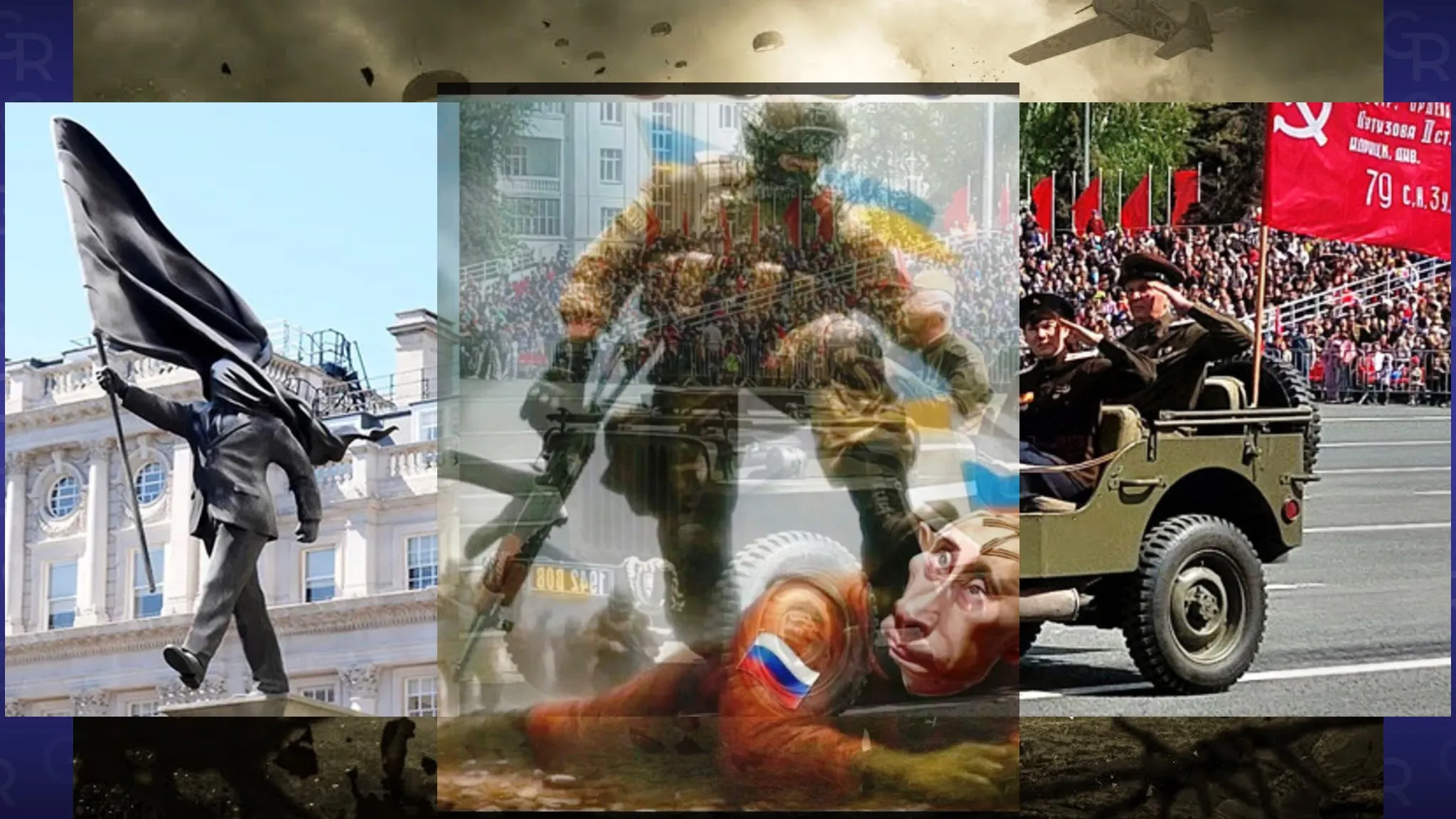
Collage by Olena Zelenina.
A man in an expensive suit walks confidently forward, but instead of a face, he has the canvas of a flag. Banksy's new sculpture is a powerful metaphor of our time. It hits below the belt with its directness.
It is an ideal illustration of how any symbol, even the noblest, becomes a trap when it covers the eyes. When a banner turns into a blindfold, you no longer carry an idea — you become its hostage.
We all remember the military parades on the sacred day of May 9. For those who actually went through the Second World War, the true witnesses of the tragedy, these parades were the most important event of the year, a living connection with their youth and a chance to see a modern army and feel pride for their winning country, which the whole world respected.
They did not tear themselves away from the television screens, because for them it was about their destiny and the Victory and about the faith that war would never happen again, as no one would dare to go with weapons against such military force.
But for their children and grandchildren, this picture gradually became "plastic." The ritual swallowed the meaning. While military blocks marched on the screen, the youth packed their bags and went for barbecues.
It was a healthy immunity against anachronism, which over the years turned into an aggressive cult, where behind the pathos the human was no longer visible — only a crowd under a piece of cloth.
I remember the parades in Ukraine on August 24 before the full-scale invasion. This was not the necrophilia of the past or the worship of idols on a podium. The army that, after 2014, held the front here and now, was marching along Khreshchatyk.
In 2014, about fifty units of military equipment drove through the capital's main street, including the latest models of Kharkiv BTRs, as well as KRAZ Cougar and KrAZ-Spartan armored vehicles.
Then moved the "Bastion-01" and "Bastion-02" multiple launch rocket systems and the most powerful MLRS — "Smerch," "Osa" anti-aircraft missile systems, and "Tochka-U."
The S-300 air defense systems closed the column. The same ones that were successfully hidden on the eve of the invasion and which began shooting down enemy planes over Kharkiv.
14 parade units with a total number of about one and a half thousand servicemen of the Armed Forces, National Guard, Ministry of Internal Affairs, and the State Border Guard Service marched.
The passage of a combined "block," which included 120 participants of military operations in eastern Ukraine, became symbolic.
Part of the equipment and personnel headed to the ATO zone after the completion of the parade.
On the same day, a naval parade, in which ships of the Ukrainian Navy and border guards participated, also took place in Odesa.
This was about authenticity, about patriotism with open eyes. Such a parade gave a feeling: "I am a person with a banner, but I see where I am going and what I stand for." It was a demonstration of strength that protects, not an ideology that blinds.
The problem arises when the flag becomes more important than the one who carries it. As soon as the flag begins to dictate where you should look, you turn into Banksy's hero — confident, but blind. The irony is that the bloodiest wars were started by such "men in suits," who became so carried away by the greatness of their banner that they stopped seeing the abyss beneath their feet.
However, Banksy's sculpture warns us of a thin line. When the flag becomes more important than the person, when the ritual swallows the meaning, and pride turns into fanaticism — the figure loses its sight.
History teaches that the most terrible wars began precisely when nations, blinded by their banners, stopped seeing the face of the "other" and the road leading to the precipice.
True patriotism is the ability to hold the banner without allowing it to close one's eyes to truth and humanity.
REFERENCE "Gromada"
Military Parades of Ukraine
— from post-Soviet traditions to a symbol of resilience
1994 – 1997: First parade: held on August 24, 1994. Accepted by President Leonid Kuchma. Feature: without military equipment.
Era of "Heavy Armor" (1998 – 2004): In 1998, combat equipment first appeared on Khreshchatyk. 2001 saw the largest parade (173 units).
Democratization and Ban (2005 – 2013): Viktor Yushchenko changed the concept to "humanity" (marching bands only in 2005). Under Yanukovych (2011–2013), parades were canceled under the pretext of "cost savings."
Parade as a Symbol of War and Dignity (2014 – 2018): In 2014, equipment from the parade went straight to the ATO zone. New greeting "Glory to Ukraine!" introduced in 2018.
Modern Period (2019 – today): 2019 "March of Defenders" (veterans and volunteers). 2021: last major parade. After 2022: traditional parades suspended; replaced by the exhibition of destroyed Russian equipment on Khreshchatyk.

Comments
Some more relevant news for now