

Return from Foreign Lands: Why the Ukrainian Pantheon Is Not About the Cemetery, but About the Living
Articles | | 1,916 | Author: Olena Zelenina
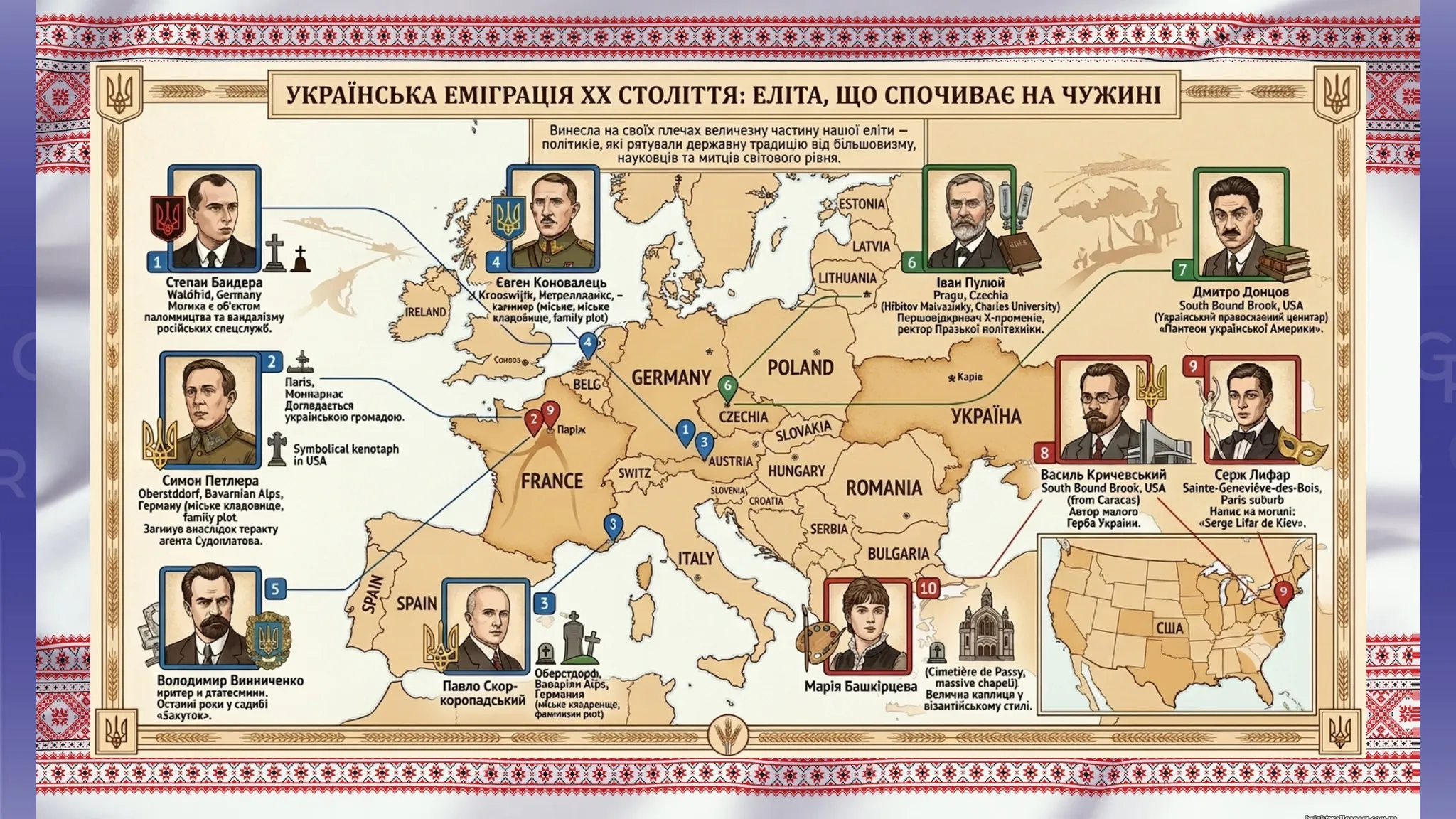
Europe has given refuge to the Ukrainian elite: politicians, scientists and artists. Infographics by Gemini.
When on June 28, 2026, Constitution Day, President Volodymyr Zelenskyy submitted a draft law on the National Pantheon to the parliament, it became clear: Ukraine is venturing into a complex but necessary act of historical self-assertion. It is an attempt to gather under one sky the intellectual and political elite scattered by the winds of emigration—from the rulers of Rus and Cossack hetmans to modern defenders.
"No one will ever dictate to us how to live and which heroes to honor"—this thesis sounds weighty. However, a colossal challenge stands behind it. For the Pantheon is not just an architectural ensemble in Kyiv with a guard of honor. It is an open book of our history, every page of which will have to be argued.
Shadows of the Paris Pantheon
and the Choice of Descendants
The experience of Old Europe proves that no national necropolis was created in an atmosphere of complete tranquility. The inscription on the facade of the Paris Pantheon—"To great men, the grateful homeland"—seems like an axiom today. However, in the 19th century, this building was the epicenter of ideological wars: it was either returned to the Catholic Church or turned back into a secular tomb, depending on who won—monarchists or republicans. The bodies of some figures were brought there with fanfares, only to be quietly carried out a few years later under the influence of a new political conjuncture.
And the hardest part of this process is not the stone, but the people. The return of ashes to the Homeland is not a legal procedure, but a delicate, sometimes almost intimate conversation with descendants, where states not infrequently receive a refusal. When Paris sought to transfer Albert Camus to the Pantheon, his son Jean came out categorically against it, reminding everyone that his father had stayed away from any state officialdom during his lifetime. The descendants of the Marquis de Lafayette likewise flatly refused to give up the ancestor's ashes, insisting on the execution of his last will—to rest in a private cemetery next to his wife.
Ukrainian diplomats will have to demonstrate remarkable tact and psychological flexibility when knocking on the doors of the families of Bandera, Skoropadsky, or Konovalets, where the memory of ancestors was cherished for decades without state participation.
Fragility of Space
and Electoral Elements
There is also another, completely rational fear. Over the last century, Ukrainian territories have too often become the epicenter of destructive geopolitical storms, in the mills of which entire cultural layers disappeared without a trace. We still do not know for certain where Ivan Mazepa or Bohdan Khmelnytsky rest. At a time when security guarantees in the world are becoming fewer, the foundation of a single sacred center is a great responsibility and a serious test of the state's ability to protect its heritage from physical destruction.
Internal discussions are also unavoidable. A society prone to sharp disputes over the past will inevitably project current political passions onto the Pantheon. Furthermore, the stakes are rising on the international arena as well: Karol Nawrocki, who for a long time opposed Ukrainian historians in his role as head of the Institute of National Remembrance, is now the President of Poland. His uncompromising stance on the leaders of OUN and UPA is recently the official course of Warsaw at the highest level, which will require filigree diplomacy from Kyiv.
This is probably the deepest and hardest question in this entire discussion. If we simply transfer the ashes of historical figures to Kyiv but bring modern political barricades along with them, we will get not a Pantheon of unity, but a minefield.
The secret of France or Britain is not that they had "ideal" heroes, but that they learned to transfer characters from the plane of modern morality into the plane of historical fact.
The Wisdom of a Mature Nation:
How to Peal the Past from the Present
Despite all the risks, discussions around the Pantheon are a marker of a healthy, conscious society that is ridding itself of indifference.
However, one should not harbor illusions: Ukrainians are ideologically divided, and figures of the level of Symon Petliura or Stepan Bandera still have opposite "plus" or "minus" signs for different parts of society.
The main test for us now is not just to build a memorial, but to learn to perceive these figures in the context of their era, and not our modern electoral preferences.
Each of them acted in specific, often existential historical circumstances, guided by the ideological motives of their time. The task of the Pantheon is to return them to history, evaluating their contribution to statehood, rather than judging them by the standards of the 21st century.
Old Europe passed this path long ago. Every year, France pompously celebrates Bastille Day—an event that opened the way to bloody terror, guillotines, and civil war. In the Paris Pantheon, a staunch republican and a monarchist can lie side by side. The French do not look for ideal saints; they accept their history as a collection of tragedies and triumphs that ultimately created their state.
The famous French thinker and historian Ernest Renan, in his fundamental essay "What Is a Nation?", derived a brilliant formula that is the key to understanding the Pantheon:
"A shared glory in the past and a shared will in the present; the realization that you have accomplished great things together and wish to do even more—these are the main conditions for being a people. [...] But the essence of a nation also lies in the fact that all individuals must have many things in common, and at the same time—they all must have forgotten something."
This "ability to forget" is not about amnesia, but about the nation's capacity to peel minor grievances, internal strife, and modern political assessments away from historical figures for the sake of the main thing—the recognition of their role in the foundation of the state.
The Ukrainian concept of the memorial has a significant advantage: it is not confined exclusively to military or political history. Here, a place is provided for the titans of science, architecture, and art—from Serge Lifar to Marie Bashkirtseff. This gives a chance to create a space not for ideological duels, but for national understanding.
We are finally exiting the paradigm of historical scatteredness. Ukraine is becoming mature enough not just to remember its outstanding figures from a distance, but to bring them home—without unnecessary pathos, but with deep, calm, and mature respect for its own complex history.
The Ukrainian emigration of the 20th century carried on its shoulders a huge part of our elite—politicians who saved the state tradition from Bolshevism, scientists, and world-class artists.
Here are the 10 most famous figures who still rest in foreign lands, with the exact locations of their burial places:
Political and State Leaders
1. Stepan Bandera (Leader of OUN)
Where buried: Germany, Munich.
Cemetery: Munich Forest Cemetery Waldfriedhof.
His grave with a large stone cross is still an object of pilgrimage and, unfortunately, frequent acts of vandalism by Russian special services.
2. Symon Petliura (Supreme Otaman of the UNR Army, Head of the UNR Directory)
Where buried: France, Paris.
Cemetery: Montparnasse Cemetery (Cimetière du Montparnasse). Buried in sector No. 11, his grave is tended by the Ukrainian community of France, in particular by the Symon Petliura Library in Paris. (Interesting fact: a symbolic cenotaph in his honor is installed at the Bound Brook cemetery in the USA).
3. Pavlo Skoropadsky (Hetman of the Ukrainian State of 1918)
Where buried: Germany, Bavaria.
Cemetery: Town cemetery in the high-mountain town of Oberstdorf in the Alps. He is buried in a family tomb next to his wife Alexandra and children.
4. Evhen Konovalets (Founder and first head of OUN, Colonel of the UNR Army)
Where buried:* Netherlands, Rotterdam.
Cemetery:* Crooswijk.
Konovalets died in Rotterdam as a result of a terrorist attack organized by Soviet agent Sudoplatov, and has since rested in the local cemetery.
Outstanding Scientists and Thinkers
5. Ivan Pului (Physicist, electrical engineer, discoverer of X-rays, translator of the Bible)
Where buried: Czech Republic, Prague.
Cemetery: Malvazinky Cemetery (Hřbitov Malvazinky). An outstanding Ukrainian scientist who gave fundamental discoveries to the world found his final rest in Prague, where he worked for a long time as the rector of the Prague Polytechnic.
6. Dmytro Dontsov (Chief ideologue of Ukrainian nationalism, publicist, philosopher)
Where buried: USA, state of New Jersey.
Cemetery: Ukrainian Orthodox Cemetery South Bound Brook. This place is often called the "Ukrainian Jerusalem" or the "Pantheon of Ukrainian America".
Figures of Culture and Art
7. Vasyl Krychevsky (Patriarch of Ukrainian architecture, creator of the Ukrainian Art Nouveau, author of the small Coat of Arms of Ukraine — the Trident)
Where buried: USA, state of New Jersey.
Cemetery: South Bound Brook. Died in Caracas (Venezuela) in 1952, but later his ashes were transferred to the Ukrainian pantheon in the USA, as he had willed.
8. Volodymyr Vynnychenko (Chairman of the UNR Directorate, Chairman of the General Secretariat of the UCR, writer).
Where buried: France, Mougins (near Cannes).Cemetery: Mougins City Cemetery (Cimetière de Mougins).
9. Serge Lifar (Serhiy Lifar — one of the most outstanding dancers and choreographers of the 20th century, star of the Paris Opera)
Where buried: France, suburbs of Paris.
Cemetery: The famous emigrant necropolis Sainte-Geneviève-des-Bois. On his grave, according to his will, a concise but eloquent inscription is carved: "Serge Lifar de Kiev" ("Serge Lifar from Kyiv").
10. Marie Bashkirtseff (World-famous painter and master of the epistolary genre)
Where buried:* France, Paris.
Cemetery: Passy Cemetery (Cimetière de Passy). A large, magnificent chapel in the Byzantine style (recognized as a historical monument of France) was erected over her grave, inside of which her easel, furniture, and some paintings are preserved.
Please note: The return of precisely these names to the Homeland is a key task of the future diplomatic corps, which will work within the framework of the newly created draft law on the National Pantheon.

Comments
Some more relevant news for now