

Ghosts of "Guernica" on the fields of "Donnyland": Bulgarian "earthquake," Islamabad deadlock, and the world in search of a new language of power
Articles | 22 April, 2026 at 9:11 | 934 | Author: Olena Zelenina, Olexandr Sydorenko (caricature)
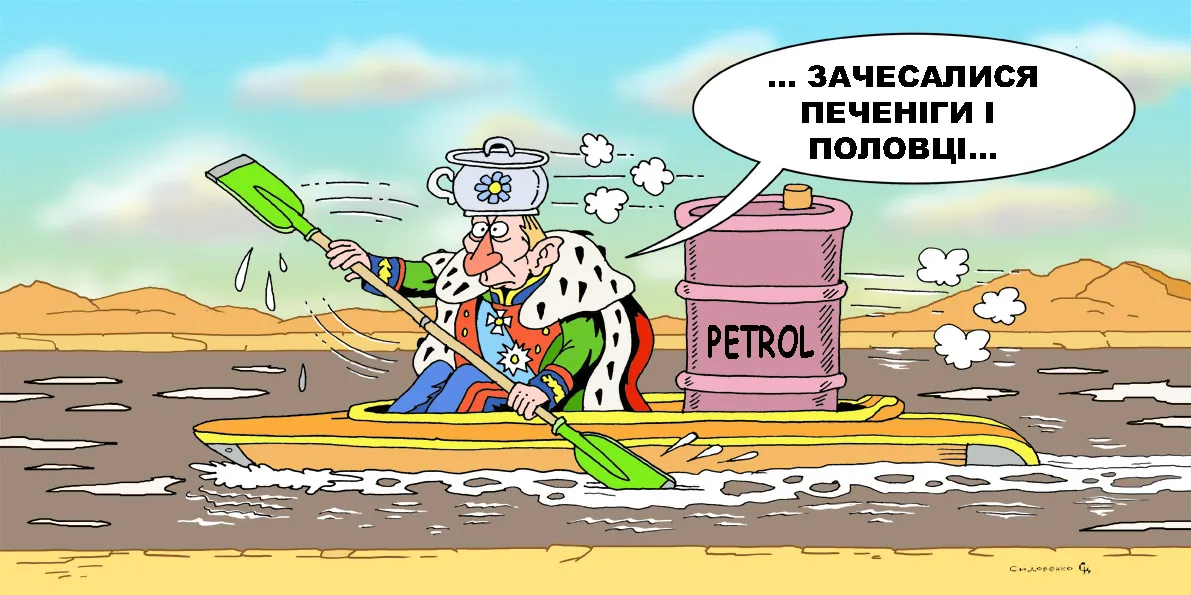
Cartoon by Olexandr Sydorenko.
At negotiations in Pakistan, the parties simply cannot reach an agreement. Finally, one diplomat whispers to another: "You know, we have two ways to solve the problem: a realistic one and a fantastic one." "And what are they?" "The realistic one is if aliens from space fly down and fix everything for us." "And the fantastic one?" "The fantastic one is if we ourselves agree on something."
This joke, circulating in the corridors of the Serena Hotel in Islamabad, describes better than anything else the atmosphere of the first round of negotiations between the USA and Iran. While US President Donald Trump stated that he is extending the truce with Iran indefinitely, diplomacy increasingly resembles a "fantastic" scenario where both sides speak different languages of power.
While the USA tries to play the "art of the deal," Iran plays the "art of survival." The difference is that for Trump, these are negotiations about prestige, but for Tehran—about existence itself.
Summary
This media review analyzes three pivotal geopolitical and cultural shifts occurring in April 2026.
The US-Iran Standoff: Negotiations in Islamabad have reached a "fantastic" deadlock. While the U.S. pursues a "total victory" strategy under Donald Trump, Iran views its nuclear and proxy assets as existential foundations rather than bargaining chips. The lack of decision-making authority within the U.S. delegation further complicates the path to peace, risking a return to full-scale regional conflict.
"Donnyland"? Ukraine proposes renaming part of Donbas after Trump — The New York Times. According to observers Anton Troianovski and Andrew Kramer, this proposal reflects a global reality where governments appeal to President Trump’s vanity to secure American influence, much like Poland’s "Fort Trump" or the "Trump Route" in the Caucasus. Applying such a name to a devastated, depopulated stretch of industrial heartland underscores the lengths to which international actors will go to align themselves with U.S. power in the current geopolitical climate.
The Bulgarian Political Shift: Rumen Radev’s "Progressive Bulgaria" alliance has secured a dominant parliamentary majority, signaling a move toward "pragmatic" pro-Russian neutrality. Critics label Radev a new "Trojan Horse" within the EU, utilizing populist rhetoric and controversial energy contracts (like the Botaş deal) to mask continued dependence on Russian gas.
The end of the cloak and dagger era: Modern geopolitics is undergoing a radical transformation as the "cloak and dagger" secrecy of the Cold War gives way to a new era of overt electoral interference. From high-profile endorsements of Viktor Orbán in Hungary and Sanae Takaichi in Japan to early outreach toward Jordan Bardella in France, the Trump administration has institutionalized foreign electioneering as a cornerstone of U.S. national security strategy. By replacing clandestine intelligence operations with public social media endorsements and engineered campaign swings by Cabinet officials, global powers have turned foreign ballots into open battlegrounds for ideological alignment, blurring the line between domestic politics and international diplomacy.
Cultural Reflections of War: The review highlights the enduring relevance of Picasso’s Guernica as a backdrop for President Zelenskyy’s visit to Spain, symbolizing the modern horrors of aerial terror. Simultaneously, the mobilization of Ukrainian writer Andriy Lyubka illustrates a profound shift in the intelligentsia, where cultural figures trade "the pen for the drone" to gain the moral right to tell the story of their nation's survival.
Read more in the Ukrainian edition....
This material was created within the framework of the project of the Institute of Mass Information with the support of the Ministry of Foreign Affairs of the Netherlands.

Comments
Some more relevant news for now