















The Kitaihorod Recipe: Why It Is Talked About at the UN and Where the Community Will Be in 5 Years?
Articles | | 1,450 | Author: Olena Zelenina
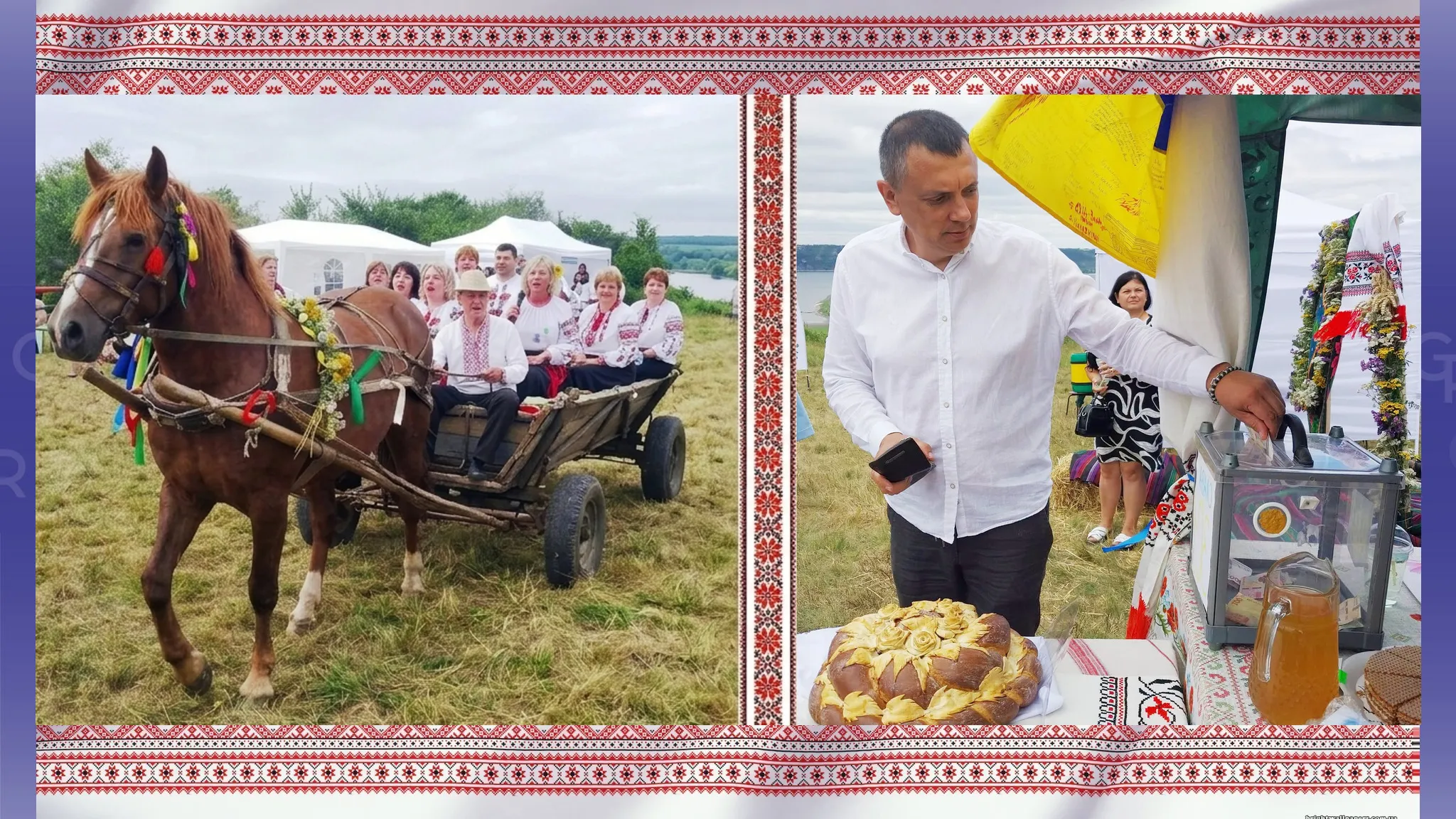
Collage by Olena Zelenina.
When discussing the challenges of the full-scale war, media attention is usually focused on regional centers and industrial giants. However, the real test of the viability of decentralization is passed daily by small, low-population communities.
This is the subject of a conversation between journalist Oleksandr Shvets in a new episode of "Voice of the Community" — a joint project of the local media network Gromada Group and the Kharkiv Press Club. The guest was Yuriy Bezrodnyi, head of the Kitaihorod Village Territorial Community (TC) of the Khmelnytskyi region.
The Kitaihorod community is one of the very first in Ukraine; in August 2026, it celebrated its 11th anniversary. At one time, the local press called it one of the most problematic: a scattered territory (13 settlements, 5 starosta districts), a population of slightly over 3,700 residents, a lack of large-scale industry, and a significant distance from recreational centers. However, over more than a decade, the community has managed to turn its disadvantages into competitive advantages.
Administrative Logic and Budget Sustainability
The first non-standard step of Kitaihorod was the decision to locate the administrative center not in Kitaihorod itself, but in the village of Vykhvatnivtsi. This is a natural crossroads where logistical routes from all the villages of the community converge. It is convenient for people to reach by transport, and local authorities oriented themselves around this very comfort.
The war dealt a heavy blow to demographics and the local economy. However, while in 2020 the community's own revenues amounted to only 7 million UAH, in 2025 this figure reached almost 21 million UAH.
This threefold growth is the result of flexibility: the community provides benefits and attracts businesses, relocates enterprises (in particular, an enterprise from Zaporizhzhia that creates about 100 new jobs), and makes a decisive bet on the tourism industry.
UN Global Initiative and the Bet on Tourism
Small Kitaihorod has become one of five Ukrainian candidate villages for participation in the UN global initiative Best Tourism Villages. And there is truly something to be proud of: the unique Kitaihorod outcrops, the Potocki Castle, picturesque canyons, and the banks of the Dnister River, which washes most of the community's territory.
"The budget needs to be replenished, and since our region is not industrial, we made a bet specifically on tourism development. Over five years, tourist traffic here has grown 2.5 times, and the tourist tax exceeded the 100 thousand hryvnia mark. For us, this is just the beginning," stresses Yuriy Bezrodnyi.
The community does not work in isolation. On the initiative of a People's Deputy and neighboring communities, a joint municipal enterprise of four TCs was created (Kamianets-Podilskyi, Staroushytsia, Kitaihorod, and Khotyn), which will attract grants and investments for joint tourist routes, cycling, and water rafting on the Dnister.
Care for People:
From Free Meals to a Culture of Daily Life
The social block is no less impressive. All 205 schoolchildren in the community eat in schools completely free of charge at the expense of the local budget.
The community launched a network of free social services: a social hairdresser and a seamstress who travel to elderly people in remote villages, a social taxi for military personnel, IDPs, and people with disabilities, and is also preparing to open a Hygiene Center with laundry and shower facilities.
In parallel, Kitaihorod is shaping a daily culture of civic life. To combat illegal dumpsites on poles and trees in problematic areas, the community installs hidden trail cameras.
Photo-fixing violators and holding them administratively liable brought an immediate result — residents are massively switching to official garbage disposal at a symbolic rate of 50 UAH/month.
An example of partnership during the war is the cooperation with the Oleksiivka community of the Kharkiv region: despite the distance and the challenges of the front, children from the Kharkiv region have been coming for rest and health recovery to picturesque Podillia for two consecutive years.
A Reliable Rear:
5 Cars in Half a Year and the "My Angel Has UAF Wings" Fair
A special source of pride and priority for the Kitaihorod community is prompt and bureaucracy-free assistance to the Defense Forces of Ukraine. Responding to the requests of defenders happens instantly — without any queues or delays.
The indicators of the second half of 2024 vividly confirm this: in just half a year, the community managed to attract and transfer 5 cars to military units.
The community has a large-scale charitable tradition — the annual fair-festival "My Angel Has UAF Wings", which takes place in the village of Kolodiivka on the banks of the Dnister. The program includes authentic treats, a fair, master classes, an exhibition of craft products, and a performance by the military band of the 36th Podillia Regiment of the National Guard of Ukraine.
Residents raise significant funds to meet the urgent needs of fellow countrymen at the front: while last year more than 185,000 UAH was raised at the fair, during the recent event, the assistance bank was replenished by another 161,000 UAH.
In the villages of the community, the collection of humanitarian supplies, the production of trench candles, the weaving of camouflage nets, and the preparation of food products for the frontline are organized.
In addition, the community has taken under special patronage the families of military personnel, missing persons, and fallen Heroes, providing them with social taxis, benefits, and personal assistance.
Bottom-Up Initiative and Support for IDPs
Despite the difficulties, participation is developing in the community. Any initiatives are agreed upon with residents, and self-organization yields concrete results:
· Local projects: in the village of Demshyn, residents personally cleared a pond and set up a park with municipal and financial support from the village council.
· Integration of displaced persons: internally displaced persons revitalize community life, purchase houses for permanent residence, and initiate their own social and charitable projects.
Comparing Experience: From "Extras" to Masters
Assessing the 11-year path as head, Yuriy Bezrodnyi recalls the times before the reform, when village councils functioned essentially as extras:
· Before decentralization: lack of a real budget; work came down to issuing certificates or unloading two truckloads of gravel for the entire settlement.
· After decentralization: a drastic expansion of opportunities. Almost all cultural institutions have been renovated in the community, a new modern outpatient clinic has been built, extensive work is underway on the lyceum, and local starostas provide a full range of services to residents without the need to travel to the center.
Reflecting on the necessary legislative changes, the head of the community emphasized the need for further expansion of local self-government powers. According to him, at the level of small communities (3–5 thousand population), there is no threat of "local authoritarianism," as the leader and deputies constantly report to voters in person.
However, another problem is acute — a shortage of the deputy corps due to war and migration.
"In our community, 4 deputies have already surrendered their powers, and now a fifth is in line (someone is abroad, someone for other reasons). Because of this, it is difficult to gather a quorum for adopting critically important decisions," emphasized Yuriy Bezrodnyi.
The community pinpoints hopes on draft bill No. 14405 (regarding decision-making based on the actual number of elected deputies in communities of up to 10 thousand population).
Blitz Vision: Kitaihorod in 5 Years
When asked what keeps him in shape through the years of leadership, the head answered: "A reliable team of the apparatus that believes in ideas, and the trust of the people."
Among the main current tasks are energy independence (installing solar panels on all social facilities in case of blackouts) and road repairs.
"Kitaihorod in 5 years is a tourist hallmark of Podillia and all of Ukraine," summarized Yuriy Bezrodnyi.

Comments
Some more relevant news for now