









Russian Generals Behind the Attack on "Factor-Druk"
Articles | | 939 | Author: Olena Zelenina
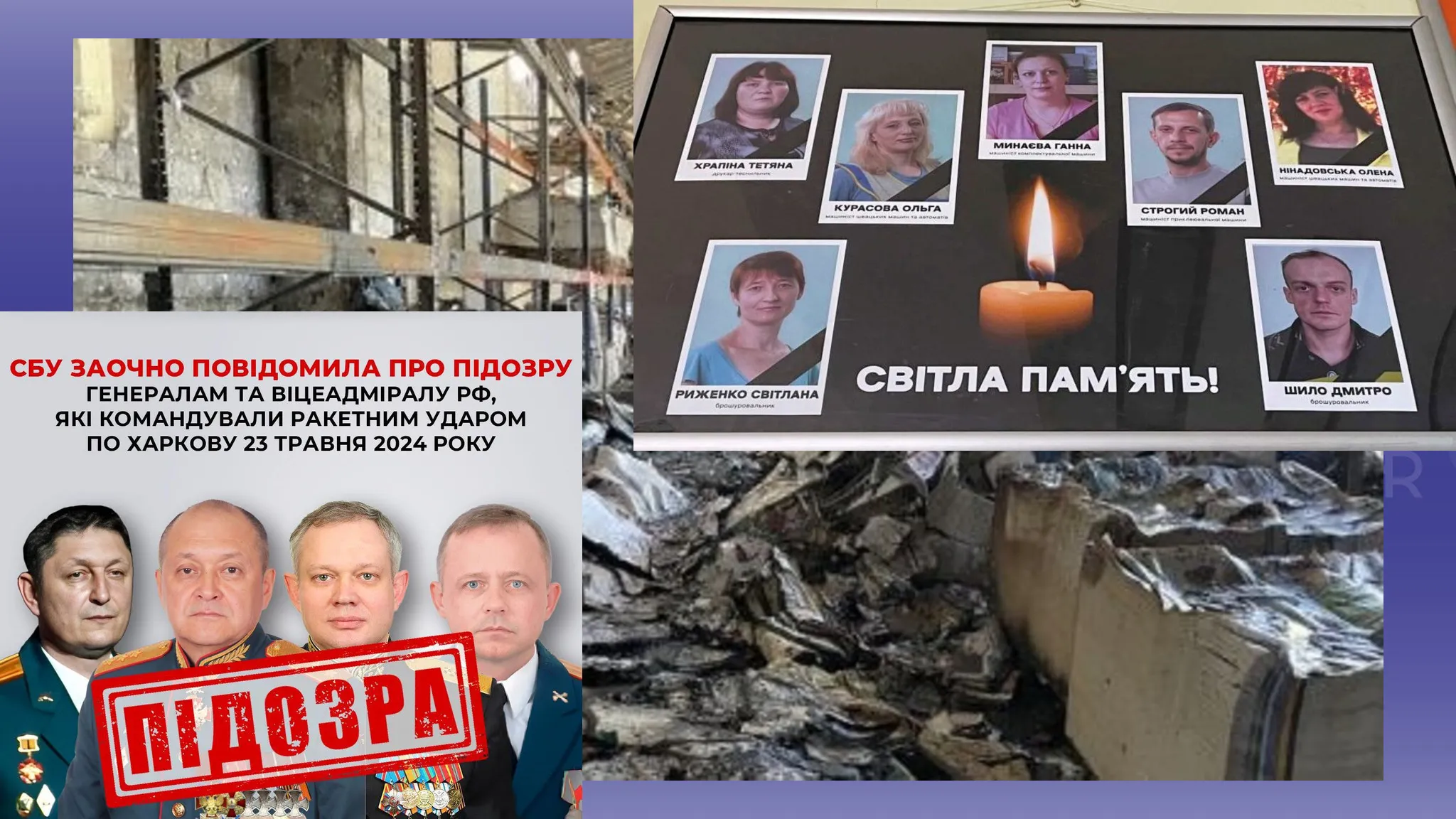
Photo collage by Olena Zelenina/ Foto: Office of the Prosecutor General of Ukraine and Factor-Druk.
Office of the Prosecutor General of Ukraine has officially announced suspicions against four high-ranking Russian military officials responsible for one of the most resonant war crimes in Kharkiv — the missile strike on the country's largest printing house, "Factor-Druk."
As a reminder, on May 23, 2024, Russia attacked the civilian enterprise with three S-300 missiles. As a result of the strike, 7 employees were killed, and 9 others were injured. Printing equipment and over 50,000 textbooks intended for Ukrainian schoolchildren were destroyed.
Who Gave the Order?
Thanks to the joint work of the SBU and the Main Intelligence Directorate of the Ministry of Defense (GUR MO), it was possible to reconstruct the decision-making chain minute by minute. The following individuals have been held criminally liable (in absentia):
Colonel General Aleksey Kim
Role: Made the final decision to shell the civilian object.
Dossier: Since 2022 — Deputy Chief of the General Staff of the Russian Armed Forces. He is considered an "experienced war criminal": he went through Afghanistan, Tajikistan, and both Chechen wars. He specialized in "suppressing insurgencies" and operations in Syria and Chechnya.
According to the "Myrotvorets" database, he took an active part in planning the aggression against Ukraine as early as the stage of creating puppet "republics" in Donbas. He was the deputy commander of the Russian group of forces in Syria, where he practiced "scorched earth" tactics.
Formerly the head of the Center for the Reconciliation of Controversial Parties in the Syrian Arab Republic (CPVS).
It was during Kim’s command that some of the most brutal operations to "reconcile" the enclaves around Damascus and in the Homs province took place. In international reports (e.g., Human Rights Watch), this period is described as the "Surrender or Starve" strategy. Under Kim's leadership, the CPWC coordinated humanitarian pauses which, according to observers, were used to regroup forces and pressure the civilian population to force the opposition to evacuate the territories.
In 2017, the CPWC actively broadcasted narratives about "chemical provocations" by the opposition.
Observers point out that it was under Kim that the Center became the primary tool for the shifting and discrediting of the "White Helmets."
In specialized military blogs (even those loyal to the Russian Federation), Kim is often described as a specialist in “unconventional methods of warfare.”
Unlike many "armchair" generals, Kim is under heavy sanctions pressure, which confirms his significance within the Russian criminal military hierarchy.
Colonel Sergey Monetov
Role: Initiator of including the printing house in the list of targets.
Context: It was he, as the head of intelligence, who provided the coordinates of the enterprise, deliberately marking it as a "military target" despite the obvious civilian nature of the object.
Vice Admiral Alexander Peshkov
Role: Was directly involved in the preparation and planning of the strike.
Dossier: Former commander of the Caspian Flotilla (2021–2024). His career is closely linked to the Northern Fleet of the Russian Federation.
Notably, Peshkov participated in the operation to raise the sunken submarine "Kursk." Now, from naval operations, he has moved to planning missile terror against Ukrainian cities.
Alexander Peshkov, as commander of the Caspian Flotilla, participated in this crime not as a "sea wolf" on board the ship, but as a member of the task force.
His role: The investigation indicates that he was responsible for planning and coordinating the fire strike.
Hybrid command: This confirms the practice of high-ranking officers from various fleets and districts being brought into joint headquarters to direct strikes on Ukraine, even if it's not their "specialized" region or branch of the armed forces.
Lieutenant General Andrey Tsyganov
Role: Gave the order to launch missiles from the territory of the Belgorod region.
Context: Commander of the 14th Air Force and Air Defense Army of the Central Military District. Under his leadership, special tactical group No. 3, formed on the basis of the 568th Anti-Aircraft Missile Regiment, operated.
Legal Consequences and Qualification
As reported by the spokesperson for the SBU Office in the Kharkiv region, Vladyslav Abdula, all defendants have been notified of suspicion under Part 2 of Art. 438 of the Criminal Code of Ukraine (violation of the laws and customs of war, combined with intentional murder).
"These people were not just following orders. They purposefully chose a place where school textbooks were printed as the object of attack to deal a maximum blow to Ukrainian education and culture," — state the investigation materials.
Currently, measures are underway to place the suspects on the international wanted list. Crimes against humanity have no statute of limitations, and everyone on this list will sooner or later stand before a court or share the fate of other liquidated war criminals.
More information is available on the official SBU website and in the "Myrotvorets" database.

Comments
Some more relevant news for now