















The Mystery of the Scythian Cap. A Unique Find by Kharkiv Archaeologists
Articles | | 1,816 | Author: Olena Zelenina
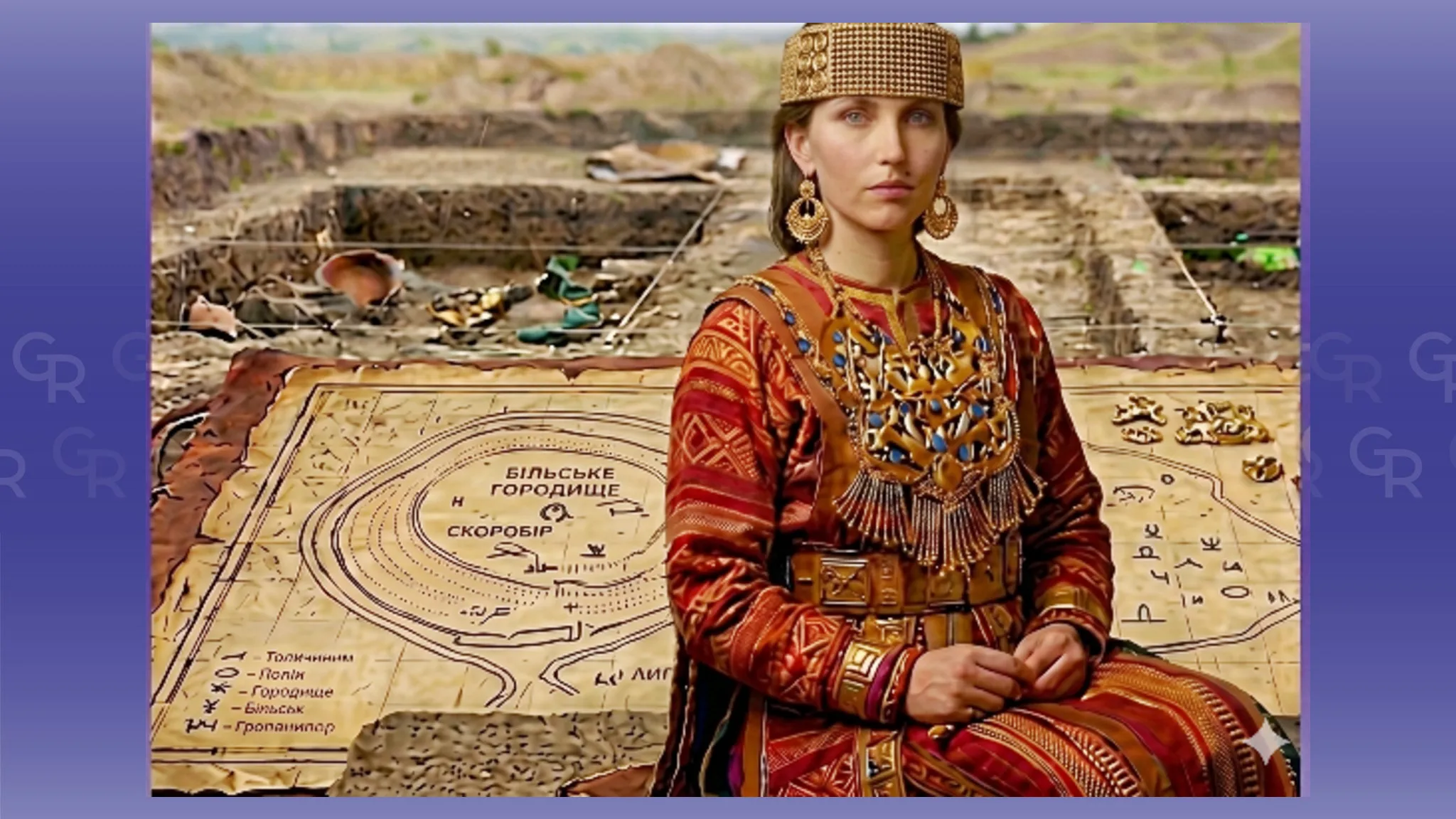
Collage created using Gemini / Idea by Olena Zelenina.
Look at this photograph! At first glance, it is just a headpiece, but it is worth looking closer to understand: before us is a true jewelry masterpiece, created over two and a half millennia ago.
With what incredible perseverance the ancient master worked on this product! The entire surface of the cap is literally "embroidered" with thousands of tiny bronze hemispherical plaques. These "beads", which tightly cover the leather base, create not just a texture, but a real protective armor — both physical and sacred.
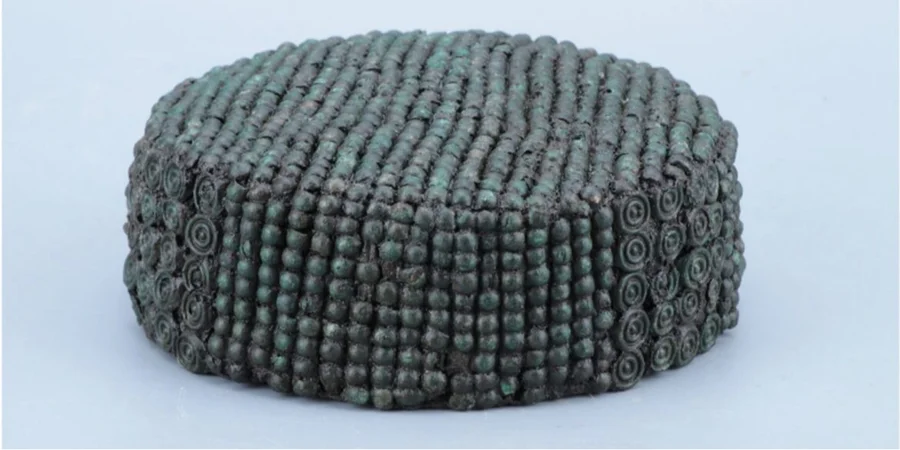
Central European women's clothing ensemble from a barrow of the Skorobir necropolis (Photo: Historical and Cultural Reserve "Bilsk")
But the most interesting part is the patterns on the sides of the headpiece. The very "labyrinths" that attract attention are interpreted in the scientific world as solar signs — symbols of the sun. For the people of the Scythian era, this was not just decoration, but a powerful magical amulet.
As noted by the researcher of the Bilsk Hillfort, Iryna Shramko, such finds testify to the existence of an integrated system of prestigious costume that connected steppe Scythia with Central Europe of that time:
"The discovery of such unique accessories as this leather headpiece and belt testifies to complex migratory and cultural processes. We see not just imported items, but an integrated system of prestigious costume, which was a sign of the high social status of the female owner."

Collage by Olena Zelenina. Photo: Historical and Cultural Reserve "Bilsk".
This cap is eloquent proof that Scythian masters were true virtuosos. Each such "bead", each solar symbol is not only painstaking work, but also the invested soul of the master. Today we see this object as a unique artifact that tells us through the centuries a story about high fashion, the richness of cultural ties, and the incredible craftsmanship of our ancestors.
The unique finds had to be saved right in field conditions — this was done by restorers of the Kharkiv branch of the National Research Restoration Center of Ukraine, Serhiy Omelnyuk and Volodymyr Bolotin. The work was precise (jewelry-like) and risky: the shriveled leather practically did not yield to softening, and any mistake could destroy the artifacts. Ultimately, the masters managed to stop the destruction and conserve the objects, completely preserving their shape.

The Balkan Trace Near Poltava
Archaeology is not only about potsherds and rust. It is about detective stories stretching through millennia. Recent studies at the Bilsk Hillfort, conducted by scientists from V. N. Karazin Kharkiv National University, force us to reconsider our ideas about the boundaries of the "Scythian world".
The Skorobir necropolis became the central object of attention. Here, archaeologists discovered the burial of a woman whose social status was indisputably high. However, the real sensation was hidden in the details of her outfit.
Thanks to DNA analysis of the teeth, conducted in the laboratory of Tartu University (Estonia) under the leadership of Karazin University professor Dr. Olha Utevska, it was possible to establish: this woman had a genetic relationship with tribes that lived on the territory of modern Croatia.

Most interestingly, the style of this headpiece, known as "Lika", is still a part of the traditional national costume of Croatians today. Seeing how this item looked 2500 years ago became possible thanks to a three-dimensional model prepared by Valentyn Shramko.
The Future of the Finds:
From Display Case to Safety
The uniqueness of this women's set is so high that it has already been submitted for inclusion in the State Register of National Cultural Heritage of Ukraine. It is planned that the cap and belt will become the central exhibits of a special exhibition in Poltava, where other finds from the Skorobir necropolis will also be presented.
However, the joy of a scientific breakthrough is mixed with anxiety. As researchers note, the main challenges remain the security of the collections and the creation of proper conditions for their storage and restoration. After all, preserving for descendants an object that has lain in the ground for over two and a half millennia is a task no less difficult than excavating it.
Kharkiv archaeologists continue their work, proving: the history of Ukraine is not an isolated island, but a part of a large pan-European mosaic where our ancestors played key roles.
REFERENCE of "Gromada"
Bilsk Hillfort in the Poltava region is considered one of the most important sites of the Early Iron Age in Eastern Europe. Many researchers identify it with the city of Gelon, described by the ancient Greek historian Herodotus. It was not just an outpost, but a huge political and cultural center at the intersection of trade routes between the Greek colonies, nomadic Scythians, and settled communities of the forest-steppe.

Comments
Some more relevant news for now