
























Top PSYOPs of the Week (July 13 – July 19, 2026): Burnt Relics! Why Graduates in Ruska Lozova and Gas Stations in Kharkiv Scare Moscow More Than ChatGPT?
Articles | | 1,549 | Author: Olena Zelenina, Olexandr Sydorenko (caricature)
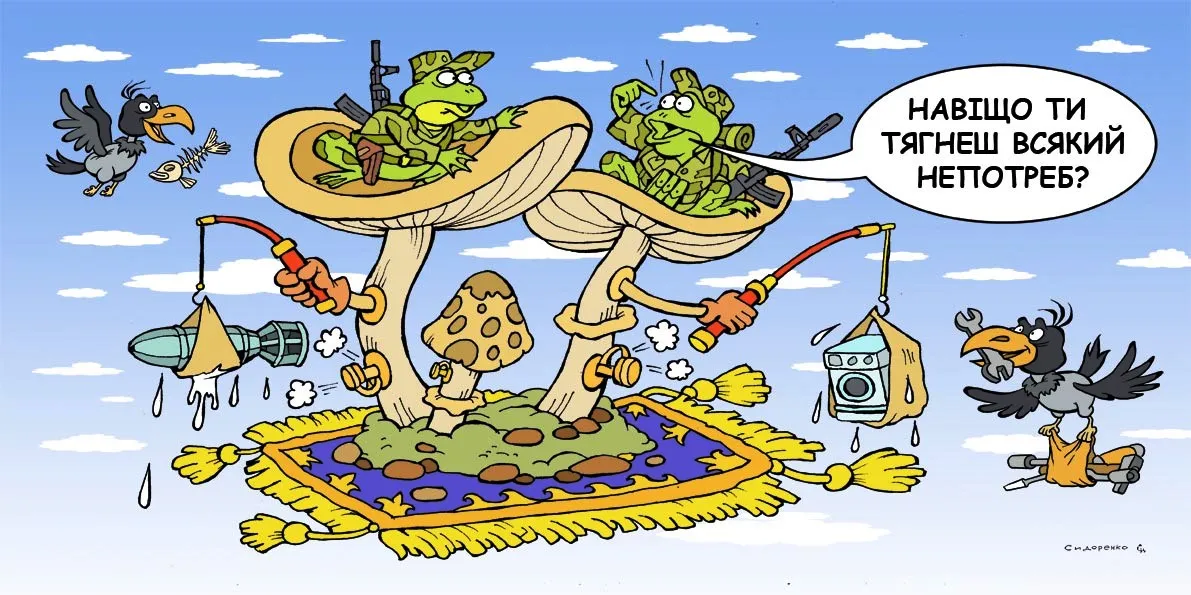
Cartoon by Olexandr Sydorenko.
Leo Tolstoy and Dostoevsky meet in the afterlife: — You know, Fyodor Mikhailovich, — Tolstoy sighs, — I look at this "special operation" of theirs... It is pure "War and Peace"! A senseless war for the sake of a petty tsar's ambitions, which will end in complete collapse and shame for Russia.
Dostoevsky, gloomily adjusting his blanket:
— Oh no, Lev Nikolayevich... "War and Peace" is for high society. But what they are doing in Ukraine now is pure, refined "Demons". Psychopaths obsessed with destruction, who have dragged an entire country into a bloody swamp.
Tolstoy thought for a moment and said:
— Well, the main thing is that in the end, "Crime and Punishment" comes out of it.
This joke perfectly illustrates the main trend of Russian PSYOPs (psychological operations) this week. Russian liberals and the so-called "good Russians" suddenly remembered humanism and in unison struck up the old song: "In this war there will be no winners, only the defeated will remain."
The most interesting thing is that, as their main argument, they began to massively drag quotes by Valerii Zaluzhnyi into their narrative — specifically his theses on the "positional deadlock" and technological breakthrough, twisting them beyond recognition.
When Zaluzhnyi wrote about the transition of the war into a positional phase, he was acting as a military analyst and strategist. His message was clear: we need new technologies and air parity to break the enemy's defense. This was a sober calculation and a call to action for Western partners.
What do the "good Russians" do? They take the word "deadlock" and interpret it as: "See? Even your legendary general says that Ukraine cannot win, so let's negotiate on the Kremlin's terms."
The thesis "there will be no winners" is a classic emotional manipulation. It places the aggregator (who came to destroy and capture) and the victim (who defends its right to exist) on the same scale.
For Russia, "not winning" simply means retreating to its borders and licking its wounds. For Ukraine, "not winning" means disappearing from the world map as a nation. Therefore, the phrase "everyone loses" is intended to blur Russia's guilt and force the West to reduce its support for Ukraine under the pretext of a "humane end to the bloodshed."
Russian liberals are trying to sell the world Ukraine's capitulation in a beautiful wrapper of "pacifism," hiding behind the out-of-context words of the Ukrainian general, and trying to save Russia from a future tribunal (that very "Crime and Punishment").
The Parade of Sovereignty Inferiority
Russian state propaganda suffered a severe case of cognitive dissonance over the annual military parade in Paris. After years of preaching hatred toward Ukraine, Russian state TV hosts (like Olga Skabeeva) went into hysterics watching Ukrainian soldiers march proudly down the Champs-Élysées.
Lacking any logical response, the Kremlin's mouthpieces desperately tried to hijack the glory, screaming that the Ukrainians marched "just like they were taught in the USSR," "like the Kremlin guard," or "using the marching step introduced by Russian Emperor Paul I." This reaction perfectly exposes Moscow's toxic "big brother" syndrome — an inability to accept Ukrainian self-sufficiency and a pathetic urge to claim credit for Ukraine's international recognition.
The Zaporizhzhia "Offensive" in the Enemy’s Imagination
This week, Russian Telegram channels heavily pushed a panic narrative claiming that the ZSU lines on the southern front had collapsed and Russian troops were on the verge of entering Zaporizhzhia. However, a field report by the German outlet WELT completely debunked these myths.
Ukrainian front-line commanders confirmed that the defenses remain rock-solid, and the enemy's "successes" are nothing more than short-lived PR stunts. Russian suicide assault groups occasionally manage to breach a position for a few hours just to take a photo before being completely wiped out.
Meanwhile, Ukrainian long-range drones are systematically turning Russian rear logistics into ashes.
Fanning Kharkiv’s Fires
with Russian Fears (Mirror Propaganda)
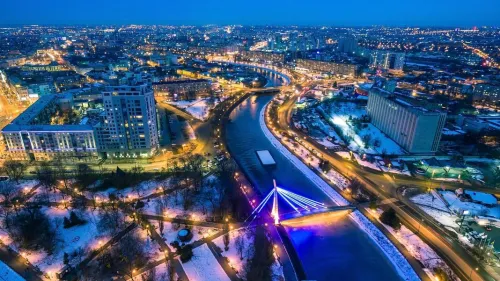
Moscow launched a localized disinformation campaign claiming that Kharkiv was facing a catastrophic fuel shortage due to "destroyed gas stations." In reality, this was a textbook example of "mirror propaganda" — projecting Russia's own structural failures onto Ukraine.
An investigation by the Kharkiv Press Club proved that gas stations in the city are operating normally with stable prices. The fake photos used by Russian bots actually depicted long lines from past fuel crises inside Russia.
This PSYOP aimed to trigger panic-buying, terrorize civilians into evacuating the fortress-city, and provide a mental coping mechanism for ordinary Russians who are currently witnessing their own oil refineries being regularly blown up by Ukrainian drones.
How Russians Feared
a School Graduation in Ruska Lozova
The occupation authorities, led by puppet official Vitaly Ganchev, spread a bizarre rumor that a school in the village of Ruska Lozova (Kharkiv Oblast) was extorting money from students for military "food rations" under the threat of withholding their graduation certificates. The truth turned out to be incredibly inspiring: the school voluntarily joined the nationwide "Donated Instead of Flowers" campaign.
The community raised 113,369 UAH, which was used not for food, but to buy 5 Starlink terminals and 4 routers for the reconnaissance unit of the 58th Motorized Infantry Brigade. The fake reflects a deep psychological projection: Russian officials cannot comprehend voluntary civilian support, as their own system relies on forcing citizens to pack socks and canned goods for their troops under duress.
The Scarcity of "Powers":
Loss of Relics and the Collapse of Tech Myths
Social media erupted with satire over rumors that a Ukrainian strike destroyed a Russian transport vehicle carrying the holy relics of Prince Alexander Nevsky to the front lines. While Novaya Gazeta Europe ultimately exposed the story as a network parody rather than a factual event, the myth went viral because it mirrors the absurd, neo-medieval reality of the Russian army.
The Russian Ministry of Defense routinely flies icons around military sites and has previously lost a $40 million fragment of the True Cross on the sunken cruiser Moskva. The parody also accurately highlights historical irony: Alexander Nevsky was actually a brutal collaborator with the Mongol Horde who blinded his own citizens.
As Russia increasingly turns to mysticism and fake holy relics to boost its fading military "power," the civilized world is moving forward. According to the 2026 Global Survey by the Digital Education Council (DEC), global universities are successfully integrating cutting-edge Artificial Intelligence (AI) into higher education, leaving Russia’s isolated, chip-starved economy standing on the sidelines of human progress.
Read more in the Ukrainian edition....

Comments
Some more relevant news for now