










Trostyanets: Reconstruction Not "As It Was", But "Better Than It Was"
Articles | | 1,828 | Author: Olena Zelenina
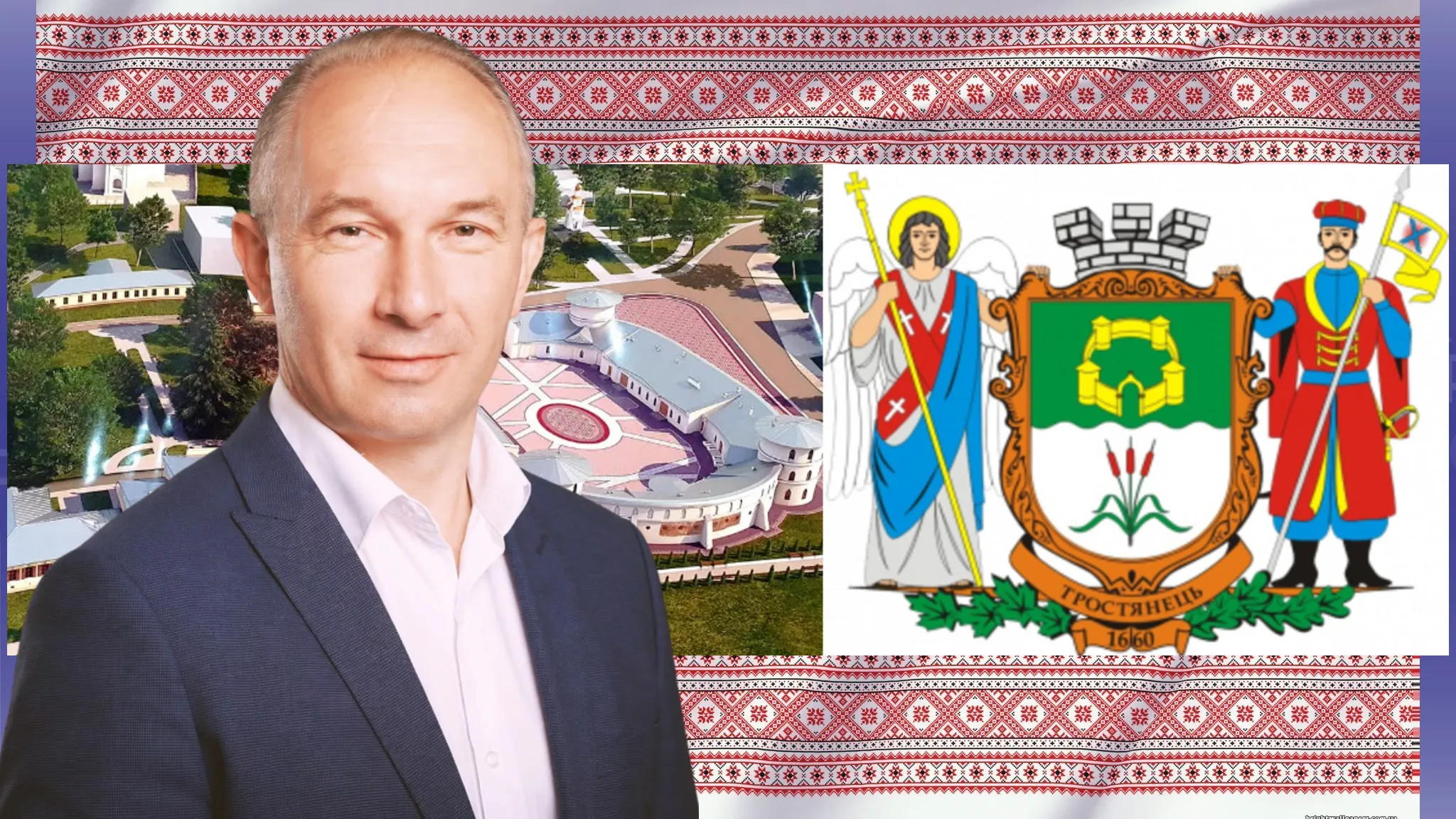
Collage by Olena Zelenina.
Thirty-one days of occupation — from February 24 to March 26, 2022 — and four years that were needed to gather what survived and build anew what had disappeared.
About this path on the air of the "Hromada Voice" project of the Kharkiv Press Club told the mayor Yuriy Bova — a person who has been managing the hromada (community) for six terms already and saw it both as a depressed district center in 2005, and as scorched frontline land in 2022, and as what Trostyanets is trying to become today — an energy-independent, "green" model city.
A Month That Cost a Decade
There are cities whose biography is measured in years. And there are those whose fate breaks sharply in a single month. Trostyanets in Sumy Oblast belongs to the second category.
The numbers that open this story speak more for themselves than any epithets. During the occupation in the hromada, about one hundred facilities were damaged or destroyed, losses according to various estimates reached 120 million dollars, almost 900 residential houses and apartments were destroyed.
But, as Bova clarifies, these numbers are only the visible part of the catastrophe: during the occupation, all enterprises, small and medium businesses, all utility vehicles — from garbage trucks to ambulances — were looted, and budget institutions were left without a single surviving computer or printer.
The city hospital suffered the most — Russians shelled it from tanks and mortars, blowing out 480 windows. The reason, according to the head of the hromada, is simple and terrible at the same time: medical workers refused to cooperate with the occupiers.
For this they paid with both the building and, most importantly, with lives: 49 residents of the hromada died during the occupation, about ten more people are still considered missing without a trace. Tortures took place right in the center of the city — in the boiler room under the railway station, which the occupiers turned into a torture chamber.
And despite all this — the city resisted. They acted as partisans, baked bread for the military, launched drones to record the movements of enemy equipment and pass intelligence. It was thanks to this data, according to Bova, that liberation became possible — on March 26, 2022, Trostyanets became the first liberated Ukrainian city, not just a village.
At the same time, the occupiers lost 142 units of equipment here and rushed to flee — this, as the head of the hromada notes, was the first flight of the Kantemirovskaya Tank Division from Ukraine. In the headquarters that the Russians set up right in the offices of the city council, plans for a further offensive were later found — on Okhtyrka, Lebedyn, Sumy.
From Scratch:
How the Dead City Was Coming to Life
The liberated city found itself on the brink of a humanitarian catastrophe: without electricity, without water, without medicines, without internet. The first thing the local government did was starting to bring in dozens of tons of humanitarian cargo daily so that, in Bova's words, "from the first day of liberation Trostyanets was not hungry."
The hospital, destroyed and seemingly doomed to mothballing upon the recommendation of the State Emergency Service, they decided not to close. Medical staff were given a month to rest, and in the meantime patched up those premises where damage was less — and already in a month the hospital was accepting its first patients again.
A telling detail: when civic activist from Kyiv Anna Hulevska, unknown at the time to the head of the hromada, offered 10 thousand dollars for medical equipment, Bova asked instead to fund windows for the hospital — there was nowhere to put equipment yet. The money did not arrive immediately, but the factory took the order on trust, and in just a few days windows were being transported to Trostyanets. This, according to the head of the hromada, is that human dimension of reconstruction which is not always noticeable in dry reports about millions of hryvnias of assistance.
Overall over four years, according to the hromada's estimate, the state directed about one billion hryvnias toward the recovery of Trostyanets, approximately the same amount — international partners. About the scale of losses reminds the book "Trostyanets. Chronicle of an Unconquered City", written by Sumy writer Yevhen Polozhiy based on the memories of doctors, teachers, librarians, and military personnel who survived the occupation.
Reconstruction Not "As It Was",
But "Better Than It Was"
The key principle, which, according to Bova, was formulated personally by the President during his visit to the city in March 2023, is build back better.
Not restoring the destroyed in the form in which it was, but making it better: safer, more energy-efficient, more inclusive. An example is the railway station, which previously did not have a single ramp for people with disabilities, and is now being rebuilt with accessibility in mind. Or road repair, during which all underground utilities are completely replaced — from storm sewers to lighting — and not simply patching asphalt.
For a systematic approach, the hromada ordered a master plan from the consulting company IC Consulting — a document that European cities compose 5 to 30 years ahead, with clear calculations: how many solar panels can be installed on roofs, how much the reform of municipal solid waste management will cost.
It was thanks to such an approach that Trostyanets got into the state pilot project of comprehensive reconstruction — the only city among five settlements, the remaining participants of which are villages and settlements.
The most telling object of the experiment is a five-story residential building, which the hromada together with the German environmental organization Greenpeace turned into an almost completely energy-independent one. Costing about 230 thousand euros, the project provides for two heating systems — air and ground source heat pumps, as well as solar panels on the roof that power this system. In summer, the building does not consume external resources at all.
Medicine Without Showmanship
Even before the full-scale war, in 2017, Trostyanets Hospital became the first in Ukraine that the local hromada took out of district subordination — and its experience was taken as an example for the nationwide medical reform of 2018.
The principle approach of the head of the hromada: to abandon the Soviet standard of "two bathrooms per floor" in favor of separate bathrooms and showers in every ward — following the model of private hospitals in Poland — fewer beds, more comfort, Wi-Fi, refrigerators.
"I forbade spreading millions of hryvnias of funds with paint," — says Bova about the decision to refuse cosmetic patches in favor of capital repairs that can be transparently checked against the cost estimate.
People, Not Only Numbers
According to official data, 95–98% of the population returned to Trostyanets, and additionally the hromada accepted 2,600 internally displaced persons — proportionally this is comparable to the indicators of Kharkiv. A separate social program is the payment of 7,500 hryvnias to every woman giving birth in the local hospital, regardless of where she came from.
More than 300 elderly people living alone are under the care of the hromada's social services, who regularly visit them at home. And children from families of fallen military personnel or those affected by shelling go on a rehabilitation vacation to the French partner city of Gennevilliers — for four weeks, which, according to Bova, return "a smile to their face and a desire to live on."
Practical Adaptation:
Methane Buses Instead of Gasoline Ones
Another example of a flexible solution in crisis conditions is the choice of transport. Buses received from partners from the city of Bern (Switzerland), Trostyanets deliberately put out on routes running on methane, not on diesel or gasoline.
After the occupiers completely destroyed gas stations in the city, methane remained the only stable fuel that is supplied via pipeline. This is an example of how a frontline hromada calculates the logistics of survival several steps ahead.
Assistance Needs Coordination
The head of the Trostyanets hromada directly stated that very few international donors realize the need to update the municipal transport fleet of frontline cities — the overwhelming majority of programs is focused on humanitarian assistance, power banks, or blankets, whereas equipment — excavators, buses, municipal service vehicles — funds finance by single units.
Even more sharply sounded his assessment of the distribution geography of the equipment that nevertheless arrives. According to Bova, new buses or fire engines often end up in cities in western Ukraine that did not suffer at all from combat operations, whereas frontline Sumy, Chernihiv, Mykolaiv, Kharkiv, whose infrastructure is destroyed daily, do not receive such assistance.
As an example, he cited fresh news that the embassies of Latvia and Lithuania are transferring a significant number of generators and electrical transformers to Lviv — whereas logically, in his opinion, it would be to direct this equipment precisely where there are the greatest destructions.
"Reconstruction priorities must be clearly formed by the state," the head of the hromada is confident, adding that this issue requires elementary coordination of assistance at the level of the profile ministry, which must shape priorities for donors in advance at the stage of the first negotiations with funds.
The conversation, which lasted almost two hours — a record for the "Hromada Voice" project — leaves the impression not of a triumphant report, but of an extremely practical, almost engineering view of reconstruction: without pathos, but with concrete kilowatts, cost estimates, and payback periods. And, perhaps, precisely in this pragmatism lies the secret of why a city that was under occupation for a month and lost a decade of development is today catching up with what was lost faster than might have seemed possible in the spring of 2022.

Comments
Some more relevant news for now