


The war has left its scars in each of us: six investigations by the Kharkiv Press Club from the SCARS\СЛІДИ series at Berlinale 2025
Articles | 06 March, 2025 at 20:50 | 772 | Author: Olena Zelenina
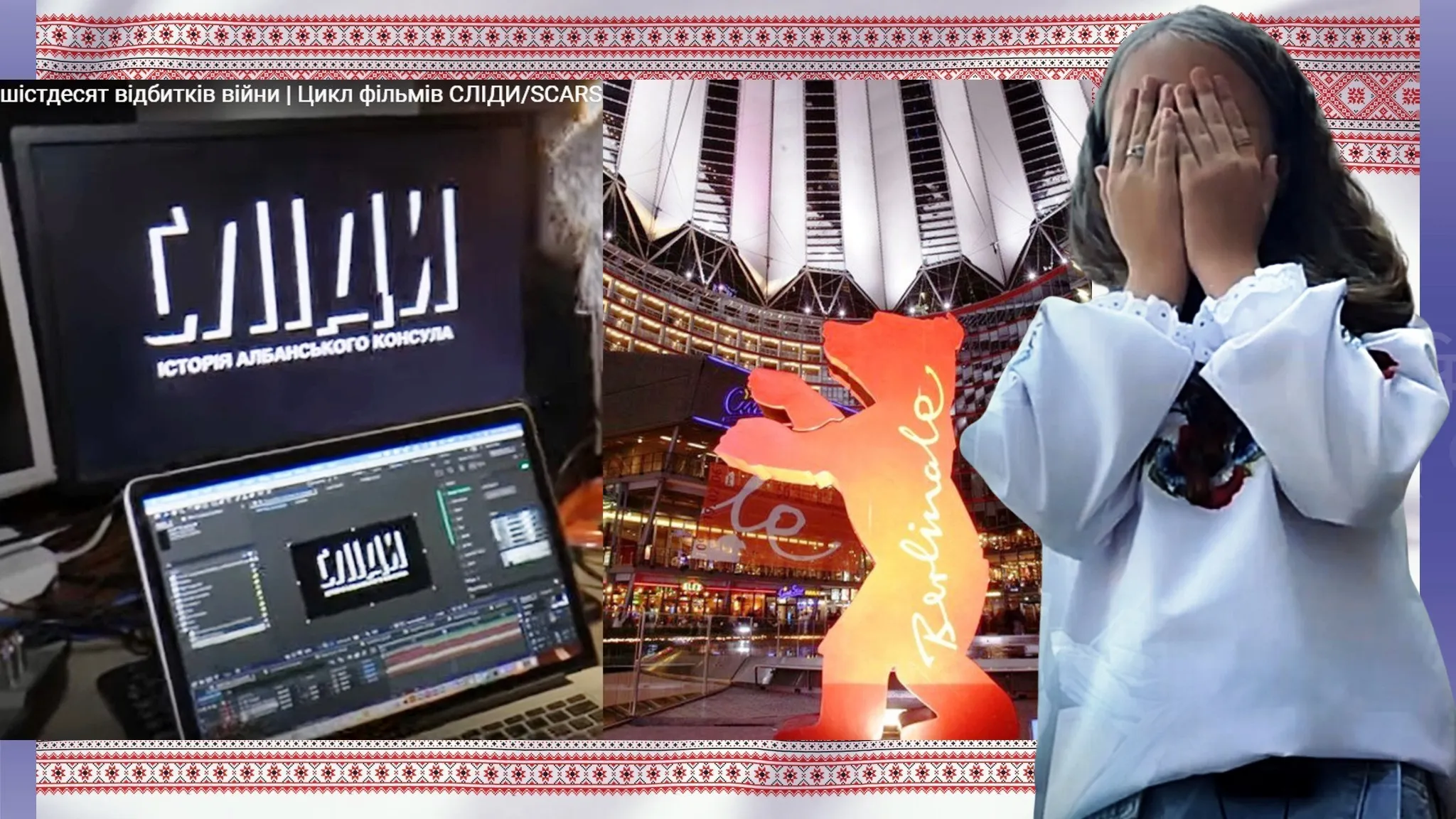
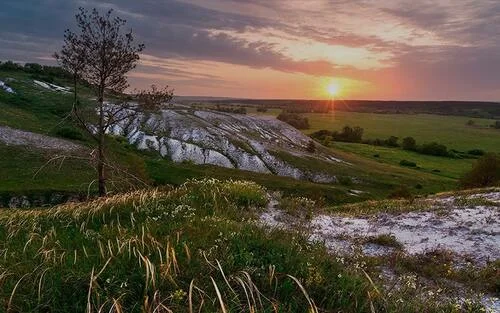
Collage by Olena Zelenina.
The Ukrainian Film Association and the Ukrainian State Film Agency presented a catalog of Ukrainian films at the 75th anniversary Berlinale, the International Film Festival in Berlin.
The catalog (Catalog of Ukrainian Films and Services) was created by the Ukrainian Film Association with the support of the Ukrainian State Film Agency and in cooperation with MRM.
It was launched at the European Film Market (Berlinale), one of the world's most important film markets that brings together film and media industry professionals.
The catalog contains 200+ animated, documentary, and feature films, including six investigative films shot in 2023-2024 by journalists of the Kharkiv Press Club as part of the 60-episode Traces project from the Kharkiv Region: Destroyed but Unbreakable series.
...How did the full-scale war begin for Kharkiv? What plans did the enemy have for Kharkiv? How did the events develop and what traces and scars did they leave in people's lives? What united people and gave them hope in the most difficult times? And what have we not yet been told about it?
A page from the catalog:

“I buried five people in a mass grave-my family, my aunt, and my wife separately,” says Mykhailo Yatseniuk. The people who died in the house stayed under the rubble for a month. Only then did the occupiers allow rescuers in.
Mykhailo recounts how “different fragments of arms and legs were put into one coffin for burial...”About this in the movie “Ground Floor”The city of Izyum is not inferior to Bucha in terms of the number of atrocities committed by Russians against civilians. And the Kharkiv Press Club was one of the first to report in detail on what happened in Izyum.
The press club's journalists also helped their colleagues from Studio 9 Films (UK) to make a moving film about the graves of innocent Ukrainians in the Izium forest.
The film tells the story of the search for the truth about what happened in Izyum, occupied by Russian troops, and for responsibility for the occupiers' horrific war crimes.
For their contribution to the film, the Kharkiv Press Club received a letter of gratitude from London addressed to its director Oleksandr Shvets.
The movie Ground Zero tells the story of another crime: On March 9, 2022, the Russian army launched an air strike on a residential building on Pershotravneva Street.Forget all the old war movies: what's happening in Ukraine today is much more brutal, and the real-life scenarios are even more complicated.
This is the most tragic story of the project, where the only elderly witness who survived and lost all the people he cared about tells how it wasAccording to the project manager Gennadiy Khomyk, to record video stories that document the horrific consequences of the Russian invasion, the film crew of the Kharkiv Press Club asked residents of Kharkiv and the region to share their memories of the events.
A page from the catalog:
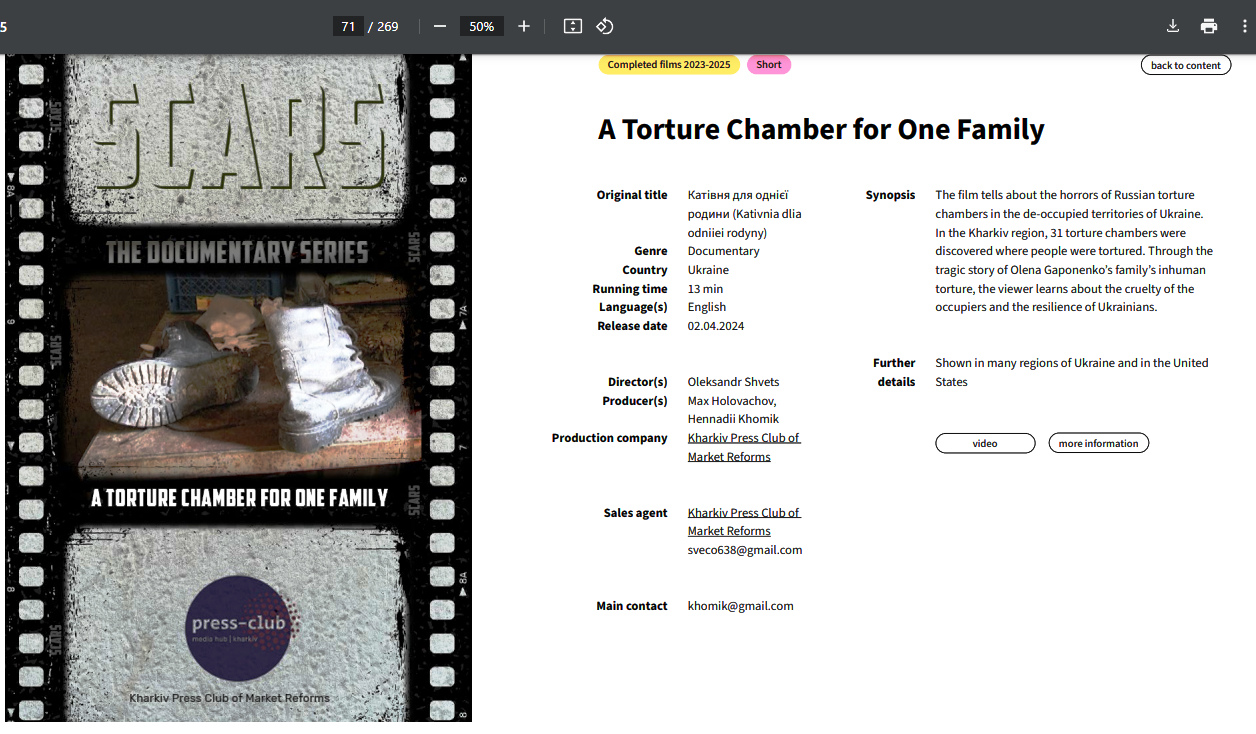
...The family of Olena Haponenko from the village of Kozacha Lopan, Dergachiv community, was taken to a torture chamber by the Russians: she, her son and daughter-in-law, and her daughter...
What did this family and thousands of residents of the occupied villages of the Kharkiv region go through?
In Ukraine, the police discovered 101 brothels in the de-occupied territories where Russian invaders illegally detained and tortured people.
Most of them are in Kharkiv region - 31 torture chambers. The exact number of tortured people is still unknown.
Hundreds of criminal proceedings have been opened in the Kharkiv region regarding the disappearance of hundreds of civilians, children, women and men.
This is the subject of an investigative documentary film by the Kharkiv Press Club, “A Torture Chamber for a Family”.
- “Important: during the filming, journalists of the Kharkiv Press Club asked people to name the missing persons by name,” says Hennadiy Khomik, “hoping that this would help their relatives find them or someone would provide information about their fate...
Imagine that you cannot reach your loved one for hours, days...
A page from the catalog:
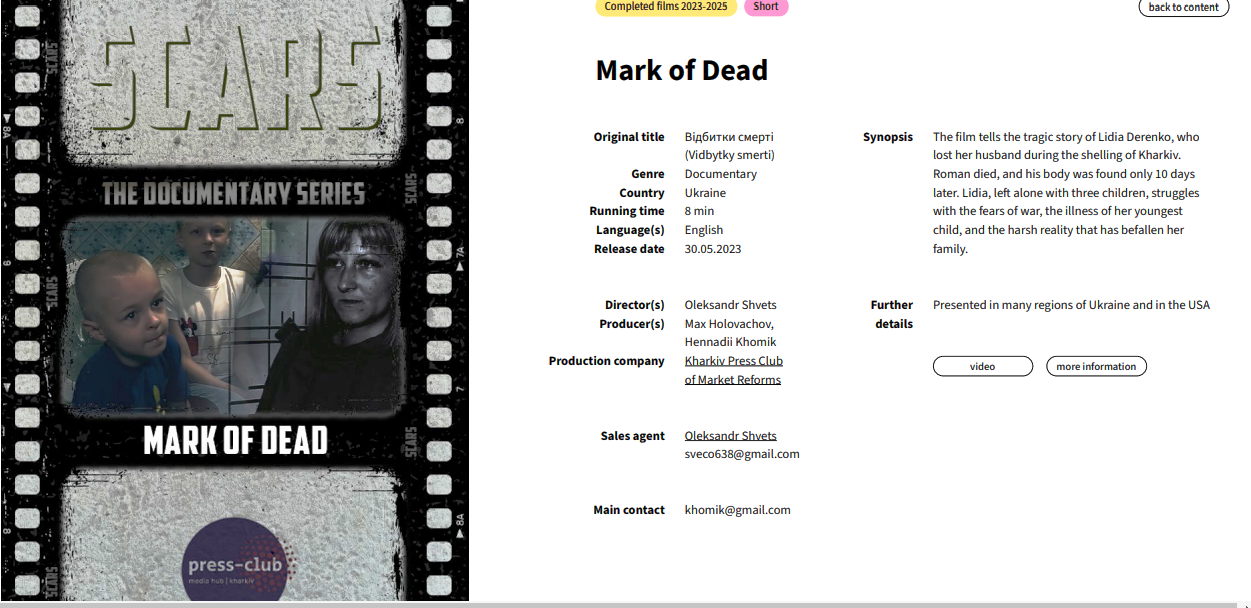
A young man died during the shelling of Kharkiv in the summer. He was alone in his room for more than 10 days. His wife Lidia Derenko could not reach him from another country for 10 days.
When the police arrived at his home and broke down the door, Roman's body had already begun to decompose.
His wife was left alone with three small children. The youngest child is sick, but Lidia cannot leave the other young children to go to the hospital with the sick mother...
The journalists of the Kharkiv Press Club managed to fit a maximum of information and emotional intensity into extremely short documentary stories.
A page from the catalog:
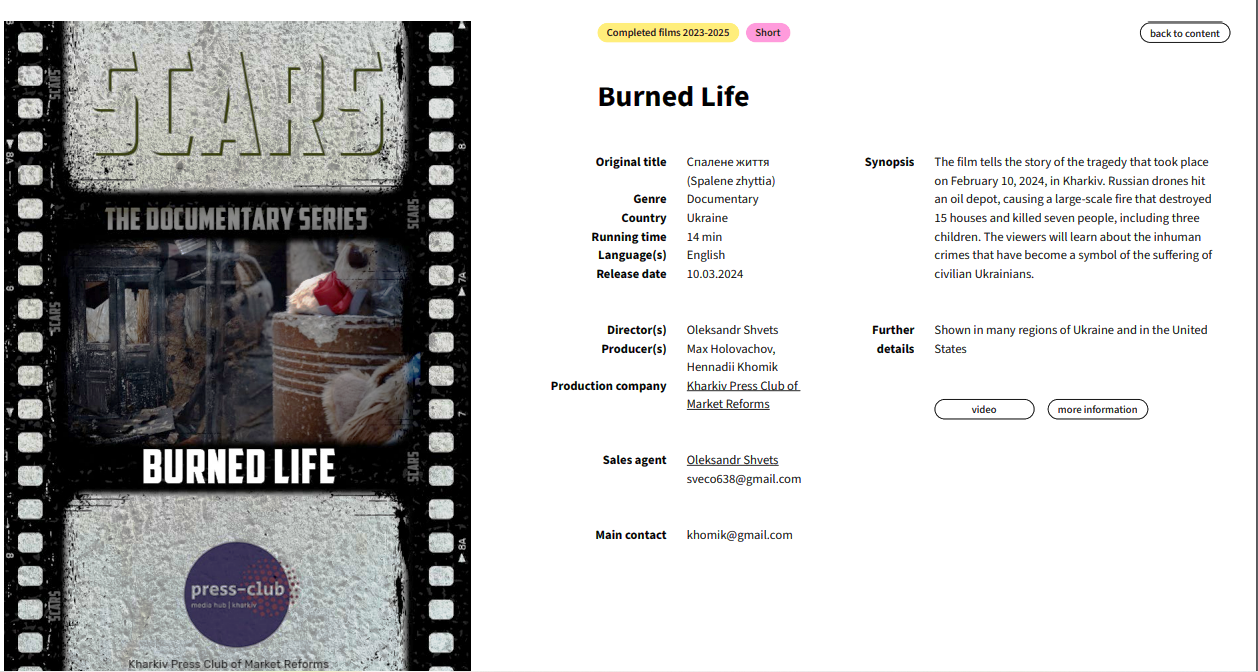
...Olga Putiatina's family: her husband Hryhoriy and three sons, the youngest of whom was 10 months old, burned alive in the fire. Her husband's body was found in the corridor of the house, while the mother and children tried to escape in the bathroom, but in vain. The burning temperature during the fire was such that even the bones of the dead baby turned to ash...
A page from the catalog:
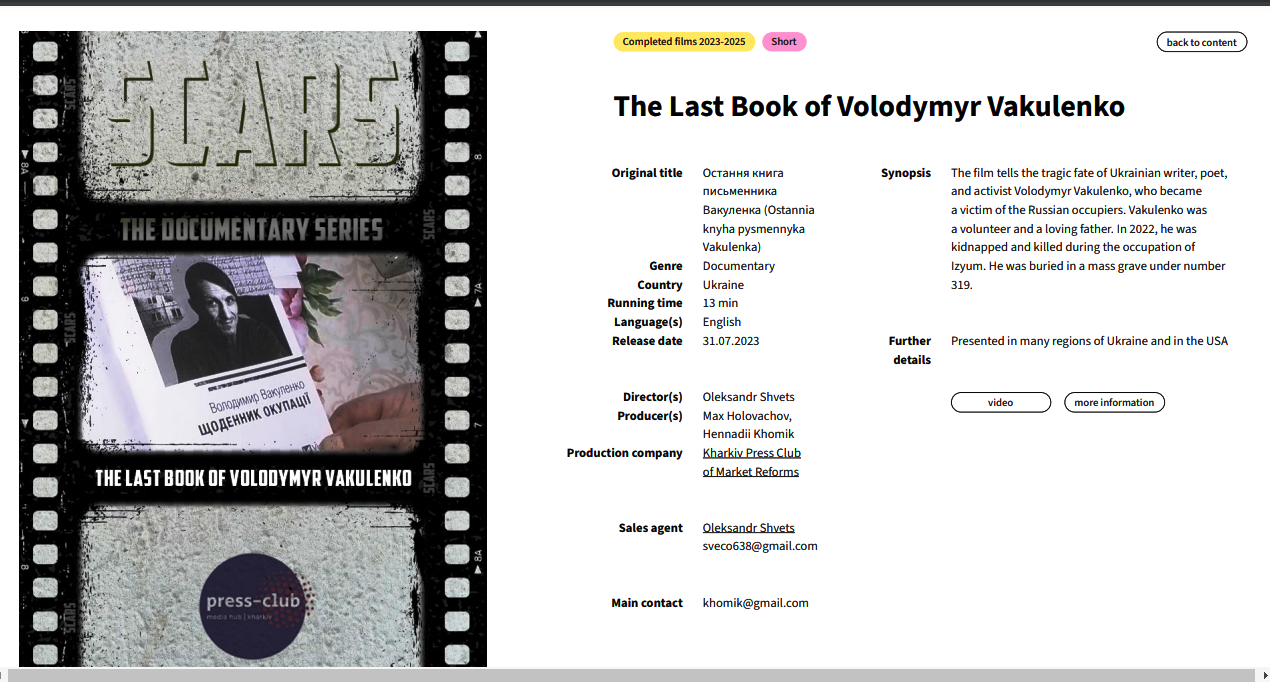
The Kharkiv Press Club was also one of the first to tell this story in detail...
For Volodymyr Vakulenko, the war began with massive bombing in his native village of Kapytolivka, near Izyum. The house where Volodymyr lived with his son and father was shattered by cluster munitions.
In the summer of 2022, an enemy tank drove into the Vakulenko's yard. On March 23, 2022, the Russian military came to their home, seized their books, and took Volodymyr and his son away. That day, he was severely beaten and released after three hours of interrogation. The next day, on March 24, the same military took the writer away again. His family never saw Volodymyr alive again.
Later, his body was found in a mass grave near Izium. The exhumation of more than 400 bodies of men, women and children lasted more than a week. It was here that children's writer Volodymyr Vakulenko was buried under the number 319. This was confirmed by the results of the DNA examination. Experts found two bullets in the body...
The Kharkiv Press Club is full of impressive stories and brilliant camerawork.
A page from the catalog:
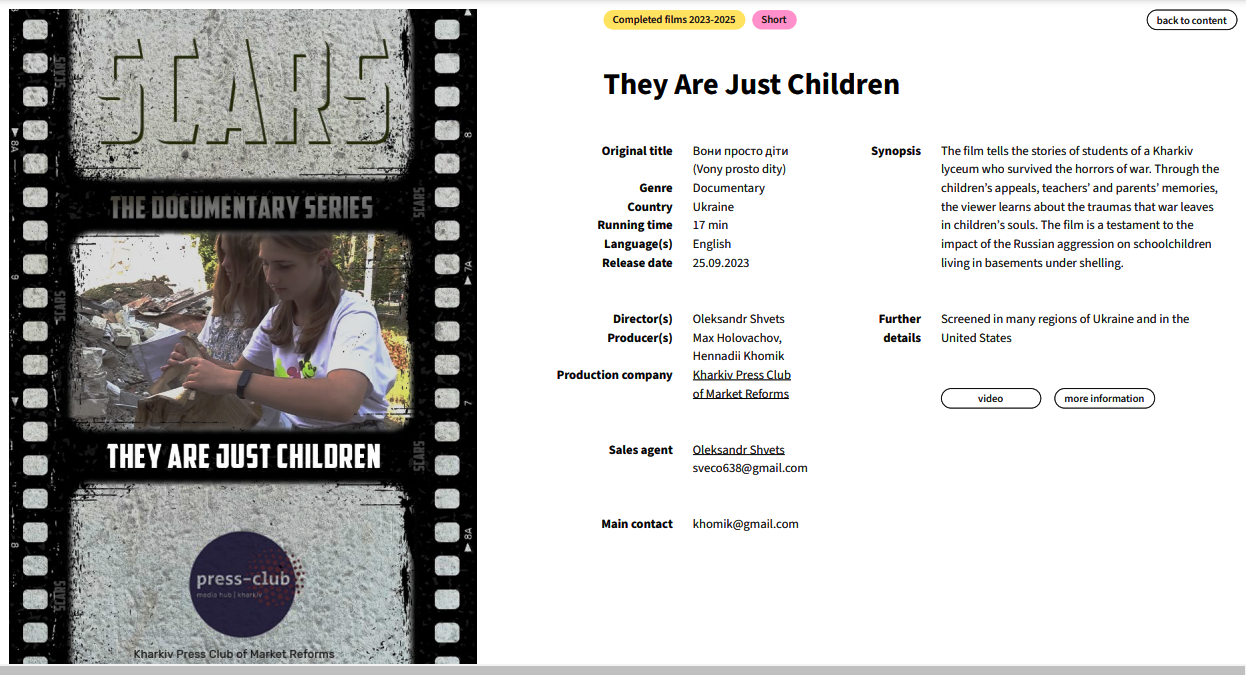
Margarita Pochepetskaya, a student of Kharkiv Lyceum #131, appeals to the world community for help: “...I live in Kharkiv, Ukraine. I am fifteen years old...”.
Streets, schools, houses are destroyed. People are dying. I am still a child. But this childhood has ruined my whole future life. My whole life will now be darkness after a horror movie. Now I will be panicked by loud sounds and bright flashes.
The address was recorded in February 2022 in a bomb shelter, where she was hiding from the missiles and shells that Russian aggressors were using to destroy Kharkiv in those days. They were destroying it together with the residents - children and adults.
Telling and showing the truth
is one of the most powerful weapons...
- Every wartime event leaves a mark on our lives. It affects not only our fate, our attitude to life, our worldview, but also encourages us to act,” says project curator Hennadii Khomyk.
When you are in despair, when you are in mortal danger, when a cruel enemy is at your doorstep, and when the propaganda of the aggressor country is full of anger, hatred, and lies, what can a journalist do armed only with a movie camera, a camera, and a laptop?
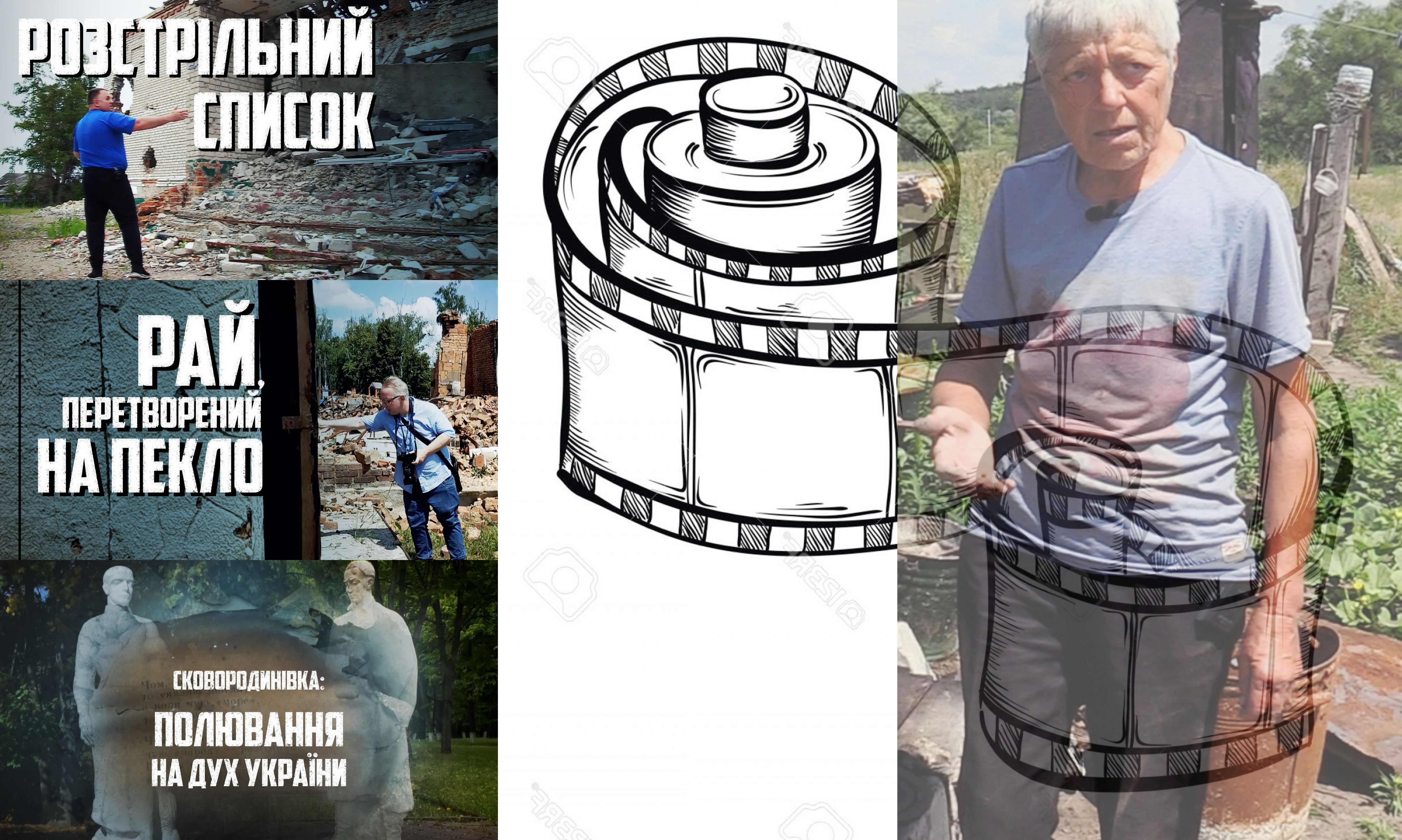
- “When I was offered to participate in the Kharkiv Press Club's project dedicated to what the Russian occupiers did in the Kharkiv region, I wanted to move away from the banal visual image,” says Maksym Holovachov, the project's artistic director.“We decided that each story should have a detail that visualizes the image of a scar/trace on people who had to survive the occupation.
In two languages, Ukrainian and English, the Kharkiv Press Club's investigative films tell the story of the life of communities during the war and the crimes of the Russian occupiers. The title of the
English version of the project is SCARS, or Scars, while the Ukrainian version is Traces. In general, the official title of the project is “Kharkiv Region: Destroyed but Unbroken.”
However, when we started discussing the artistic part, we decided that, first of all, it should be one word that can affect the viewer as emotionally as possible. In the end, we decided to call the project “Scars” in English and “Traces” in Ukrainian.
According to our creative teams, these two titles are the best answers to the needs of Ukrainian and English-speaking audiences.The idea of the title is that the Ukrainian audience does not need to be explained what traces the war leaves behind. Therefore, the title should not be emotionally overloaded, it should be calmer and more neutral. But for foreign viewers, the version of the title “Scars” will immediately immerse them in the context, so that they can feel more strongly on a psycho-emotional level what Ukrainians are going through now.
“We have to leave this behind.
As a testament to the war, as a plea for peace...”
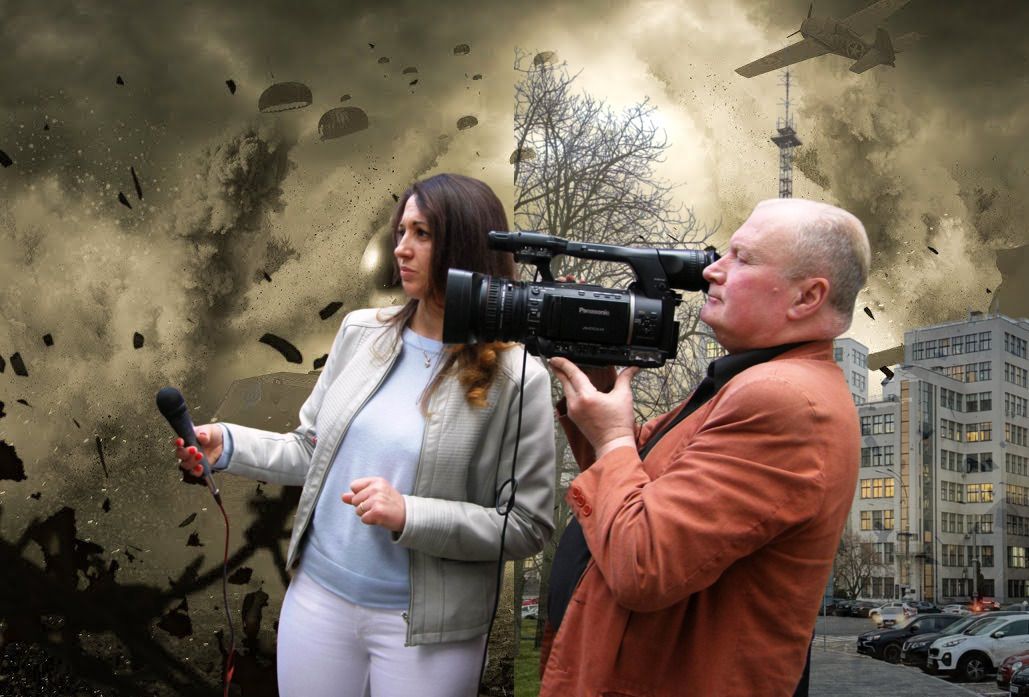
...Many of the films in the project are very difficult to watch, and perhaps not everyone will be able to psychologically withstand this story. But the author of these lines, following the talented Soviet film director Elem Klimov, can repeat it: “Go and watch!”.
We would like to remind you that Soviet film director Elem Klimov once made the war drama Go and Look (1985), a two-part feature film based on a script he wrote together with Ales Adamovich.The shocking film was awarded at several major film festivals.The director realized that it would be a very violent movie and believed that hardly anyone would be able to watch it.
When he said this to Adamovich, Klimov responded: “We have to leave this behind. As a testament to the war, as a plea for peace.”Sixty episodes of tragic, scary, painful and, despite everything, life-affirming stories. Because they tell us how we can remain human in... inhuman conditions.
Every frame of these films shows our burnt cities and villages that were subjected to a barbaric invasion, our people, the elderly, women, and children who survived the occupation and are rebuilding their lives in the ashes of their homeland, which they did not abandon.
This is our story today, filmed in real time.- It is a great honor for us that the Ukrainian Film Association has deemed it possible to select six of our documentaries for the international catalog,” emphasizes Oleksandr Shvets, director of the Kharkiv Press Club. “The Berlin International Film Festival has always been characterized by special attention to the most pressing problems of our time.This year, Ukraine became a member of the Eurimages Executive Committee, which opens up new opportunities for promoting national interests and integration into the European cultural space.
REFERENCE OF “ Gromada”
Eurimages is the cultural support fund of the Council of Europe. It has been operating since 1989 and includes 38 of the 46 member states of the Strasbourg-based organization, as well as Canada.
Reportedly, within the framework of the Berlin International Film Festival, the Head of the Ukrainian Film Association Victoria Yarmoshchuk, producer Oleksandra Kostina and Deputy Head of the State Film Agency of Ukraine Maksym Aleksandrov held talks with Roberto Cicutto, President of Eurimages, Susan Newman-Baudais Executive Director of the Eurimages Fund, Enrico Vannucci Deputy Executive Director of the Eurimages Fund, where they discussed the support of Ukraine by other Eurimages members, measures to ensure the continuity of film production in Ukraine, cultural diplomacy and the need to convey European values to the global audience.
The Berlin International Film Festival is over, and the catalog with Ukrainian films has traveled to countries and continents, offering producers and TV companies a diverse, talented and relevant world of Ukrainian cinema, including the works of the Kharkiv Press Club's team of journalists, shot on the frontline and often under fire and bombs.
I think this heroic work is not in vain. Our Kharkiv stories will be seen and heard by people all over the world, and perhaps even paid attention to by prosecutors and judges of the International Criminal Court.

Comments
Some more relevant news for now