


























Ukraine in the Space Game: Last Chance Not to Stay on the Sidelines of the Universe
Articles | | 2,512 | Author: By Olena Zelenina

Collage by Olena Zelenina.
When we say "space," our imagination usually conjures up majestic footage of SpaceX launches or NASA's ambitious plans to colonize the Moon. But where is Ukraine's place on this stellar map?
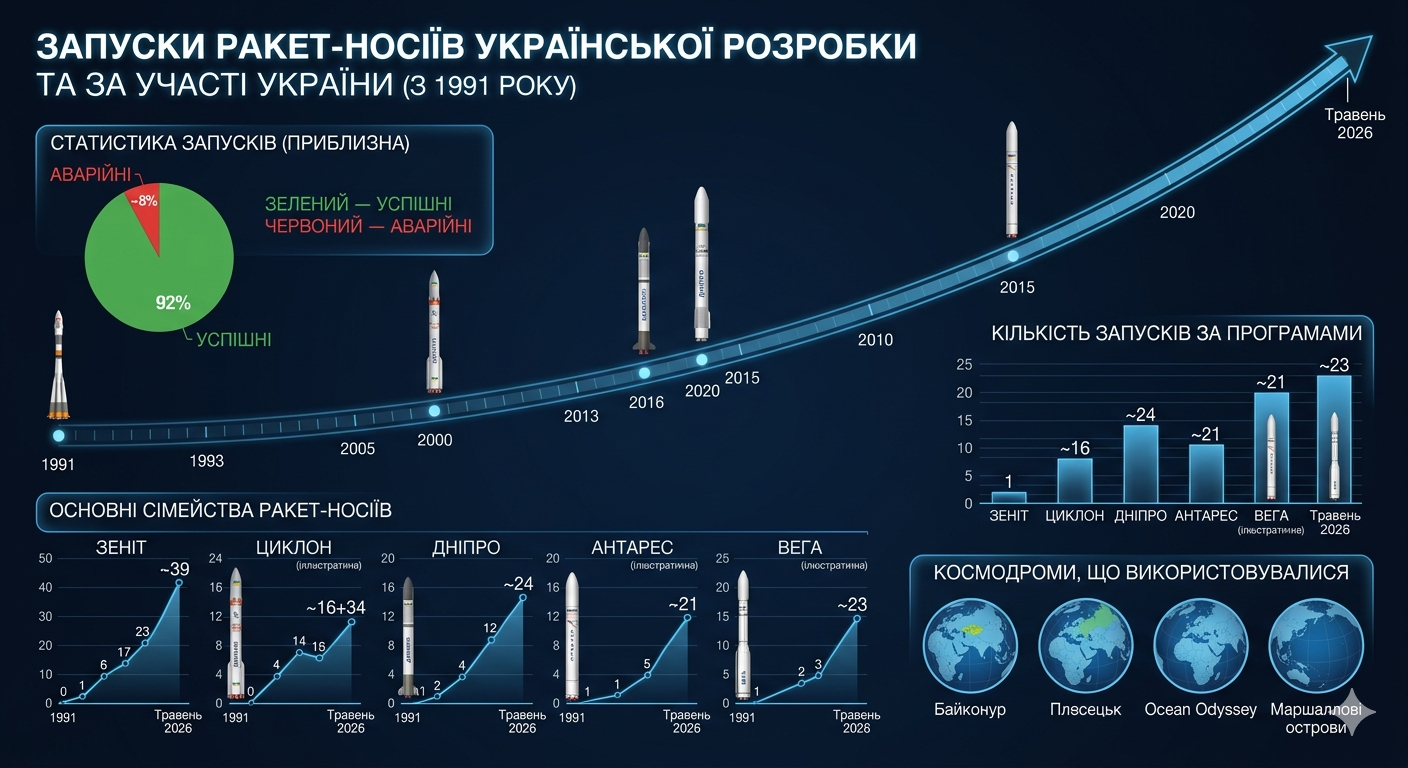
We are used to being proud of our status as a "space-faring nation," but today this title more and more resembles a yellowed photograph in a family album: honorable, but too far from reality. Why has Ukraine lived without a state space program for seven years, and do we have a future beyond our glorious past?
This is discussed in a candid conversation with Oleh Fedorov, Director of the Space Research Institute of the NAS of Ukraine, a prominent scientist in the field of metal physics and space research, and a Corresponding Member of the NASU. The interview is part of the new episode of "About Science. Competently" on the National Academy of Sciences of Ukraine YouTube channel. The program is hosted by Academician Volodymyr Semynozhenko, Vice President of the NAS of Ukraine.
Institutional "Football" and Lost Time
The situation in which the domestic space industry finds itself is a paradox. On one hand, our engineering schools are still considered among the best in the world; on the other, the state has effectively lost the "steering wheel" of management in this sphere.
In recent years, Ukraine's space agency has passed through a literal bureaucratic labyrinth: from being under the Ministry of Strategic Industries to the Ministry of Defense. The result was a kind of managerial "football," where powers are scattered and strategic vision is absent. Currently, for several years, Ukraine has had neither an approved space program nor a permanent head of the agency—only acting directors with limited rights.
"If you don't have your own strategy, you become an object of someone else's strategy," Oleh Fedorov reminds us. This is not just a poetic metaphor. Without a clear understanding of why we need space, we risk finally turning from an active player into a passive consumer of other people's technologies.
Not Just Rockets:
Space as a Foundation for Security
We are used to associating success in space with the number of engines produced or rockets launched. However, the modern paradigm is fundamentally different. Today, space is primarily about Earth Intelligence.
It is about the full integration of satellite data into state management. These are not just "pictures from the sky," but powerful AI-based tools that allow:
· Monitoring destruction and planning reconstruction: Space sees the dynamics of urban revival much better than any ground commissions.
· Guaranteeing security: From detecting hidden threats to fire control.
· Developing the economy: The modern agricultural sector is impossible without precision positioning—even combine harvesters today run on satellite navigation.
It is critically important for Ukraine to have its own source of information—a national constellation of satellites. This is as much a component of sovereignty as having our own army or currency.
Private Space:
The Musk Example and Ukrainian Realities
The world is experiencing a boom in the commercialization of space. Elon Musk's example proved that private companies are faster and more flexible in implementing innovations. However, there is an important nuance: even SpaceX works primarily with budget funds.
In Ukraine, the intellectual potential of the private sector is enormous, but it needs a state framework. "Tell me where to invest my talent, and I will work," Oleh Fedorov quotes a fellow scientist. The state must define priorities, and business must propose solutions. Without innovation incentives, tax breaks, and depreciation mechanisms—which they are currently trying to promote through the Verkhovna Rada—this engine will not start.
Where is Our Chance for a Breakthrough?
Despite all the difficulties, Ukraine still has "trumps" up its sleeve that are of interest to global partners.
· Engine building: Our classic, which is still in demand on the international market (e.g., the Antares project).
· Materials science: Unique sapphire windows, laser gyroscopes, and docking detectors—these are components we can use to equip the most sophisticated technology in the world.
· Space biology: Few know that when European experts selected projects for future missions, Ukrainian developments in biology and plant cultivation in space took top positions.
· Docking systems: Our specialists are working on modern docking units that could become part of global projects like the American Artemis program.
Between Past and Future
Is Ukraine a space-faring nation today? Oleh Fedorov answers cautiously: "Currently—no." We have brilliant roots, we remember Yanghel and Korolyov, but the status of a nation is determined by future decisions, not past merits.
Space today is not about prestige. It is about physical survival in a rapidly changing world. If we can combine the efforts of science, the defense sector, and private business, Ukraine can still have its say among the stars. Но we must act now, because the "window of opportunity" in space is closing faster than we can prepare another bureaucratic report.
In the Meantime
Ukraine is preparing to create a new branch of the Armed Forces, which will be able to receive its own intelligence from space and shoot down enemy orbital missile systems. During the war, the GUR (Defense Intelligence) has already conducted unique operations, twice launching carriers into space. This was shared in an interview with RBC-Ukraine by Fedir Venislavskyi, Chairman of the Subcommittee on State Security and Defense Innovations of the Verkhovna Rada.

Comments
Some more relevant news for now