











“They Hid in the Bushes While FPV Drones Flew Overhead”: How the Burning Borderland of Zolochiv Community Lives Under the Sight of Drones
Articles | | 1,299 | Author: Olena Zelenina
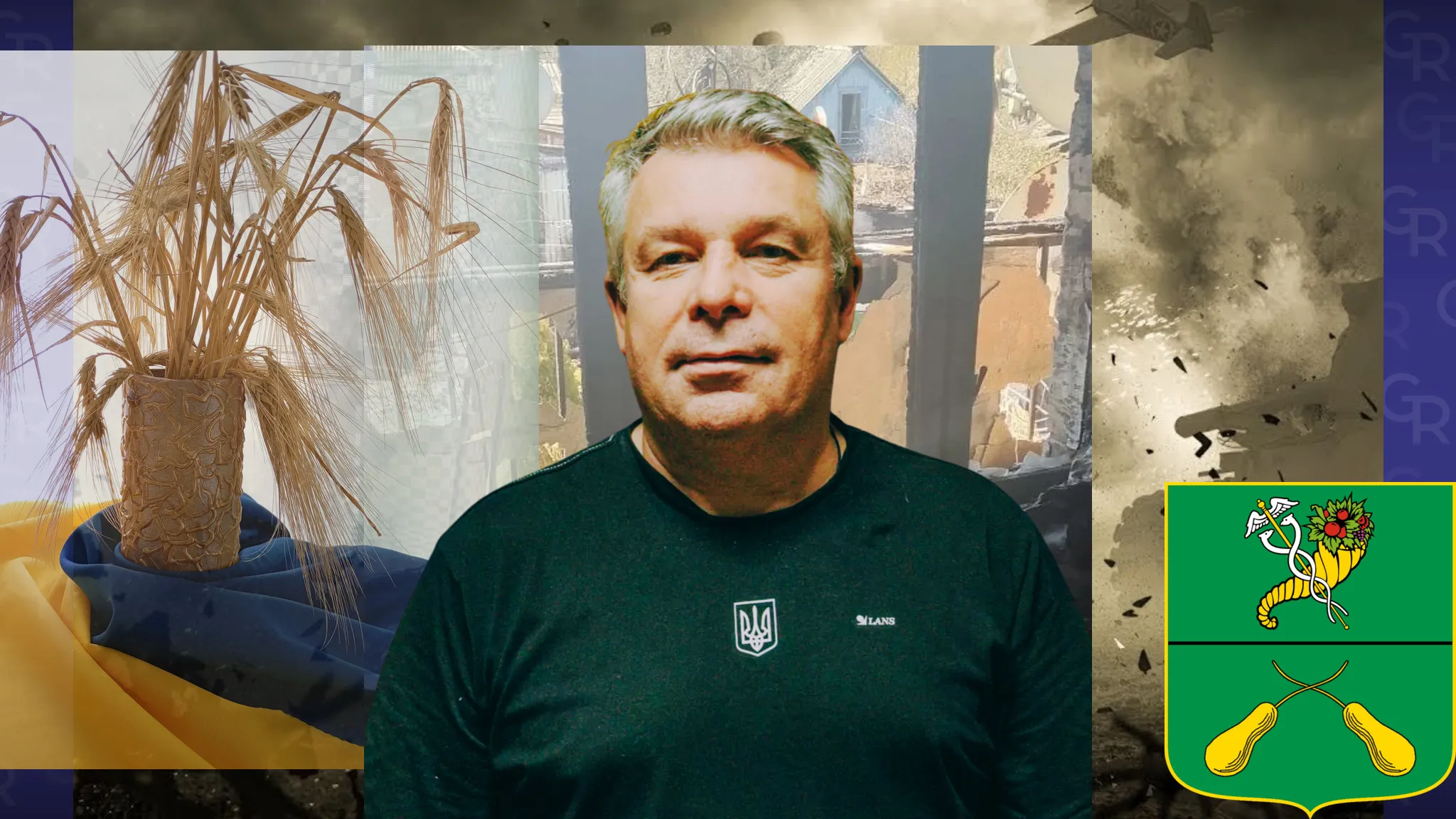
Collage by Olena Zelenina.
“Imagine being in the shoes of the last three residents leaving Ivashky. They set out at one in the afternoon and arrived only at four in the morning... The distance was a mere ten kilometers! For over 15 hours, they hid in the bushes while FPV drones swarmed literally right above them.”
This shocking story was shared by the Head of the Zolochiv Military Administration, Viktor Kovalenko, in the new episode of journalist Oleksandr Shvets’ program “Voice of the Community”
— a joint project of the local media network Gromada Group and the Kharkiv Press Club. Better than any official report, it demonstrates the reality in which the border Zolochiv community survives every single day.
Evacuation Is a True Special Operation
The border with Russia is just a few kilometers away. What used to be peaceful, thriving villages have today turned into a zone of continuous danger.
The enemy hunts people using drones as if they were targets at a shooting range. The village of Liutivka, once home to half a thousand residents, stands empty today. Only a single inhabitant remains in Turove, and five in Vydrodzhenivske.
Despite the round-the-clock horror, local authorities and volunteers continue to rescue every single family.
“We fight for every individual! We pull them out one by one, two by two. Life is ultimately more valuable than staying under constant shelling under infernal psychological pressure.”
Today, evacuation is a true special operation where the price of rescue can be the lives of the rescuers themselves.
Viktor Kovalenko recalls a tragic case when a civilian man who categorically refused to leave was killed in an attack. Simply to retrieve his body, military personnel and sappers had to be deployed.
“The battalion commander provided a vehicle. Before even reaching Zolochiv, an FPV drone hit the car! Thank God, the men survived, although they suffered concussions. We had to face the danger all over again — transferring the body into another vehicle. This is extremely hazardous not only for the residents, but also for our heroes holding the line here.”
Despite all the hardships, over 3.5 thousand people have already been evacuated from the border districts of the community. Not a single child remains in the mandatory evacuation zones — all children along with their parents have been brought to safety.
People are not left alone with their distress. Everyone who evacuates receives comprehensive support through the Coordination Humanitarian Center: an initial financial payment of 12,300 UAH, monthly IDP allowances, free accommodation in dormitories in Kharkiv and partner communities (including Zolochiv in Lviv Oblast), as well as medical assistance.
Every Organization, Without Exception,
Continues to Operate
In Zolochiv itself, the situation remains tense — the occupiers deliberately target and destroy civilian infrastructure. Nevertheless, the town continues to live and hold its ground on the civilian front.
“Strikes hit the private sector, vehicles, administrative buildings, and hospitals. But municipal services keep working! Every single organization without exception — the Pension Fund, the Employment Center, banks, pharmacies, and grocery stores — everything is operational. Although, of course, we notice targeted attacks on local shops.”
It is precisely due to the threat of logistical collapse and regular attacks on retail outlets that the community authorities took advanced measures to secure food supplies for residents and prepare for the winter period.
“I reached out with a request to the leadership of the UN World Food Programme. God forbid there are food supply disruptions in winter — we have everything in stock: grains, canned foods, cooking oil. I tell people: stock up! A massive task right now is preparing for winter. We lived through 2022 and know our motto: 'A candle and a stove.' All our partners — both German and Italian — are preparing assistance, just like last year.”
Lost Housing and Bureaucratic Dead Ends
The outflow of population remains a painful issue for the community. According to Viktor Kovalenko, over 200 families whose property was completely destroyed by the enemy received compensation payments and purchased new housing in Kharkiv or other parts of Ukraine.
Families of fallen defenders and civilians are also purchasing new homes in safer regions.
For the Zolochiv region, this represents a severe demographic loss, yet the procedure for obtaining compensation under the “eRecovery” (єВідновлення) program continues to face serious legal loopholes.
While the situation regarding damaged property is clearer, a blind spot emerges when it comes to completely destroyed housing in active combat zones.
According to government regulations, the commission requires video footage and aerial photography to confirm destruction.
Physically visiting these locations is impossible for the commission due to the constant threat of shelling, while satellite footage from the State Space Agency often raises questions — it is difficult to accurately determine the extent of damage from space.
The main trump card in such a scenario is drone footage, but here the community hit a bureaucratic snag.
“The Cabinet of Ministers decree states that only units of the Armed Forces of Ukraine have the legal right to provide aerial survey materials. But the policymakers failed to account for the fact that a third of our border area is under the control of the National Guard and the State Border Guard Service! And those happen to be the three starostynskyi districts with the densest residential development. Border guards or National Guard soldiers film the destruction using Mavics, but they simply lack the legal authority to submit this data to the commission!”
The head of the community emphasizes that incorporating data from National Guard soldiers and border guards would significantly accelerate the payout process for people who have lost everything.
The regional leadership of Kharkiv Oblast and the Zolochiv Military Administration have already appealed to the Vice Prime Minister and raised the issue at the Congress of Local and Regional Authorities to demand the necessary amendments to the Government decree. The community awaits this decision, as the fates of hundreds of displaced persons depend on it.
Shelled Farms, Abandoned Fields,
and the Hunt for Combine Operators
The Zolochiv community has always been known as a powerful agricultural area with thousands of hectares of fertile land. However, due to its proximity to the border, the local agricultural sector has suffered a devastating blow: livestock farming has been practically wiped out, and harvesting crops has turned into a deadly lottery.
The most painful blow was the loss of the livestock industry, which was once the pride of the entire Kharkiv Oblast.
“Agricultural enterprises like 'Alpha', '1st of May', 'Viktoria', and 'Patriot' owned thousands of hectares of land and breeding farms. In Svitlychne, there was a wonderful breed of cows — the Russians simply shot them down and killed them on the spot. Some livestock was driven out and sold because keeping them was impossible. The agricultural enterprise in Pysarivka held onto its dairy herd until the very last moment, but when heavy shelling started, they sold them. Livestock farming in the community is now simply non-existent.”
The situation with crop production is equally critical. While last year farmers managed to sow and harvest two-thirds of the land, this year thousands of hectares of ripe grain will simply rot in the fields.
The enemy employs a insidious tactic: FPV drones deliberately hunt not so much for expensive equipment, but for the machine operators and drivers themselves, dropping munitions near workers to chase them out of the fields.
A second catastrophic problem is the widespread mining of transport routes and fields.
“A combine harvester arrives to cut the grain, but on the way back, the road is already covered with 'surprises': 'petal' mines, booby traps, and micro-containers filled with explosive pellets. There were instances when our machinery operators blew up. We lost a huge harvest.”
Farmers — wise and united people — evacuated most of their heavy agricultural machinery to safer locations across Kharkiv Oblast well in advance, bringing it back into the community only selectively during the early grain harvest.
Yet even harvested grain is extremely difficult to save: the enemy destroyed all three local gas stations, stripping the community of fuel, and targeted and burned heavy trucks trying to transport grain. Crop yields have to be hauled away in small batches at great personal risk.
Against the backdrop of this disaster, local farmers are left without adequate state financial subsidies.
“Last year, farmers received support in the amount of 1,000 UAH per hectare. This year, there is a corresponding Cabinet decree, but due to a lack of funds, there is no actual financing. I raised this issue at the April Congress of Local and Regional Authorities in Uzhhorod. For large farms in the rear, this money might not seem critical. But for our border farmers, the ability to offset at least part of the cost of fuel or fertilizer is a matter of survival. Unfortunately, there is no support yet.”
The borderland of Zolochiv finds itself on the front lines of security challenges. Population outflow, lost housing, destroyed livestock, and mined fields — this is the daily price the community pays for its proximity to the enemy border.
Nevertheless, despite daily shelling, the Zolochiv region continues to fight for its survival.
The fate of these territories today hinges on the speed of government decisions: people need simplified compensation mechanisms, and farmers need real financial assistance so that after victory, local life can bloom once again.

Comments
Some more relevant news for now