

























"Young Xi Jinpingites", "Colonels from Viber" and a Badge for Pseudo-Zaluzhnyi: How the Kremlin Spends €2 Billion on Fakes
Articles | | 1,668 | Author: Olena Zelenina, Olexandr Sydorenko (caricature)
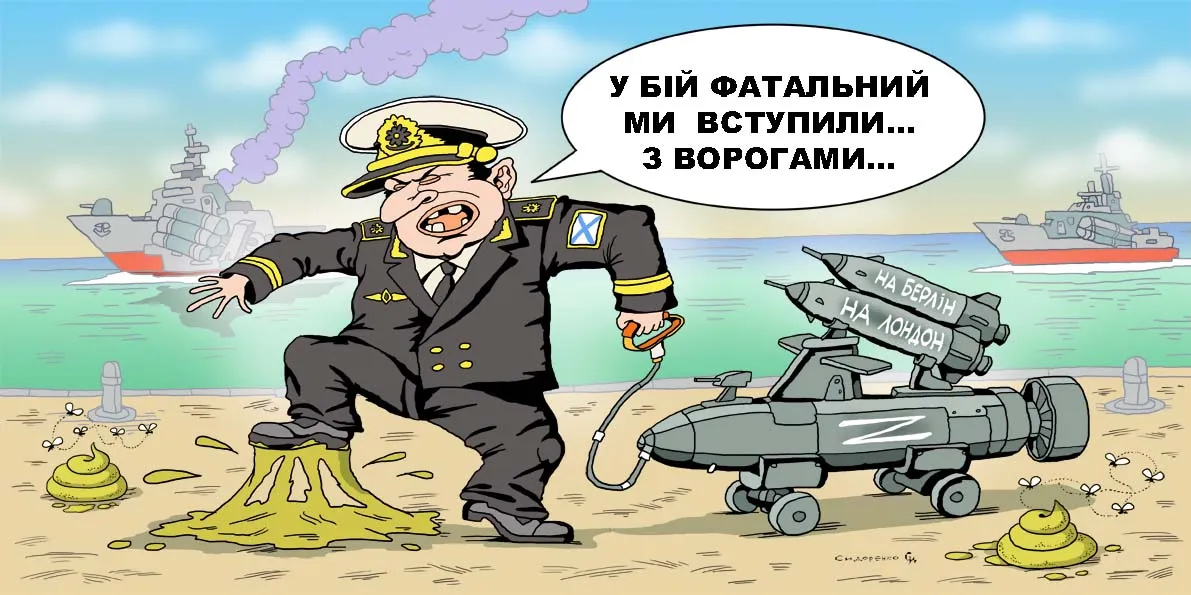
Cartoon by Olexandr Sydorenko.
In the State Duma of the Russian Federation, they decided to revive the Pioneer movement. They argued for a long time over whose name the organization should bear, since "young Putinists" sounds somewhat too predictable, and "young Medvedevites" threatens early alcoholism.
Eventually, taking into account geopolitical realities and sponsors, they approved the final version: "Young Xi Jinpingites named after Kim Jong Un." The motto of the organization: "Be ready!", the response: "Always ready to work for a bowl of rice and three dollars a month!".
Laughs aside, but the Kremlin's attempts to return its brainwashed electorate into blind totalitarianism are just a facade for a much more aggressive foreign expansion.
While in Russian schools children are taught to march under absurd slogans, completely adult, astronomical sums are allocated for brainwashing the planet's population.
As People's Deputy Yevheniya Kravchuk stated during the URC 2026 conference in Gdańsk, Russia has increased its propaganda budget to nearly €2 billion — which is 50% more than last year.
A huge part of these funds goes towards information sabotage in EU and NATO countries, while on the occupied territories of Ukraine, a scorched media desert is being created, where cynical fakes are stamped under appropriated brands of Ukrainian media.
Turning their relay transmitters to full capacity, the Kremlin feeds its own population a rigid myth about a "besieged fortress", wraps an aggressive war in the packaging of a "sacred rebuff" and makes citizens believe as if they are the poor and miserable ones who "entered into a fatal battle with enemies."
We present to your attention a fresh analysis of the enemy's key information-psychological operations of the week, on which the Kremlin did not spare its new billion-dollar tranches.
Brief English Summary
"FAKE" Badge for Pseudo-Zaluzhnyi: This section details how Telegram marked a large fraudulent channel mimicking the "Zaluzhnyi Team" as fake. The channel used the high-trust image of Valeriy Zaluzhnyi to subtly introduce destructive Kremlin narratives, discredit Ukraine's military-political leadership, sow public division, and collect financial donations or personal data under the guise of regular internet scammers.
How the Enemy is Searching for Strains in Kharkiv and Odesa Again: Russian propaganda resources are recycling a 20-year-old marginal narrative about US-controlled "biological weapon components" and illegal clinical trials in Kharkiv and Odesa. The section debunks this, explaining that these are standard civil research labs modernized back in 2005 via the transparent international Nunn-Lugar program with modest funding. The Russian psychological operation aims to induce panic and force evacuations in these heavily bombed frontline cities.
"Burned Temple with Civilians": Another Religious Fake by TASS: The Russian state news agency TASS fabricated a story accusing the Armed Forces of Ukraine (AFU) of intentionally burning down a temple with 19 civilians inside in Kostiantynivka. In reality, Russia's own FAB-250 bombs and artillery heavily damaged or destroyed several local UOC-MP churches. TASS mirrored its own war crimes onto Ukraine to emotionally blind the audience and demonize Ukrainian defense forces on religious grounds.
TikTok Sabotage: How the Kremlin Spreads Anti-Ukrainian Trends in Poland: Ukraine's Center for Countering Disinformation detected a coordinated Russian operation in the Polish segment of TikTok. Using AI voice generators, network bot farms simulated mass discontent of Polish youth toward Ukrainian refugees. This targeted subversion aims to undermine the strategic partnership between Warsaw and Kyiv by manipulating social media algorithms.
How "Colonels from Viber" Stormed a Kyiv Apartment: A satirical, firsthand account of Russian-Ukrainian phone scammers trying to trick an experienced media analyst. Posing as Ukrainian intelligence and police "officers" via Viber (speaking with poor Ukrainian accents), the scammers claimed that the journalist received tracking devices for Iranian Shahed drones and demanded a video tour of his house—specifically targeting his home safe. The analyst easily exposed them, illustrating that the Kremlin’s multi-billion cyber campaigns ultimately rely on cheap psychological shock and fear, which fail against media immunity.
Read more in the Ukrainian edition....

Comments
Some more relevant news for now