


























The Zoom-Generation Near Empty Test Tubes…
Articles | 19 May, 2026 at 9:35 | 2,165 | Author: Olena Zelenina
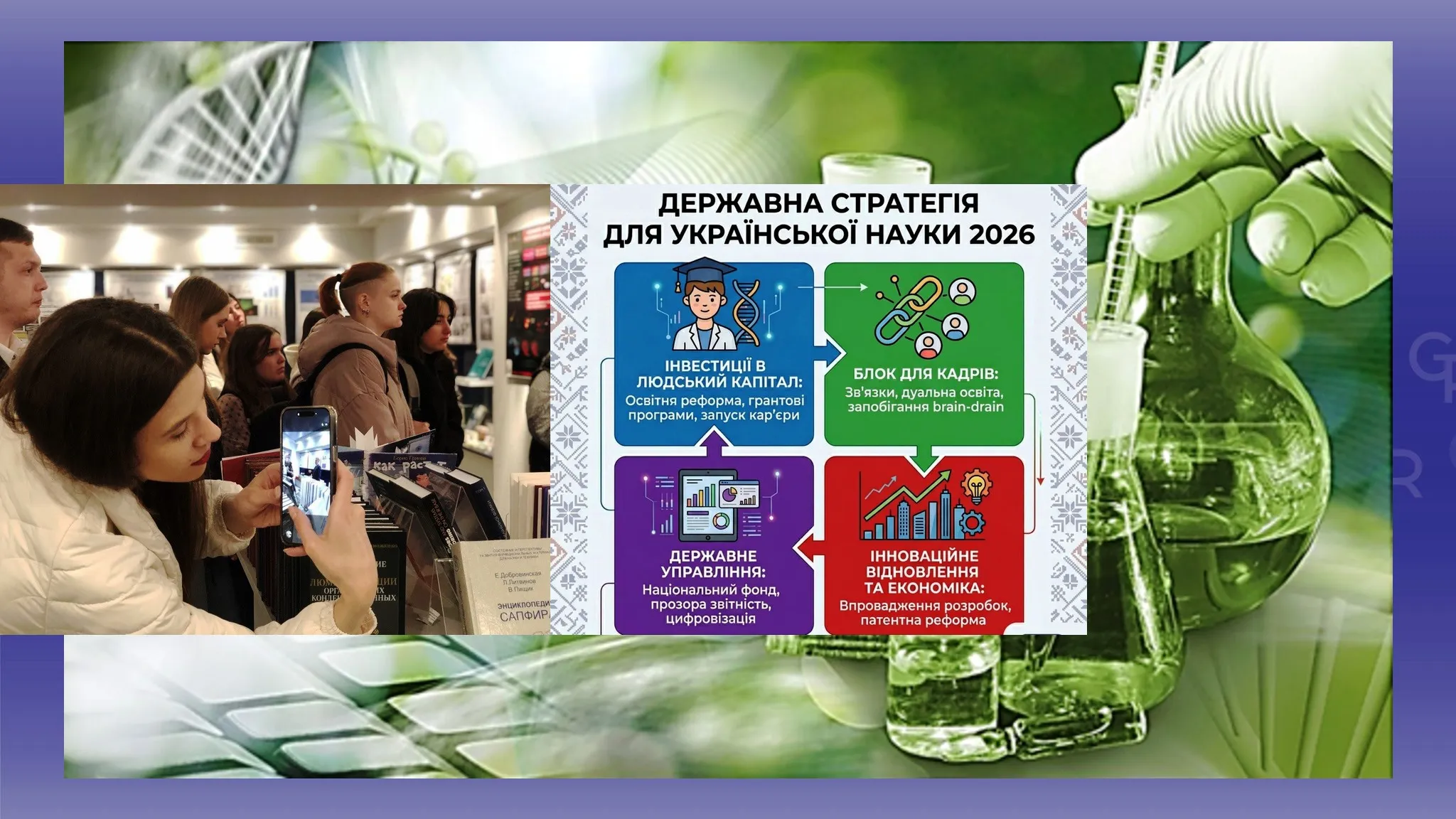
Collage by Olena Zelenina.
When we write about Ukrainian science, the last thing I want to hear are pompous speeches about "resilience" and "traditions." I think about the smoke from arrivals [strikes] on Kharkiv, about the smell of coffee from a thermos during another air raid alert, and the depth of cellars where Kharkiv scientists lower unique equipment time and time again.
Today, our science lives in a mode of superhuman efforts, holding on by sheer stubbornness, fanatical dedication to its work, and... chronic lack of money. What is actually happening behind the closed doors of academic institutes that run the risk of being hit every day?
Recently, I happened to listen to an extremely frank, in some places painfully harsh discussion "Problems of Science of Ukraine 2026" on the platform of the lecture hall "Scientific Meetings".
The speakers were colleagues whose courage I never tire of marveling at: Deputy Director for Scientific Work of the Institute for Chemistry of Functional Materials of the STC "Institute for Single Crystals" of the NAS of Ukraine, Candidate of Chemical Sciences Olesya Kulik, and the Director of this same Institute, Head of the Department of Organic Chemistry and Molecular Materials of V. N. Karazin Kharkiv National University, Academician of the NASU Valentyn Chebanov.
The "Double Shock" of Higher School
As a journalist, it pains me to look at current master's students and postgraduate students. This is a generation that was formed in conditions of a "double shock."
First, the pandemic tore them away from normal life, and then the big war immediately covered them with its blackouts and evacuation. Years of continuous "remote monitor" have presented their bill.
Let's be honest: it is impossible to grow a classical chemist, physicist, or biologist if he sees reagents only on a laptop screen!
Due to safety restrictions and a banal deficit of funding, students often simply do not have access to modern laboratories. We risk getting certified theorists where the country critically needs practitioners capable of creating new materials, technologies, and medicines right now.
A School Experiment at the Cost of the Future:
Chemists with a Zero Balance
But higher school is only the tip of the iceberg. The real catastrophe, from which it becomes creepy, begins much earlier.
– I would dig a little deeper and say that our problem does not begin with the university. Our problem begins with school education, and currently our state is conducting some kind of colossal big experiment with reforming the school... Schoolchildren come from school and they do not know what chemistry is, they really do not know what physics is, – states Academician Valentyn Chebanov. – And of course, they do not choose precisely these sciences as their future specialties.
This is a shocking anti-record of 2026: the number of applications from applicants for the fundamental specialty "Chemistry" fell below the critical mark of ONE PERCENT!
If we do not stop this fall, tomorrow we will not have developers of the defense complex, pharmacists, technologists.
As Valentyn Chebanov believes, this negative trend of lowering the level of education in STEM sciences cannot be overcome only by the efforts of universities and schools, because this is a complex state problem.
Yes, academic institutes try to save the situation pointwise — through dual education, involving youth in real international grants. But this is the treatment of symptoms, while the organism needs systemic changes at the level of the school curriculum.
Emigration or Evacuation of Brains:
How Not to Lose Those Who Left
Another personal pain of scientists is the large-scale exit of intellect abroad. What we considered a temporary rescue and integration into Europe in 2022 has today turned into a harsh challenge of irreversible loss of people.
Our scientists, having received laboratories and stable grants in the West, take root there. And my tongue does not turn to judge them for the desire for safety and normal work.
But what should we do? Scientists during the meeting emphasized: the classical fight against "brain drain" no longer works. We need "brain circulation."
The state must develop such mechanisms so that a Ukrainian professor in Munich or a researcher at the Sorbonne remains in our context — remotely manages projects in Kharkiv or Kyiv, delivers lectures online, and maintains a connection with the native institution.
Only in this way will we preserve bridges for their return after the victory.
Instead of Cabinet Silence
— Long-Term Foresight
All these problems, as if against a wall, bump into the old, clumsy Soviet system of science management.
The speakers are convinced: the reform cannot be created in the silence of bureaucratic cabinets. This is a task for the entire expert community, where the key voice should belong to the Scientific Committee of the National Council for Science and Technology Development.
And here the personal responsibility for the result must lie at the highest level — on the Prime Minister of Ukraine, who heads this council.
Today, the hope of scientists is connected with the development of a new law on priority directions of development of science and innovations, which is currently being hotly discussed in the Verkhovna Rada.
Listening to them, I realized: we are standing on the threshold of an intellectual abyss that can still be jumped over if we act immediately.
The main thing that inspires optimism is the attempt to tie state priorities to foresight research, that is, to forecasting the country's needs for 10–15 years ahead.
As experts believe, it is time for us to stop living from budget to budget, patching holes for a year or two.
The mission of science is to become the main tool of our national security, the basis of an innovative economy, and the foundation on which we will rebuild the country.

Comments
Some more relevant news for now