















Without Waiting for a Miracle: How Trostyanets Is Building the Energy of the Future
Articles | | 1,905 | Author: Olena Zelenina
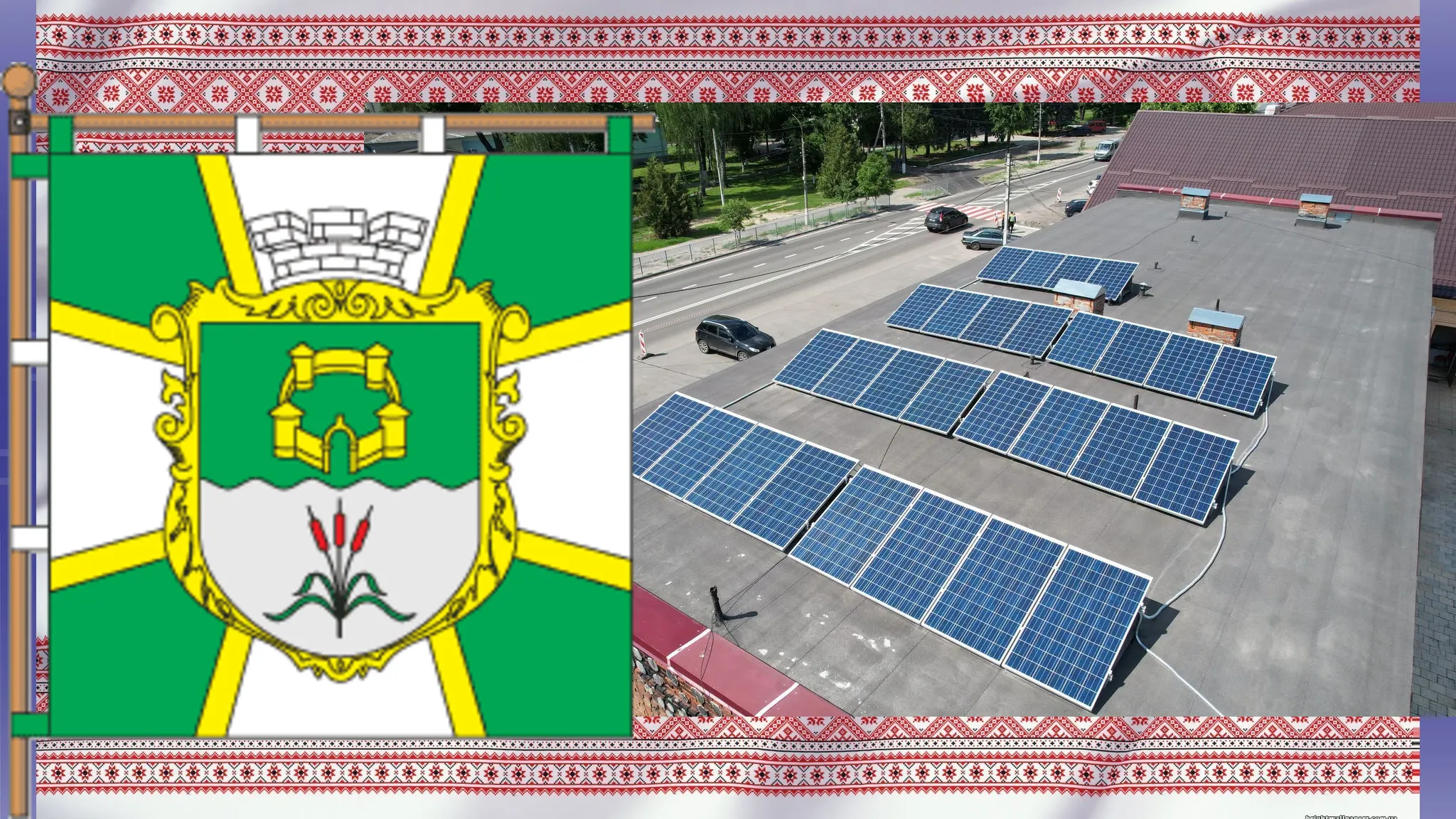
Collage by Olena Zelenina.
“I don’t have time to wait for someone to come and do it for us. Those communities that wait are simply losing time and putting their people in danger.”
This is how the head of the Trostyanets hromada, Yuriy Bova, outlined the survival philosophy of the border town during a live broadcast of the Gromada’s Voice project at the Kharkiv Press Club.
The dialogue with Yuriy Bova proved that what scientists and energy efficiency experts talk about is already being implemented in Trostyanets “in metal” and concrete.
This conversation became a direct response and a logical continuation of analytical publications by the Gromada Group network.
As a reminder, in the article “Energy Salvation: Do Ukrainian Cities Stand a Chance to Survive the Winter?”, we searched for answers to alarming questions: how Ukrainian cities can withstand total blackouts, safeguard critical infrastructure, and avoid freezing during the winter under constant shelling.
And in the material “After the Kharkiv Press Club Broadcast: How Scientists Propose Solving Energy Issues”, scientists and experts provided clear calculations: the only salvation lies in the immediate decentralization of generation, the creation of autonomous “energy islands,” and the use of renewable energy sources.
The city of Trostyanets, which endured the hell of combat and a month of brutal occupation from February 24 to March 26, 2022, learned the price of total collapse firsthand.
Russian troops completely looted and destroyed the municipal infrastructure: they stole and smashed garbage trucks, ambulances, equipment, work clothing, and even locksmith tools, causing damage exceeding $120 million. Trostyanets was left without electricity, water, gas, communications, or medical supplies.
The local hospital—which the occupiers shelled with tanks and mortars, blowing out 480 windows and wrecking the buildings—became a true symbol of survival.
“We were recommended to close this hospital because it was partially destroyed and very dangerous to stay there... To be honest, that is the wrong approach,” Yuriy Bova recalled.
The medical staff performed a real feat: fifteen employees refused to collaborate with the enemy and stayed with the patients. In cold basements, under the roar of tank guns, they delivered babies—nine newborns came into the world during the occupation!
Today, this hospital has been turned into an autonomous outpost: it is equipped with powerful diesel and petrol generators for operating rooms and intensive care units, while solar panels with battery storage are being deployed on its roofs.
The same principle of continuity was applied to the water supply. Water utility pumping stations were backed up by powerful generators, so even if the entire oblast loses power, Trostyanets residents will have tap water, and the sewage system will operate without disruption.
Regarding heating, instead of giant, vulnerable central boiler houses, the city is deploying a network of modular block boiler units. Where possible, gas with backup pump power is used; where not, they switch to alternative fuels like pellets, firewood, or wood chips.
However, the community understands well that a generator is only temporary “first aid” that burns hundreds of liters of expensive fuel daily.
For long-term resilience, Trostyanets relies on solar power plants with energy storage systems (PV + ESS).
Panels with batteries and inverters are installed on the roofs of schools, outpatient clinics, and administrative buildings. During the day, the sun provides free electricity, and excess power is stored in batteries to power lights, communications, servers, and duty equipment at night or during outages.
“We strive to keep municipal enterprises at least profitable or break-even, because everyone thinks a municipal enterprise is a bottomless pit where money just disappears,” explained the head of the community.
Solar generation significantly cuts utility bills for public institutions during the warm season, and every saved hryvnia goes toward purchasing fuel for generators and enhancing security.
Yet the most important aspect of this system is simple human care. In Trostyanets, the feeling of helplessness in the dark is well remembered, so a heating station or shelter here is not just a cold basement. These are modern hubs where people can charge their phones, contact loved ones, read the news via stable internet, and have a hot cup of tea.
For relieving shock and supporting mental health, this is no less important than gas cylinders. To protect private homes, the city developed an algorithm for immediately sealing the thermal envelope—using plastic sheeting, OSB boards, and tarpaulins—to prevent houses from freezing during shelling.
“Thank you for raising these very important topics... Because Trostyanets is not the only one working on energy resilience. Frankly speaking, I am very happy about the success of my colleagues—the mayors of Slavutych, Chortkiv, Dolyna... There are about a dozen cities doing this effectively. If this conversation benefits even someone, I will be morally satisfied,”
said Yuriy Bova, summarizing the ninety-minute live broadcast on the Kharkiv Press Club’s project Gromada’s Voice.
...The experience of Trostyanets proves the main point: the era of large, unprotected combined heat and power plants has passed. The future belongs to flexible, decentralized energy systems that combine solar power, batteries, local gas microturbines, and alternative fuels.
A small boiler house or solar facility is hard to destroy with a single missile, yet it can keep an entire neighborhood running.
Trostyanets lost a lot during the occupation, but by attracting international grants and support from European partners, it is rapidly catching up with leaders—clearly demonstrating to other communities how to keep the lights and heat on, even right next to the enemy’s border.

Comments
Some more relevant news for now